Pressure on space and changes in planning law mean that loft conversions are now at the forefront in the race to improve the performance of Britain's ageing housing stock. Since 1990, roof space conversions have increased UK housing capacity by more than 200 million square feet - a living area equivalent to a medium-sized city - without the loss of a single square foot of greenfield land.
Loft Conversions is the definitive technical guide to the conversion of roof spaces in single family dwellings. It brings together a wealth of practical and regulatory guidance in a form that is easy to read and comprehensively illustrated.
This fully revised and updated second edition is intended primarily for architects, builders, surveyors and others professionally involved in the process of loft conversion. The insights it provides are also invaluable to self-builders and to householders wishing to achieve a deeper understanding of what a loft conversion involves.
eBook - ePub
Loft Conversions
About this book
Information
1 Planning and legal considerations
This chapter examines the influence of planning and other legal mechanisms on the loft conversion process in England. Obligations imposed by the Building Regulations are considered in Chapter 2.
The controls and mechanisms examined both here and in Chapter 2 are largely separate from each other. Planning and building control, for example, are administered independently. Approvals granted under one mechanism do not automatically confer rights under another, nor are they intended to. Building Regulations and planning law have specific and generally unrelated aims.
PERMITTED DEVELOPMENT
Most loft conversions are carried out under permitted development legislation. Where permitted development rights exist, no specific application for planning permission is required, provided that work is carried out in accordance with the legislation. Permitted development rights apply to dwellinghouses only. A loft conversion in a building containing one or more flats, or a flat contained within such a building, would require planning permission. The following section considers current permitted development legislation for England only.
Permitted development law
Permitted development legislation is set out in The Town and Country Planning (General Permitted Development) (Amendment) (No. 2) (England) Order 2008. This came into force on 1 October 2008 and represents the first major change in planning law relevant to small-scale domestic building works, such as loft conversions, since 1995.
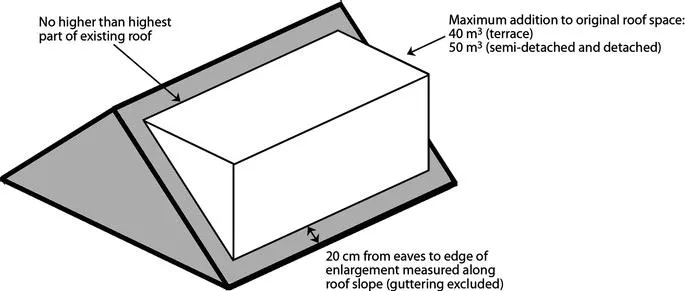
One of the notable features of the 2008 General Permitted Development Order (GPDO 2008) is that it is rather more generous in its scope than the earlier legislation. It dispenses with the principle of a whole-dwelling volume allowance (at least as far as loft conversions are concerned) and only the volume of the roof is now considered (Fig. 1.1). A ground floor extension to a dwellinghouse, whether proposed or existing, no longer counts against a loft conversion.
Fig. 1.1 Permitted development (England): primary constraints.
Reproduced below are three extracts from The Town and Country Planning (General Permitted Development) (Amendment) (No. 2) (England) Order 2008. All are relevant, or potentially relevant, to loft conversions. The meaning and implications of the GPDO 2008 are considered in the next section.
Class B
Permitted development
B. The enlargement of a dwellinghouse consisting of an addition or alteration to its roof.
Development not permitted
B.1 Development is not permitted by Class B if –
(a) any part of the dwellinghouse would, as a result of the works, exceed the height of the highest part of the existing roof;
(b) any part of the dwellinghouse would, as a result of the works, extend beyond the plane of any existing roof slope which forms the principal elevation of the dwellinghouse and fronts a highway;
(c) the cubic content of the resulting roof space would exceed the cubic content of the original roof space by more than –
(i) 40 cubic metres in the case of a terrace house, or
(ii) 50 cubic metres in any other case;
(d) it would consist of or include –
(i) the construction or provision of a veranda, balcony or raised platform, or
(ii) the installation, alteration or replacement of a chimney, flue or soil and vent pipe; or
(e) the dwellinghouse is on article 1(5) land.
Conditions
B.2 Development is permitted by Class B subject to the following conditions –
(a) the materials used in any exterior work shall be of a similar appearance to those used in the construction of the exterior of the existing dwellinghouse;
(b) other than in the case of a hip-to-gable enlargement, the edge of the enlargement closest to the eaves of the original roof shall, so far as practicable, be not less than 20 centimetres from the eaves of the original roof; and
(c) any window inserted on a wall or roof slope forming a side elevation of the dwellinghouse shall be –
(i) obscure-glazed, and
(ii) non-opening unless the parts of the window which can be opened are more than 1.7 metres above the floor of the room in which the window is installed.
Interpretation of Class B
B.3 For the purposes of Class B ‘resulting roof space’ means the roof space as enlarged, taking into account any enlargement to the original roof space, whether permitted by this Class or not.
Class C
Permitted development
C. Any other alteration to the roof of a dwellinghouse.
Development not permitted
C.1 Development is not permitted by Class C if –
(a) the alteration would protrude more than 150 millimetres beyond the plane of the slope of the original roof when measured from the perpendicular with the external surface of the original roof;
(b) it would result in the highest part of the alteration being higher than the highest part of the original roof; or
(c) it would consist of or include –
(i) the installation, alteration or replacement of a chimney, flue or soil and vent pipe, or
(ii) the installation, alteration or replacement of solar photovoltaics or solar thermal equipment.
Conditions
C.2 Development is permitted by Class C subject to the condition that any window located on a roof slope forming a side elevation of the dwellinghouse shall be –
(a) obscure-glazed; and
(b) non-opening unless the parts of the window which can be opened are more than 1.7 metres above the floor of the room in which the window is installed.
Class G
Permitted development
G. The installation, alteration or replacement of a chimney, flue or soil and vent pipe on a dwellinghouse.
Development not permitted
G.1 Development is not permitted by Class G if –
(a) the height of the chimney, flue or soil and vent pipe would exceed the highest part of the roof by 1 metre or more; or
(b) in the case of a dwellinghouse on article 1(5) land, the chimney, flue or soil and vent pipe would be installed on a wall or roof slope which –
(i) fronts a highway, and
(ii) forms either the principal elevation or a side elevation of the dwellinghouse.
Commentary on permitted development provisions – England
A degree of caution should be exercised when exercising rights associated with permitted development. Where any doubt exists, clarification should be sought from the local planning authority and a Lawful Development Certificate obtained (see p. 13) before undertaking any work.
Permitted development rights are not universal: they do not apply to flats, for example, nor do they apply to dwellinghouses on designated land (see section on Article 1(5) land, below). It is also emphasised that development that is not permitted under one class may be permitted development under another: chimneys, soil pipes and solar panels all fall into this category.
It should also be noted that interpretation of the GPDO varies considerably between local planning authorities. Areas of inconsistency include:
- Raising a party wall (see also appeal decision letter in Appendix C)
- Providing a highway-facing roof window in a dwelling in a conservation area
There are also risks when working at the volume limits of permitted development. A local planning authority has discretionary powers to take enforcement action if, in its view, there is an unacceptable breach of planning control. In cases where any degree of doubt exists, therefore, it is prudent to consult the local planning authority before work commences.
The Department for Communities and Local Government has sought to clarify some of the 2008 provisions and has published two supporting documents. These are: Changes to Householder Permitted Development 1 October 2008 – Informal Views from Communities and Local Government (this document has now been superseded) and Permitted development for householders – Technical guidance (published August 2010). The latter document is described as ‘CLG guidance’ where it is referenced below.
The following section highlights areas that require consideration in the 2008 GPDO.
Development within the curtilage of a dwellinghouse
This is the title of Part 1 of the 2008 GPDO. The meaning of ‘curtilage’ is subject to a degree of interpretation. This has important implications for conversions that involve raising a party wall between dwellinghouses: some local authorities consider raising a party wall to be permitted development, others do not. See Curtilage: raising party walls, below, and Appendix C.
B. Dwellinghouse
The GPDO 1995 definition remains valid in this section for the purposes of Part 1:
‘dwellinghouse’ does not include a building containing one or more flats, or a flat contained within such a building.
B.1 (a) Defining the highest part of an existing roof
The ridge of a conventional pitched roof is generally its highest part. Where the roof is of slated or tiled construction, it is usually capped with ridge tiles. But the definition of precisely which part of the ridge is to provide the highest point datum remains open to a degree of interpretation, particularly where the original roof is capped with decorative ‘crested’ ridge tiles which may project more than 150 mm above the apex.
The position with walls and other masonry projections is less ambiguous. In the case of buildings with butterfly roofs and a front parapet wall, local planning authorities have tended historically to take the roof as the highest point, even though the highway-facing parapet is higher (Fig. 3.1c). This position is supported by CLG guidance, which suggests that:
Chimneys, firewalls, parapet walls and other protrusions above the main roof ridge line should not be taken into account when considering the height of the highest part of the roof of the existing house.
B.1 (b) Roof slopes: principal elevation fronting a highway
Alterations to a roof slope fronting a highway (other than the installation of roof windows in the same plane as the existing roof) are not permitted development. For example, a front dormer window (i.e. one occupying and projecting from the principal roof slope facing a highway) could not be considered permitted development. Planning permission would be needed.
Defining precisely what constitutes a ‘principal e...
Table of contents
- Cover
- Title page
- Copyright page
- Preface
- Acknowledgements
- 1 Planning and legal considerations
- 2 The Building Regulations and building control
- 3 External forms
- 4 Fire safety
- 5 Conversion survey
- 6 Beams and primary structure
- 7 Floor structure
- 8 Wall structure
- 9 Roof structure
- 10 Energy performance
- 11 Lofts in context
- Appendix A Specification
- Appendix B The Building Regulations: appeals and determinations
- Appendix C Planning and curtilage
- Glossary
- Bibliography and useful contacts
- Advertisements
- Index
Trusted by 375,005 students
Access to over 1.5 million titles for a fair monthly price.
Study more efficiently using our study tools.
Frequently asked questions
Yes, you can cancel anytime from the Subscription tab in your account settings on the Perlego website. Your subscription will stay active until the end of your current billing period. Learn how to cancel your subscription
No, books cannot be downloaded as external files, such as PDFs, for use outside of Perlego. However, you can download books within the Perlego app for offline reading on mobile or tablet. Learn how to download books offline
Perlego offers two plans: Essential and Complete
- Essential is ideal for learners and professionals who enjoy exploring a wide range of subjects. Access the Essential Library with 800,000+ trusted titles and best-sellers across business, personal growth, and the humanities. Includes unlimited reading time and Standard Read Aloud voice.
- Complete: Perfect for advanced learners and researchers needing full, unrestricted access. Unlock 1.5M+ books across hundreds of subjects, including academic and specialized titles. The Complete Plan also includes advanced features like Premium Read Aloud and Research Assistant.
We are an online textbook subscription service, where you can get access to an entire online library for less than the price of a single book per month. With over 1.5 million books across 990+ topics, we’ve got you covered! Learn about our mission
Look out for the read-aloud symbol on your next book to see if you can listen to it. The read-aloud tool reads text aloud for you, highlighting the text as it is being read. You can pause it, speed it up and slow it down. Learn more about Read Aloud
Yes! You can use the Perlego app on both iOS and Android devices to read anytime, anywhere — even offline. Perfect for commutes or when you’re on the go.
Please note we cannot support devices running on iOS 13 and Android 7 or earlier. Learn more about using the app
Please note we cannot support devices running on iOS 13 and Android 7 or earlier. Learn more about using the app
Yes, you can access Loft Conversions by John Coutts in PDF and/or ePUB format, as well as other popular books in Technology & Engineering & Construction & Architectural Engineering. We have over 1.5 million books available in our catalogue for you to explore.