- Global in focus, offering up-to-date topics from an interdisciplinary, international set of scholars addressing key issues concerning globalization, social movements, and citizenship
- The majority of chapters are new, including those on environmental politics, international terrorism, security, corruption, and human rights
- Revises and updates all previously published chapters to include new themes and topics in political sociology
- Provides an overview of scholarship in the field, with chapters working independently and collectively to examine the full range of contributions to political sociology
- Offers a challenging yet accessible and complete reference guide for students and scholars
- English
- ePUB (mobile friendly)
- Available on iOS & Android
eBook - ePub
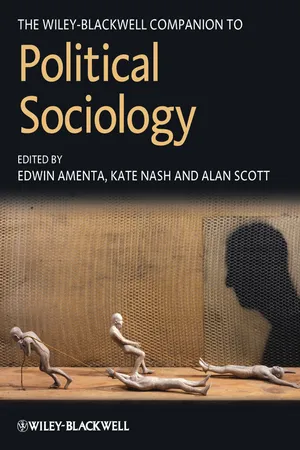
The Wiley-Blackwell Companion to Political Sociology
About this book
The Wiley-Blackwell Companion to Political Sociology is a complete reference guide, reflecting the scope and quality of the discipline, and highlighting emerging topics in the field.
Information
Part I
Approaches to Power and Politics
Chapter 1
Marxist Approaches to Power
Marxist approaches to power focus on its relation to class domination in capitalist societies. Power is linked to class relations in economics, politics and ideology. In capitalist social formations, the state is considered to be particularly important in securing the conditions for economic class domination. Marxists are also interested in why dominated classes seem to accept (or fail to recognize) their oppression; so they address issues of resistance and strategies to bring about radical change. Much recent Marxist analysis also aims to show how class power is dispersed throughout society, in order to avoid economic reductionism. This chapter summarizes the main trends in contemporary Marxism and identifies some significant spatio-temporal aspects of class domination. It also assesses briefly the disadvantages of Marxism as a sociological analysis of power. These include its neglect of forms of social domination that are not directly related to class; a tendency to overemphasize the coherence of class domination; the continuing problem of economic reductionism; and the opposite danger of a voluntaristic account of resistance to capitalism.
Marxists have analyzed power relations in many different ways. But four interrelated themes typify their overall approach. The first of these is a concern with power relations as manifestations of a specific mode or configuration of class domination rather than as a purely interpersonal phenomenon lacking deeper foundations in the social structure. This focus on class domination does not imply that power and resistance are the preserve of social actors with clear class identities and class interests. It means only that Marxists are mainly interested in the causal interconnections between the exercise of social power and the reproduction and/or transformation of class domination. Indeed, Marxists are usually well aware of other types of subject, identity, antagonism and domination. But they consider these phenomena largely in terms of their relevance for, and their overdetermination by, class domination. Second, Marxists are concerned with the links – including discontinuities as well as continuities – among economic, political and ideological class domination. Despite or, perhaps, because of the obvious centrality of this issue to Marxist analysis, it continues to prompt widespread theoretical and empirical disagreements. Different Marxist approaches locate the bases of class power primarily in the social relations of production, in control over the state, or in intellectual hegemony over hearts and minds. I will deal with these options below. Third, Marxists note the limitations inherent in any exercise of power that is rooted in one or another form of class domination and try to explain this in terms of structural contradictions and antagonisms inscribed therein. Thus Marxists tend to assume that all forms of social power linked to class domination are inherently fragile, unstable, provisional and temporary and that continuing struggles are needed to secure class domination, to overcome resistance and to naturalize or mystify class power. It follows, fourth, that Marxists also address questions of strategy and tactics. They provide empirical analyses of actual strategies intended to reproduce, resist or overthrow class domination in specific periods and conjunctures; and they often engage in political debates about the most appropriate identities, interests, strategies and tactics for dominated classes and other oppressed groups to adopt in particular periods and conjunctures to challenge their subordination. An important aspect of strategic analysis and calculation is sensitivity to the spatio-temporal dimensions of strategy and this is reflected in growing theoretical interest in questions of temporality and socio-spatiality.
Power as a Social Relation
Marxists are interested in the first instance in power as capacities rather than power as the actualization of such capacities. They see these capacities as socially structured rather than as socially amorphous (or random). Thus Marxists focus on capacities grounded in structured social relations rather than in the properties of individual agents considered in isolation. Moreover, as these structured social relations entail enduring relations, there are reciprocal, if often asymmetrical, capacities and vulnerabilities. A common paradigm here is Hegel's master–slave dialectic – in which the master depends on the slave and the slave on the master. Marx's equivalent paradigm case is the material interdependence of capital and labour. At stake in both cases are enduring relations of reproduced, reciprocal practices rather than one-off, unilateral impositions of will. This has the interesting implication that power is also involved in securing the continuity of social relations rather than producing radical change. Thus, as Isaac notes, ‘[r]ather than A getting B to do something B would not otherwise do, social relations of power typically involve both A and B doing what they ordinarily do’ (1987: 96). The capitalist wage relation illustrates this well. For, in voluntarily selling their labour-power for a wage, workers transfer its control to the capitalist along with the right to any surplus. A formally free exchange thereby becomes the basis of workplace despotism and economic exploitation. Conversely, working-class resistance in labour markets and the labour process indicate that the successful exercise of power is a conjunctural phenomenon rather than being guaranteed by unequal social relations of production. Thus Marxists regard the actualization of capacities to exercise power and its effects, if any, as always and everywhere contingent on specific actions by specific agents in specific circumstances. It follows that there can be no such thing as power in general or general power – only particular powers and the sum of particular exercises of power.
General Remarks on Class Domination
Marxism differs from other analyses of power because of its primary interest in class domination. In contrast, for example, Weberian analyses give equal analytical weight to other forms of domination (status, party); or, again, radical feminists prioritize patriarchy, its forms and effects. But its distinctive interest in class domination is not limited to economic class domination in the labour process (although this is important) nor even to the economic bases of class domination in the wider economy (such as control over the allocation of capital to alternative productive activities). For Marxists see class powers as dispersed throughout society and therefore also investigate political and ideological class domination. However, whereas some Marxists believe political and/or ideological domination derive more or less directly from economic domination, others emphasize the complexity of relations among these three sites or modes of class domination.
Even Marxists who stress the economic bases of class domination also acknowledge that politics is primary in practice. For it is only through political revolution that existing patterns of class domination will be overthrown. Other Marxists prioritize the political over the economic not just (if at all) in terms of revolutionary struggles but also in terms of its role in the routine reproduction of class domination. This makes the state central to Marxist analyses not only in regard to political power in narrow terms but also to class power more generally. For the state is seen as responsible for maintaining the overall structural integration and social cohesion of a ‘society divided into classes’ – a structural integration and social cohesion without which capitalism's contradictions and antagonisms might cause revolutionary crises or even, in the telling phrase of the 1848 Communist Manifesto, lead to ‘the mutual ruin of the contending classes’.
Economic Class Domination
Marxism is premised on the existence for much of human history of antagonistic modes of production. Production involves the material appropriation and transformation of nature. A mode of production comprises in turn a specific combination of the forces of production and social relations of production. The productive forces comprise raw materials, means of production, the technical division of labour corresponding to these raw materials and the given means of production, and the relations of interdependence and cooperation among the direct producers in setting the means of production to work. The social relations of production comprise social control over the allocation of resources to different productive activities and over the appropriation of any resulting surplus; the social division of labour (or the allocation of workers to different activities across different units of production); and class relations grounded in property relations, ownership of the means of production, and the form of economic exploitation. Some Marxists highlight the role of productive forces in producing social change but the majority view (and current wisdom) is that the social relations of production are primary. Indeed, it is these social relations that shape the choice among available productive forces and how they get deployed in production.
Given the primacy of the relations of production in economic class domination, some Marxists emphasize the power relations rooted in organization of the labour process. This is considered the primary site of the antagonism between capitalists and workers and is the crucial site for securing the valorization of capital through direct control over power-power. Various forms of control are identified (e.g., bureaucratic, technical, and despotic), each with its own implications for forms of class struggle and the distribution of power between capital and labour. Other Marxists study the overall organization of the production process and its articulation to other aspects of the circuit of capital. Thus emphasis is placed on the relative importance of industrial or financial capital, monopoly capital or small and medium enterprises, multinational or national firms, firms interested in domestic growth or exports. Different modes of economic growth are associated with different patterns of power. Atlantic Fordism, for example, based on a virtuous circle of mass production and mass consumption in relatively closed economies, was compatible for a time with an institutionalized compromise between industrial capital and organized labour. This supported the Keynesian welfare national state with its distinctive forms of economic, social and political redistribution. But increasing globalization (or world market integration) combined with capital's attempts to increase labour market flexibility have undermined these conditions and encouraged an assault on this compromise. This is clearest in those economies that underwent neoliberal regime shifts, such as the United States and United Kingdom, associated respectively with Reaganism (sustained under Clinton's Third Way and the George W. Bush administration) and Thatcherism (sustained by New Labour's ‘modernization’ project). This contributed to a decline in labour's share in income and wealth, to the growing divorce of financial from industrial capital, to the hyper-financialization of everyday life and, in 2007–2009, to the global financial crisis, which has had its own impact on patterns of class domination.
Political Class Domination
Marxist accounts of political class domination typically begin with the state and its direct and indirect roles in securing the conditions for economic class domination. The state is emphasized for various reasons: first, since market forces themselves cannot secure all the conditions needed for capital accumulation and are prone to market failure, there is a need for some mechanism standing outside and above the market to underwrite it and compensate for its failures; second, economic and political competition between capitals necessitates a force able to organize their collective interests and limit any damage that might occur from the one-sided pursuit of one set of capitalist interests; third, the state is needed to manage the many and varied repercussions of economic exploitation within the wider society. Marxists argue that only if the state can secure sufficient institutional integration and social cohesion will the extra-economic conditions for rational economic calculation and, a fortiori, capital accumulation be secured. This requires a sovereign state that is relatively autonomous from particular class interests and can articulate and promote a broader, national-popular interest. Where this project respects the decisive economic nucleus of the society and its capitalist character, then the state helps to secure economic as well as political class domination. This is often held to be more likely in bourgeois democratic political regimes than dictatorial regimes (see Moore 1957; Barrow 1993; Gramsci 1971; Offe 1984; Poulantzas 1978; and Jessop 1990).
There are three main Marxist approaches to the state: instrumentalist, structuralist and ‘strategic-relational’. Instrumentalists see the state mainly as a neutral tool for exercising political power: whichever class controls this tool can use it to advance its own interests. Structuralists argue that who controls the state is irrelevant because it embodies a prior bias towards capital and against the subaltern classes. And strategic-relational theorists argue that state power is a form-determined condensation of the balance of class forces in struggle. I now illustrate these three views for the capitalist state. Different examples would be required for states associated with other modes of production.
Instrumentalists regard the contemporary state as a state in capitalist society. Ralph Miliband expresses this view in writing that ‘the ‘ruling class' of capitalist society is that class which owns and controls the means of production and which is able, by virtue of the economic power thus conferred upon it, to use the state as an instrument for the domination of society' (1969: 22). More generally, theorists of the ‘state in capitalist society' stress the contingency of state–economy relations. For, despite the dominance of capitalist relations of production in such a society, the state itself has no inherently capitalist form and performs no necessarily capitalist functions. Any functions it does perform for capital occur because pro-capitalist forces happen to control the state and/or because securing social order also happens to secure key conditions for rational economic calculation. If the same state apparatus were found in another kind of system, however, it might well be controlled by other forces and perform different functions.
Structuralists regard the state as a capitalist state because it has an inherently capitalist form and therefore functions on behalf of capital. But what makes a state form capitalist and what guarantees its functionality for capital? Structuralists argue that the very structure of the modern state means that it organizes capital and disorganizes the working class. Claus Offe (1984) developed this view as follows. The state's exclusion from direct control over the means of production (which are held in private hands) makes its revenues depend on a healthy private sector; thus, to secure its own reproduction as a state apparatus, it must ensure the profitability of capital. Subordinate classes can secure material concessions only within this constraint – if profitability is threatened, such concessions must be rolled back. Yet capital cannot press its economic advantages too far without undermining the political legitimacy of the state. For, in contrast to earlier forms of political class domination, the economically dominant class enjoys no formal monopoly of political power. Instead the typical form of bourgeois state is a constitutional state and, later, a national-popular democratic state. This requires respect for the rule of law and the views of its citizens.
The strategic-relational approach was initially proposed by a Greek communist theorist, Nicos Poulantzas, and has subsequently been elaborated by the British state theorist, Bob Jessop. Building on Marx's insight that capital is not a thing but a social relation, Poulantzas argued in his later work that the state is also a social relation. Marx showed how continued reproduction of the material and institutional forms of the capital relation shaped the dynamic of capital accumulation and the economic class struggle – but the dominance of these forms could not in and of itself guarantee capital accumulation. This depended on capital's success in maintaining its domination over the working class in production, politics and the wider society. Likewise, Poulantzas saw the modern form of state as having certain inbuilt biases but argued that these were insufficient in themselves to ensure capitalist rule. Indeed they even served to reproduce class conflict and contradictions within the state itself so that the impact of state power depended heavily on the changing balance of forces and the strategies and tactics pursued by class and non-class forces alike (Poulantzas 1978).
The suggestion that the state is a social relation is important theoretically and politically. Seen as an institutional ensemble or repository of political capacities and resources, the state is by no means class-neutral. It is inevitably class-biased by virtue of the structural selectivity that makes state institutions, capacities and resources more accessible to some political forces and more tractabl...
Table of contents
- Cover
- Wiley-Blackwell Companions to Sociology
- Title Page
- Copyright
- Notes on Contributors
- Introduction
- PART I: APPROACHES TO POWER AND POLITICS
- PART II: STATES AND GOVERNANCE
- PART III: THE POLITICAL AND THE SOCIAL
- PART IV: DEMOCRACY AND DEMOCRATIZATION
- References
- Index
Trusted by 375,005 students
Access to over 1.5 million titles for a fair monthly price.
Study more efficiently using our study tools.
Frequently asked questions
Yes, you can cancel anytime from the Subscription tab in your account settings on the Perlego website. Your subscription will stay active until the end of your current billing period. Learn how to cancel your subscription
No, books cannot be downloaded as external files, such as PDFs, for use outside of Perlego. However, you can download books within the Perlego app for offline reading on mobile or tablet. Learn how to download books offline
We are an online textbook subscription service, where you can get access to an entire online library for less than the price of a single book per month. With over 1.5 million books across 990+ topics, we’ve got you covered! Learn about our mission
Look out for the read-aloud symbol on your next book to see if you can listen to it. The read-aloud tool reads text aloud for you, highlighting the text as it is being read. You can pause it, speed it up and slow it down. Learn more about Read Aloud
Yes! You can use the Perlego app on both iOS and Android devices to read anytime, anywhere — even offline. Perfect for commutes or when you’re on the go.
Please note we cannot support devices running on iOS 13 and Android 7 or earlier. Learn more about using the app
Please note we cannot support devices running on iOS 13 and Android 7 or earlier. Learn more about using the app
Yes, you can access The Wiley-Blackwell Companion to Political Sociology by Edwin Amenta,Kate Nash,Alan Scott in PDF and/or ePUB format, as well as other popular books in Social Sciences & Sociology. We have over 1.5 million books available in our catalogue for you to explore.