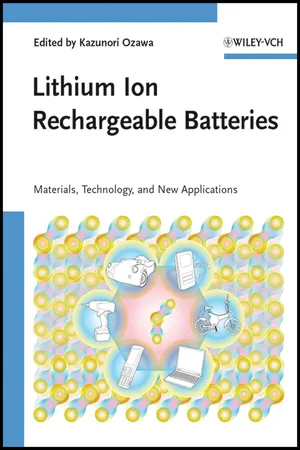
Starting out with an introduction to the fundamentals of lithium ion batteries, this book begins by describing in detail the new materials for all four major uses as cathodes, anodes, separators, and electrolytes. It then goes on to address such critical issues as self-discharge and passivation effects, highlighting lithium ion diffusion and its profound effect on a battery's power density, life cycle and safety issues. The monograph concludes with a detailed chapter on lithium ion battery use in hybrid electric vehicles.
Invaluable reading for materials scientists, electrochemists, physicists, and those working in the automobile and electrotechnical industries, as well as those working in computer hardware and the semiconductor industry.
eBook - ePub
Lithium Ion Rechargeable Batteries
Materials, Technology, and New Applications
- English
- ePUB (mobile friendly)
- Available on iOS & Android
eBook - ePub
About this book
Information
1
General Concepts
1.1 Brief Outline of Batteries
The first practical battery is the generally known Volta cell (also called the Galvanic cell). Its invention, over two centuries ago, spawned the invention of a variety of batteries based principally on the Volta cell. However, interestingly, during the last century, only three batteries, namely, the MnO2 primary battery and the secondary batteries of lead/acid or nickel have been in use. Knowing why such batteries continue to be used would give us some important pointers toward the development of new technology in this line. These old batteries are close to reaching their technical limit. Recently, however, new concepts have been used in the development of lithium-ion secondary batteries with higher ability.
A battery generally provides two functions – the ability to supply power over a duration of time and the ability to store power. These are defined by two operations, charge/discharge (progress of the reaction) and storage/stop (termination of the reaction), that is, a battery is a device that provides two functions, namely, energy storage and energy conversion (from chemical to electrical, and vice versa). As shown in Figure 1.1, the field of energy conversion is a multiphase system that is composed of positive/negative terminals and positive/negative active materials and electrolyte; the ions and electrons transfer through their interfaces. The interfaces reflect the nature of each phase. In addition, the state of these interfaces changes over time with the operation of the battery. The cell voltage is supported by an electric double layer with a remarkably high electric field between the electrodes and the electrolytic solution in which the electrode reactions take place. It should be emphasized that battery technology is essentially the same as the technology that controls these interfaces.
Fig. 1.1 Multilayer system composed of five phases and four interfaces.

1.1.1 Galvanic Cell System – Aqueous Electrolyte System
To understand the cell structure and its reaction, the well-known Daniel cell is schematically shown in Figure 1.2.
Fig. 1.2 Daniel cell.

The two half cells of Zn|Zn2+ and Cu|Cu2+ are combined and a separator is placed between them so that they are not miscible with each other. The formula that shows the principle and the structure of the Daniel cell is as follows:

where the symbols | and || show the interface of different phases and the liquid–liquid junction (separator), respectively.
The cathode (positive electrode) active material of the Daniel cell is the Cu2+ ion in the electrolyte, while the Zn anode (negative electrode) dissolves to form the Zn2+ ion. The drop in voltage of the cell occurs because of self-discharge of the active materials. Generally, a self-discharge tends to occur when the dissolved chemical species such as Cu2+ ion are used as the cathode-active material. This is one of the reasons that the Daniel cell was not used for practical purposes.
Cathodeand anode-active materials in the Leclanche cell are MnO2 (solid) and Zn metal, respectively. These electrode reactions are as follows:

When the discharge reaction takes place, the Zn anode dissolves to form a complex ion. Since MnO2 has a depolarizing ability that reduces the potential drop produced, the Leclanche type battery has been improved progressively to produce several kinds of batteries for commercial use, such as the manganese dry cell, the ZnCl2 cell, and the alkaline MnO2 cell.
In 1859, Plante invented the lead acid storage battery. This battery has been improved over the years and is now industrially mass-produced. The electrode reactions in the lead storage battery are described as follows:

During discharge, a secondary solid phase of PbSO4 is formed on both the anode and the cathode. Moreover, sulfuric acid in the aqueous solution – which is another active species – and water also participate in the charge/discharge reactions. These factors cause some polarizations that lower the cell performance.
Electrode reactions in Ni– Cd cell are as follows:

The cathode reaction involves the insertion of an H+ ion into the solid NiOOH, which is similar to the cathode reaction of MnO2 in the manganese battery, while the anode reaction is the formation of a secondary solid phase Cd(OH)2 on the Cd anode. This prevents a smooth reaction as the Cd anode is covered with Cd(OH)2.
The cathode-active material of nickel – metal hydride (Ni – MH) battery is the H species, which is adsorbed by the hydrogen-adsorbing alloy (MH) instead of the Cd anode of the Ni– Cd battery; the cell reaction is very simple because only hydrogen participates in the charge/discharge reaction. The Ni– MH battery has almost same voltage and larger electric capacity when compared with that of the Ni– Cd battery; moreover, it is free from environmental contamination. Therefore, the industrial production of Ni – MH battery has increased rapidly in recent years.
1.1.2 Lithium-Cell System – Nonaqueous Electrolyte System
To realize a battery with high potential of 3 V, batteries using lithium metal as the anode-active material and a powerful oxidizing agent as the cathode-active material were considered to be ideal. One such promising cathode-active material was MnO2 ; the development of lithium battery using this commenced in 1962. Fortunately, at that time, substantial amount of basic and application data with MnO2 was available. About 10 years later, an Li– MnO2 battery with a lithium metal anode was made available by SANYO Inc.; this became the first representative primary lithium battery.
Since then, considerable research and development has taken place in the design and manufacture of rechargeable lithium batteries. Many cathode-active materials such as TiSe, NbSe, MoS2, and MnO2 were studied. For example, rechargeable batteries based on a lithium metal anode and a molybdenum sulfide cathode (Li insertion electrode) were developed by MOLI Energy, Inc. in 1985. This battery system was abandoned owing to safety problems. Lithium batteries based on Li metal anodes and commonly used electrolyte systems revealed the thermal runaway of these systems, which can lead to their explosion; this was almost inevitable in abuse cases such as short circuit, overheating, and overcharging. Although the highest energy density available for Li batteries is achieved by a battery system that can use Li metal anode, a solution to safety issues needs to be found.
Active materials with good reversibility for the Li intercalation/deintercalation and low charge/discharge voltage were used as anode materials instead of Li metal. A carbon material was found to meet these requirements, and a rechargeable Li battery based on a carbon anode and LiCoO2 (layered lithium cobalt oxide) cathode was developed, mass-produced, and commercialized by Sony Inc. in 1991; this lithium-ion battery was capable of high performance as well as a high voltage of 4 V. As shown schematically in Figure 1.3, lithium-ion rechargeable batteries are charged and discharged through the transport of Li+ ions between anode and cathode, with electron exchange as a result of insertion (doping) and extraction (undoping). Both anode and cathode materials are layered compounds, and, as a result, the battery reaction is very simple because only Li+ ions participate in the charge/discharge reactions.
Fig. 1.3 Schematic illustration of the reaction in a lithium-ion battery.

The features of the Li-ion batteries, compared with the other rechargeable batteries, can be summarized as follows: (i) Charge and discharge reactions transfer Li+ ions between cathode and anode with minimal side reactions; (ii) The electrolytes work only as a path for the Li+ ions; and (iii) The volume of the electrolyte between cathode and anode will not be required.
1.2 Early Development of Lithium-Ion Batteries
The UK Atomic Energy Authority showed in their patent [1] that the intercalation and deintercalation of Ax-ion of the compound AxMyO2 reversibly occurs, where Ax is an alkaline metal and My is a transition metal. In 1990, Sony used this patent to first produce Li-ion batteries for a cellular phone HP-211. The cell sizes were 14500 and 20500, where 20 refers to the diameter and 50 the length in mm. The chemistry was LiCoO2/soft carbon system, and the capacities of the 14500 and 20500 models were only 350 and 900 mAh, respectively. The production was on a pilot scale. However, the naming of the lithium-ion rechargeable battery [2] was a marketing success. It was a controversial issue whether Li existed as ion or metal in the carbon anode. By the measurement using NMR, it was revealed that some part of the Li could exist as ion [3].
The actual mass production of the lithium-ion cell was carried out for a camcorder TR-1 in 1991. The cell size was 18650, which has the same volume as the 20500 cell. The chemistry was LiCoO2/hard-carbon system [4]. Figure 1.4 displays the inside structure of a 18650 cell.
Fig. 1.4 The inside structure of a 18650 lithium-ion cell.

The reasons for Sony’s success as the first producer of lithium-ion batteries is explained in the following section.
1.2.1 Ceramics Production Capability
Sony were already one of the biggest Mn – Zn ferrites producers in Japan. They also had considerable experience in the production of LiCoO2.
1.2.2 Coating Technology
Sony had been producing magnetic tapes for audioand videotape recorders. The coating technology for magnetic tapes was very useful and very important in making cathode and anode electrodes, especially in making good slurry and performing intermittent coating.
1.2.3 LiPF6 as a Salt for Electrolytes
LiPF6 is unstable and easily decomposes with heat and moisture. Since the acid HF is produced in the presence of water, numerous arguments opposing the use of LiPF6 were put forth in conferences and seminars. However, it was revealed that a small amount of HF increased the life cycle, because of the formation of a very strong passive layer such as AlF3 on...
Table of contents
- Cover
- Related title
- Title
- Copyright page
- Preface
- List of Contributors
- 1: General Concepts
- 2: Lithium Insertion Materials Having Spinel-Framework Structure for Advanced Batteries
- 3: Overlithiated Li1+x (Niz Co1−2z Mnz)1−x O2 as Positive Electrode Materials for Lithium-Ion Batteries
- 4: Iron-Based Rare-Metal-Free Cathodes
- 5: Thermodynamics of Electrode Materials for Lithium-Ion Batteries
- 6: Raman Investigation of Cathode Materials for Lithium Batteries
- 7: Development of Lithium-Ion Batteries: From the Viewpoint of Importance of the Electrolytes
- 8: Inorganic Additives and Electrode Interface
- 9: Characterization of Solid Polymer Electrolytes and Fabrication of all Solid-State Lithium Polymer Secondary Batteries
- 10: Thin-Film Metal-Oxide Electrodes for Lithium Microbatteries
- 11: Research and Development Work on Advanced Lithium-Ion Batteries for High-Performance Environmental Vehicles
- Index
Trusted by 375,005 students
Access to over 1.5 million titles for a fair monthly price.
Study more efficiently using our study tools.
Frequently asked questions
Yes, you can cancel anytime from the Subscription tab in your account settings on the Perlego website. Your subscription will stay active until the end of your current billing period. Learn how to cancel your subscription
No, books cannot be downloaded as external files, such as PDFs, for use outside of Perlego. However, you can download books within the Perlego app for offline reading on mobile or tablet. Learn how to download books offline
Perlego offers two plans: Essential and Complete
- Essential is ideal for learners and professionals who enjoy exploring a wide range of subjects. Access the Essential Library with 800,000+ trusted titles and best-sellers across business, personal growth, and the humanities. Includes unlimited reading time and Standard Read Aloud voice.
- Complete: Perfect for advanced learners and researchers needing full, unrestricted access. Unlock 1.5M+ books across hundreds of subjects, including academic and specialized titles. The Complete Plan also includes advanced features like Premium Read Aloud and Research Assistant.
We are an online textbook subscription service, where you can get access to an entire online library for less than the price of a single book per month. With over 1.5 million books across 990+ topics, we’ve got you covered! Learn about our mission
Look out for the read-aloud symbol on your next book to see if you can listen to it. The read-aloud tool reads text aloud for you, highlighting the text as it is being read. You can pause it, speed it up and slow it down. Learn more about Read Aloud
Yes! You can use the Perlego app on both iOS and Android devices to read anytime, anywhere — even offline. Perfect for commutes or when you’re on the go.
Please note we cannot support devices running on iOS 13 and Android 7 or earlier. Learn more about using the app
Please note we cannot support devices running on iOS 13 and Android 7 or earlier. Learn more about using the app
Yes, you can access Lithium Ion Rechargeable Batteries by Kazunori Ozawa in PDF and/or ePUB format, as well as other popular books in Technology & Engineering & Electrical Engineering & Telecommunications. We have over 1.5 million books available in our catalogue for you to explore.