eBook - ePub
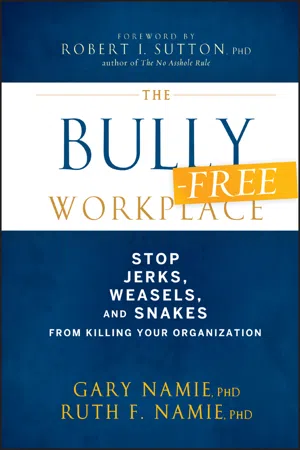
The Bully-Free Workplace
Stop Jerks, Weasels, and Snakes From Killing Your Organization
- English
- ePUB (mobile friendly)
- Available on iOS & Android
eBook - ePub
The Bully-Free Workplace
Stop Jerks, Weasels, and Snakes From Killing Your Organization
About this book
At long last a guidebook for employers that discusses workplace bullying from America's unrivaled leaders and creators of the workplace bullying consulting institute. Managers will learn how and why to stop bullying; prepare executives to lead the campaign and to resist undermining efforts of subordinates; and create a new, positive role for human resources. Outlining the required steps, The Bullying-Free Workplace includes information on how to create a preventive policy that brings consequences, like never before, when violated. The authors discourage half-hearted, short-term fixes that are prevalent today, and present their signature Blueprint methodology to successfully protect employee health and eradicate the psychological violence from organizations.
Chapter 1
Bullies and Bullying
Work is, by its very nature, about violence to the spirit as well as the body. It is, above all (or beneath all), about daily humiliations. To survive the day is triumph enough for the walking wounded among the great many of us.
—Studs Terkel
What's in a Label?
You obviously picked up this book for a reason, and it's likely that one or more jerks, weasels, or snakes works for or with you. It would almost be laughable—that is, if the consequences of their negativity were not so destructive to those they hurt.
What shall we call these perpetrators of organizational chaos? Here are some synonyms for bullies: aggressors, mobbers, offenders, backstabbers, saboteurs, harassers, nitpickers, control freaks, obsessive critics, terrorists, tyrants, perpetrators, and abusers.
Regardless of the names by which we refer to them, these individuals exhibit conduct far beyond acceptable workplace behavior. They act in non-normative, readily identifiable manners that stand out in extremely negative ways.
The reason you've identified a problem is because you've been able to put a label on the jerk where you work. When you say weasel, there is consensus about who fits the description. To call someone a snake speaks to the person's deviousness and backstabbing maneuvers.
Throughout this book, we will rely on the simplest of all labels—the bully. It is one we have all lived with since childhood. We shall call all perpetrators, across a wide spectrum of potential negative deeds, bullies. To us, it is no more negative to call someone a bully than it is to brand them using any of the synonyms already suggested. We use the term bully as shorthand, not to demonize. To nearly everyone, bullying means that something wrong or unacceptable was done—and that we can identify the one who did it.
Nearly all nations recognize the term bully or have some cultural variation of it. And believe it or not, the United States is the last among all Western industrialized nations to acknowledge workplace bullying. We're finally joining the rest of the world when we identify the acts of perpetrators of anticorporate, antiorganizational, and antiworker aggressive actions as bullying.
The power of the term bully in the workplace is illustrated by people's reaction when it is used to label them. They usually respond strongly, with instant outrage and denial. They take the label as an insult. Yet it is the bullies themselves—and their deliberate misconduct and nefarious undermining—who insult ethical coworkers who care more about work than workplace politics.
It's Not Just about Bullies
Let's state at the outset that your task is not to identify offenders within your workforce and immediately brand them as bullies. We're not interested in leading you on this kind of witch hunt. Instead, what you will do—if you follow our suggestions in the blueprint—is create a way to identify whoever dares to violate a new, clear set of standards. That person, once detected and confirmed as a wrongdoer, is referred to as a “policy violator.” This is much less pejorative than the label bully and a better fit in your (now) bullying-free organization.
There's quite a difference between focusing on bullies and focusing on bullying. Trying to change bullies is a fool's errand. However, if you concentrate on stopping the practice of bullying, your leadership quotient will skyrocket, thanks to the gratitude of so many (currently silent) employees. The first task—to change a bully—falls into the domain of spouses, life partners, and psychiatry. It's not your job to do this for an employee or colleague. Yet it is up to authentic leaders to engineer organizational solutions, and bullying presents ample opportunities to do so.
The Context for Workplace Bullying among other Negative Conduct
Figure 1.1 represents the range of negative behaviors that occur in the workplace—and what can happen as a result of these actions—and places bullying into that continuum. We start on the left, with the least offensive and injurious types of negative behavior, and end on the right, with homicide. Although people who act inappropriately may think they're funny, they frequently say and do stupid things, thus revealing their own lack of knowledge about how to act in public.
Figure 1.1 The Continuum of Negative Interpersonal Behavior

Uncivil people violate social norms. They are typically aware of what constitutes “proper” conduct but choose to ignore the limits of acceptability when in the presence of others. They act as though unspoken rules apply to others, but not to them, and they may not feel normative pressure from the group like others do. Working with an uncivil coworker brings rudeness and boorishness—not necessarily aimed at anyone in particular—into your workplace. It's difficult to be a target of incivility because it is not personalized. Research by Christine Pearson, the academic most closely identified with the study of incivility, found that only 12 percent of workers subjected to an uncivil workplace contemplated leaving. Incivility is only mildly bothersome, hence its location on the continuum.
Disrespect is more hostile and is pointedly aimed directly at another person. It can trigger distress as well as a host of anxiety-related health complications. The perpetrator—the person who's “dissing” another—acts in a manner that shows complete disregard for the target's humanity. It is as if the recipient has not earned the right to be treated well from the perpetrator.
Our experience has found that U.S. employers will tolerate the labels incivility or disrespect when referring to bullying, whereas Canadian employers are less likely to make euphemistic references to these situations. In other words, Canadian employers are not afraid to refer to bullying as bullying.
On the interpersonal behavior scale, mild bullying falls to the right, on the more harsh impact side of disrespect. Mild instances can be covert and infrequent. Bullying becomes moderate to severe when bouts of mistreatment increase in frequency and personalization. Bullies tend to “zone in” on the targeted few, causing their misery to grow exponentially. Compared with incivility, bullying is a laser-focused, systematic campaign of interpersonal destruction—one of warlike dimensions. Methods escalate in abusiveness, and escape routes for targets are blocked. Bullies even recruit coworkers to further spread the misery. And as hatred progresses, the targeted individual grows sicker from multiple stress-related health complications.
Workplace bullying is not merely hostile; it's abusive. And abuse is potentially traumatizing. The result is frequently destabilization—in the form of threats to one's self-identity—when abusers attempt to redefine the target's personality in ways to suit them. It is an extremely invasive tactic. If the target cannot find a way to alleviate the strain, he or she can quickly slide into despair. If hopelessness follows, the person might consider the option of violence.
The National Institutes for Occupational Safety and Health (NIOSH) deemed workplace bullying to be a form of workplace violence. Bullying stops short of physical violence; it is both sublethal and nonphysical. And once in a while, a target turns violent. Violence turned inward is suicide.
Bullying Can Kill Your Organization
Beware how you take away hope from any human being
—Oliver Wendell Holmes, Jr.
Consider the case of Kevin Morrissey.
In 2010, Morrissey, the managing editor for the Virginia Quarterly Review, a literary magazine housed on the campus of the University of Virginia, committed suicide. He left behind the tale of three years of torment at the hands of senior editor Ted Genoways. The university president's office and human resources had known of Morrissey's multiple complaints but had failed to either investigate or suppress Genoways. After his suicide, it was Morrissey's sister who affixed the label of bullying to the case, which caused quite a stir within the academic community across the country.
The provocative nature of the story of Mr. Morrissey's suicide prompted academic writers to recognize bullying in their host institutions.1 According to the employer's own internal investigation report, the complaints about Genoways were merely “conflicts between a creative, innovative manager and persons who did not share” his views. The employer's report exonerated Genoways. But the campus faced a public relations nightmare for months. The incident undermined the integrity of the VQR as well as the university.
When violence is directed outward, it can lead to a workplace homicide, as it did in the following scenario:
On April 16, 2007, Virginia Polytechnic Institute and State University (Virginia Tech) student Seung-Hui Cho, age 23, murdered 32 professors and students and wounded an additional 25. The rational search for an underlying explanation was overshadowed by the round-the-clock media coverage that characterized Cho as a psychopath and walking time bomb. The media revisited the story four months later when the Report of the Virginia Tech Review Panel2 was delivered to then-governor Kaine. It told of how, during the fall 2005 semester, the introverted Cho was humiliated in front of classmates by distinguished English professor Nikki Giovanni. She had made repeated demands that his sunglasses be removed and that he participate as the other students did. When Cho didn't respond, Giovanni demanded that Cho leave the class. He didn't do anything, just sat mute; he was terrified to speak, and thus, he was perceived as lazy or rebellious. He was a good writer but feared speaking.
Giovanni, in turn, hysterically threatened to resign unless Cho was removed. Other professors (Robert Hicok and Carl Bean) then had subsequent conflicts with Cho for “being quiet” and graded him accordingly in their classes, giving him a D+. Cho had similar experiences at his housing complex. His scribbling of Romeo's words to Juliet on a door whiteboard to a girl he liked led to misunderstandings, an angry father, and police questioning. The texts of suicidal thoughts that he sent to a suite-mate led him to be involuntarily committed to a psychiatric hospital. After discharge, Cho never received promised psychiatric help. The massive bureaucracy that is Virginia Tech simply lost track of him despite a “Care Team” having the responsibility not to let him disappear.
All of these events preceded the murderous attacks by 15 months. Through official officers—a department chair and several faculty, police, and campus mental health professionals—the university demonized the shy Cho. He remained isolated and untreated up to the time he violently exacted revenge and then killed himself. Ironically, Nikki Giovanni—his original predatory professor—writes fiction that Cho surely must have read as a class assignment. Her poetry contains an excessive amount of violence (Can you kill; Can you piss on a blond head; Can you cut it off; Can you kill; A ni**er can die; We ain't got to prove we can die. We got to prove we can kill.) In a 2006 course for another professor, Cho wrote a story about a character who decides to “kill every god damn person in this damn school” in response to feeling angry and estranged from other students. Was this tragedy preventable?
In the Morrissey and Cho cases, both organizations had ample opportunities to correct the injustice perceived by a person making a complaint and asking for relief from bullying. Both institutions failed to act appropriately and adequately. Two high-publicity negative events rocked those organizations. Thirty-four people died who should not have.
Chapter 2
Workplace Bullying Defined
A Working Definition
Workplace bullying is the repeated, health-harming mistreatment of an employee by one or more employees through acts of commission or omission manifested as: verbal abuse; behaviors—physical or nonverbal—that are threatening, intimidating, or humiliating; work sabotage, interference with production; exploitation of a vulnerability—physical, social, or psychological; or some combination of one or more categories.
The Workplace Bullying Institute (WBI)
We refer to the recipient of the mistreatment as a targeted—not victimized—worker. To be a target implies temporary mistreatment and abuse with the good likelihood of triumph over the situation when no longer targeted. Conversely, victimhood implies a permanent disruption of normal functioning. Victimhood breeds hopelessness. Perpetrators can be an individual bully acting alone or several acting in collusion.
Bullying at work is easily distinguished from “tough management” by asking “what has this got to do with work?” Bullying will always be used to advance a manager's personal agenda—rendering the target subservient, humiliating a person in front of his team—rather than about getting work done. Bullying actually prevents work from getting done; it's interference. Bullying undermines the government agency's mission and erodes a corporation's profits.
Tough managers are consistently harsh during crunch times. Everyone feels the wrath and mistreatment. Tough, but consistent and fair given the fact that misery is equally distributed, is something workers will tolerate and even respect. The toughness, the abusiveness of bullying, is disproportionately dumped on the targeted few. And there is no end to crunch time. There is no team celebration of a difficult project finished to which the target will be invited.
Inte...
Table of contents
- Cover
- Title Page
- Copyright
- Dedication
- Foreword by Robert I. Sutton, PhD
- Acknowledgments
- Preface
- Chapter 1: Bullies and Bullying
- Chapter 2: Workplace Bullying Defined
- Chapter 3: Impact on Targeted Employees
- Chapter 4: How Bullying Kills Good Organizations Like Yours
- Chapter 5: An Illustrative Case
- Chapter 6: Why Bullies Bully
- Chapter 7: Social Influence: How Others Define Our World for Us
- Chapter 8: A Model of Preventable Causes of Bullying
- Chapter 9: Mobilize Your Organization: Leaders' Preparations
- Chapter 10: Mobilize Your Organization: Managers' and Supervisors' Preparation
- Chapter 11: Preliminary Steps to Address Workplace Bullying
- Chapter 12: A New Role for Human Resources
- Chapter 13: The Namie Blueprint to Prevent and Correct Workplace Bullying
- Chapter 14: Sustain the Bully-Free Culture
- Appendix A: Macro-Bullying Trends That Make Workers Dispensable
- Appendix B: The Namie & Namie Bibliography
- Appendix C: Bullying Is Domestic Violence when the Abuser Is on Payroll
- Notes
- About the Authors
- Index
- Services Provided by the Namies
Trusted by 375,005 students
Access to over 1.5 million titles for a fair monthly price.
Study more efficiently using our study tools.
Frequently asked questions
Yes, you can cancel anytime from the Subscription tab in your account settings on the Perlego website. Your subscription will stay active until the end of your current billing period. Learn how to cancel your subscription
No, books cannot be downloaded as external files, such as PDFs, for use outside of Perlego. However, you can download books within the Perlego app for offline reading on mobile or tablet. Learn how to download books offline
Perlego offers two plans: Essential and Complete
- Essential is ideal for learners and professionals who enjoy exploring a wide range of subjects. Access the Essential Library with 800,000+ trusted titles and best-sellers across business, personal growth, and the humanities. Includes unlimited reading time and Standard Read Aloud voice.
- Complete: Perfect for advanced learners and researchers needing full, unrestricted access. Unlock 1.5M+ books across hundreds of subjects, including academic and specialized titles. The Complete Plan also includes advanced features like Premium Read Aloud and Research Assistant.
We are an online textbook subscription service, where you can get access to an entire online library for less than the price of a single book per month. With over 1.5 million books across 990+ topics, we’ve got you covered! Learn about our mission
Look out for the read-aloud symbol on your next book to see if you can listen to it. The read-aloud tool reads text aloud for you, highlighting the text as it is being read. You can pause it, speed it up and slow it down. Learn more about Read Aloud
Yes! You can use the Perlego app on both iOS and Android devices to read anytime, anywhere — even offline. Perfect for commutes or when you’re on the go.
Please note we cannot support devices running on iOS 13 and Android 7 or earlier. Learn more about using the app
Please note we cannot support devices running on iOS 13 and Android 7 or earlier. Learn more about using the app
Yes, you can access The Bully-Free Workplace by Gary Namie,Ruth F. Namie in PDF and/or ePUB format, as well as other popular books in Business & Human Resource Management. We have over 1.5 million books available in our catalogue for you to explore.