![]()
SECTION 1
A Call for Conscious Change Leaders
![]()
CHAPTER 1
Achieving Breakthrough Results from Change
Good is the enemy of great.
—Jim Collins
Imagine your organization being wildly successful at change. We don’t mean marginally successful; we mean so successful that your achievements are truly extraordinary, and not just in your current change initiatives, but in the vast majority of them going forward.
We adamantly believe that you, your team, and your organization can become so masterful at change that breakthrough results become consistently achievable. It won’t be easy, and it won’t be immediate, but it will be worth every ounce of effort. To get to great, we have to get beyond good, beyond managing change to truly leading it to extraordinary outcomes.
Our purpose in writing this book, and its companion, The Change Leader’s Roadmap, is to highlight how to radically increase the outcomes you get from change. We are not interested in the “normal” way change goes, how to make it a bit more effective, or how to reduce employee resistance so things go a bit smoother. We are after breakthrough results from change—not the average but the extraordinary.
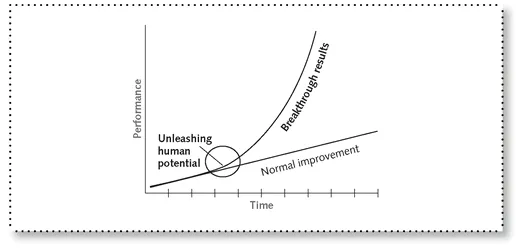
Breakthrough results (Figure 1.1) are outcomes that far exceed what would occur if your organization continued to do change in the same way it always has. Breakthrough results, by definition, are a level of achievement beyond what most people would even conceive as possible. They represent a radical, positive departure from your normal rate of improvement—a “break through” the usual or predictable to an unheralded potential that has not yet been tapped or actualized.
Figure 1.1. Breakthrough Results
Breakthrough results come in many forms. You can achieve far greater business results through change: greater profitability, increased market share, faster cycle times, improved customer satisfaction, and enhanced product innovation. You can also produce powerful, positive impacts on people through change: greater empowerment, increased collaboration across functional and hierarchical boundaries, improved morale, and increased engagement and commitment of stakeholders. Breakthroughs can occur in your culture and its ability to catalyze great performance in your people: enhanced commitment to service, more innovation and learning, more openness and authenticity, more alignment, and dedication to enterprise success.
Breakthrough results occur primarily from unleashing the human potential in your organization. You achieve this by designing better change processes that free up people to contribute more of their abilities and passion.
Generally, people do not think in terms of achieving breakthrough results, during change or any other time. They unconsciously accept middle-of-the-pack approaches and outcomes. Of course, if you ask, they will say that they are going for great, not average results. But their decisions, behaviors, and actions reveal something different.
High achievers are few and far between, in any activity. Few athletes become superstars, just as few organizations reach the pinnacle of their industries. The middle of the bell curve, the “territory of the average,” is the norm in just about everything. People expect average results during change, just as they unconsciously pursue average results in other areas of their work and life.
More is possible—far more, for you and your organization right now. But first you have to determine the level of results you are after. Certainly, what you learn in this book will help you reduce resistance and run your change efforts more smoothly. It will help you overcome common problems and assist you to deliver greater return on investment (ROI) on your change efforts. This is all good, but is good, good enough for you? We want you to think really, really big. Let’s go for breakthrough. Let’s go for great. Let’s go for the truly extraordinary. And let’s develop the change leadership skills to produce such results.
COMMON PERSPECTIVES AND MISTAKES IN LEADING CHANGE
I cannot say whether things will get better if we change; what I can say is they must change if they are to get better.
—Georg C. Lichtenberg
Change is the nature of life. Nothing ever remains the same. Growth and decay are as fundamental to our existence as our needs for water and air.
While change goes in one of two directions—either toward what we do want or toward what we do not want—most people think of change as bad, as a negative experience we endure as best we can. Leaders often talk of “getting change over with,” minimizing its disruption, and overcoming people’s resistance to it. Employees speak about how uncomfortable it is, how it is a disturbance, and if it would just go away, then they could get back to their work. Stress tests measure the amount of change in our lives because change produces extra stress for most of us.
But change is not always bad, nor does it always lead to negative outcomes. In fact, change is the vehicle to everything better, the essence of improvement, innovation, growth, expansion, and evolution. But if change is the path to breakthrough and greatness, why does it have such a bad rap? Why do people resist it?
Part of the issue is internal. Sometimes we simply unconsciously assume that the change we face will lead to bad outcomes, to some future we will not like. Many of us live in a myth that things will remain the same, that there is a normalcy that change disrupts and that we want to maintain. Some of us have a difficult time adapting. We do not like the extra effort required to figure out how to thrive in the changed circumstance. Other times we feel victimized by change, that it is happening to us and that we are powerless to influence it. The bottom line is that most of us are just not very change ready or change capable. We want and expect things to remain the same.
Another part of the issue is poor change leadership, which gives change a bad name in the minds of employees. Most leaders design and execute lousy change processes, and when the process of change is bad, the experience of change is bad, which exacerbates stakeholders’ negative reactions. They do not like it and resist the change process, even when they can accept, tolerate, or commit to the outcomes it could produce. And change fails when stakeholders resist.
A commonly quoted statistic over the past two decades is that 70 percent of all change efforts fail to deliver their intended outcomes. The most recent large study substantiating this finding is IBM’s study1 of 1500 change management executives across fifteen countries. They found that 60 percent of change efforts fail to deliver their objectives. These are alarming numbers. Is the failure rate because people inherently resist change, the intended outcomes and direction are wrong, or because of poor change leadership? Our research is very clear about this. While it is a bit of all three, the real culprit is poor change leadership.
With greater understanding of human dynamics, we can learn to lead change in ways that alter people’s negative perspectives. And achieving breakthroughs requires us to shift those perspectives. We—and those we lead—must see change as the harbinger of a more positive future. Change must become our friend, our ally, something in which we are both confident and competent. When seen this way, new possibilities occur, new heights become reachable, greater outcomes feasible. But if we cannot lead change well, it can beat us up rather severely. For this reason, change leadership is a most coveted skill and a strategic advantage.
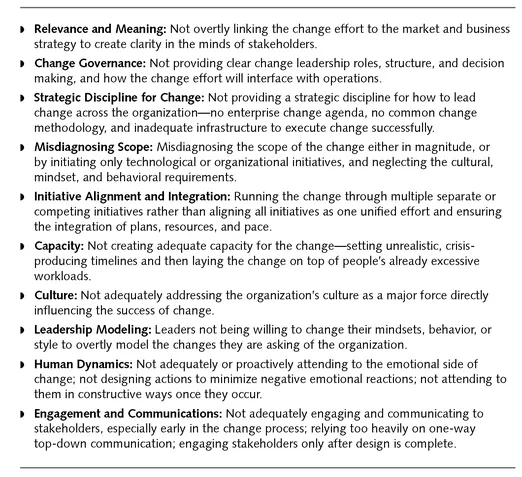
We have been researching what works and does not work in change for over thirty years. (See premium content: Ten Most Common Mistakes in Leading Transformation; www.pfeiffer.com/go/anderson.) We have been engaged in change projects in virtually every for profit industry; city, state and federal government agencies; the military; and large global nonprofits. Exhibit 1.1 highlights our findings of the common mistakes leaders are making in leading transformation that impair the change process, cause resistance and minimize ROI. One interesting note is that these same mistakes are being made regardless of the type of industry or sector. For profits, nonprofits, and governments all make the same mistakes. We are convinced this is because people are people, and how leaders approach change is similar across the board and is based on common worldviews, styles, and methods. How many of these mistakes do you recognize your organization making?
Exhibit 1.1. Common Mistakes in Leading Transformation
These mistakes are all products of how your organization is designed to handle its changes. Failed change is costly, and these mistakes cost organizations millions of dollars and vital employee commitment. For example, implementing Electronic Health Records (EHR) in a medium-sized hospital system can cost 20-50 million dollars just in hard capital costs. Customer Relationship Management (CRM) and Enterprise Resource Planning (ERP) implementations systems can be even pricier, some topping $100 million. Add in the costs of leaders’ and employees’ time and the cost of taking their attention away from running operations or serving customers, and the cost of failure grows significantly. Now add in the cost of morale and productivity dropping as people’s motivation, time, and attention are diverted to failed efforts. The true cost of failed change is beyond any sensible limit. Organizations simply cannot afford change that does not deliver its ROI, especially in difficult economic times.
What is the cost of failed change in your organization?
If leaders should put their attention on getting really good at anything, it should be leading change. No other leadership skill would bring a higher ROI. Stellar change capability can be applied to every improvement, growth opportunity, innovation, merger or acquisition, technology implementation, restructuring, process improvement, systems change, or cultural transformation the leader ever does—not just this year, but for the rest of their careers.
Imagine the financial and cultural benefit of superior change leadership skill in your organization: change efforts that consistently deliver their ROI on time and on budget; stakeholders who are committed to the outcomes and contribute fully to achieving them; projects that run efficiently with clear roles, decision making, and accountability; and capacity that is well managed to maintain operational success while change occurs. Imagine the value to your organization if you could avoid the cost of failed change and instead consistently deliver maximum ROI from change, year after year. Innovation, growth, and expansion become far greater possibilities, as does winning in the increasingly competitive battles in the marketplace.
Superior change leadership capability is an essential skill in our twenty-first century world. From our perspective, every organization should have building change capability as a key strategic objective, because when achieved, it is a real strategic advantage. Substantial increases in your personal success and your organization’s success at leading change are possible. Just how much improvement you can achieve is up to you.
Levels of Success
In our client engagements, we have an upfront conversation that informs the entire relationship and scope of work. In that conversation, we ask a simple question, “How do you define success in this effort?” Our client’s answer is important to us because we know that if the change leaders are collectively aware and aligned to a common definition of success, then every aspect of the intervention can be designed to support those outcomes. Plus, this is a key conversation where we can begin to introduce the idea of pursuing real breakthrough.
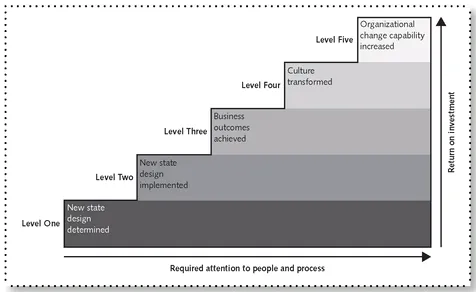
Figure 1.2 depicts five different criteria for defining successful transformation. We call them Levels of Success: (1) when you have designed your new state, (2) when you have implemented that new state solution, (3) when you have achieved your desired business outcomes from the implementation because engaged employees are using and refining the new state design, (4) when your culture has transformed as necessary to sustain and increase these results over time, or (5) when your organization (leaders and employees both) has increased its change capability so future changes go even more smoothly and produce even greater results.
These criteria depict five very different levels of success that transformation can produce. The five levels have a “nested” relationship. The higher levels include and require achievement of the lower levels.
The higher the level of success you pursue, the greater the ROI you will achieve from your change effort. But keep in mind, as the level of success you pursue increases, so will the required attention to people and process dynamics. Because of this, success at Levels Four and Five requires far more complex and well thought out change strategies and process plans than do Levels One, Two, and Three.
Figure 1.2. Levels of Success
When asked, most leaders say they want Level Four or Five Success. They want business results as well as culture change and increased change capability. But we find that few leaders truly understand what it takes to achieve those outcomes. When we arrive on the scene, their initial change strategies are built to deliver only Levels One and Two. They have the scope of work planned to design the future state and get it implemented, but they have insufficient attention to people and process dynamics to ensure that they will even get the business outcomes they are after, let alone culture change and increased change capability. Remember, 60-70 percent of all change efforts fail to produce their desired business outcomes.
Achieving business outcomes requires committed stakeholders, which usually requires a change process that has high stakeholder engagement from the start. Most leaders design their future state in isolation and then attempt to roll it out to already resistant stakeholders who feel victimized by the change because they were not represented adequately in its early phases. The leaders get the future state designed and implemented, but stakeholders do not completely buy into it. So the new state never gets fully embedded in operations and owned by end users. The results produced are mediocre and far from the breakthrough levels that were possible.
You must build your change strategy and process plan to match the level of success you pursue. A significant value we offer clients upfront is the “get real” conversation about what it really takes to achieve Levels Three, Four, and Five, especially at breakthrough ...