Filled with case studies from firms such as GT Automotive, GE Healthcare China, Vale, Dominos, Swiss Re Americas Division, and Polar Bank, among others, this book (written by Dan Denison and his co-authors) combines twenty years of research and survey results to illustrate a critical set of cultural dynamics that firms need to manage in order to remain competitive. Each chapter uses a case as a means to illustrate an important aspect of culture change focusing on seven common culture-change dilemmas including creating a strategic alignment, keeping strategy simple, and more.
eBook - ePub
Leading Culture Change in Global Organizations
Aligning Culture and Strategy
- English
- ePUB (mobile friendly)
- Available on iOS & Android
eBook - ePub
Leading Culture Change in Global Organizations
Aligning Culture and Strategy
About this book
Information
Chapter 1
Building a High-Performance Business Culture
Every human organization creates a unique culture all its own. From a small family business operating in its hometown, to a large global corporation spanning national cultures and time zones, each organization has a distinct identity. Tribes, families, cults, teams, and corporations all develop a complex and unique identity that evolves as they grow through the years.
Their culture always reflects the collective wisdom that comes from the lessons people learn as they adapt and survive together over time. Thousands of interlocking routines knit together the fabric of the firm and translate timeless knowledge into timely action on a daily basis. The traditional habits and customs that have kept the firm alive and well over time speak loud and clear. And when uncertainty rears its ugly head, the culture rules! All members of the corporate tribe tend to fall back on their tried-and-true methods in order to weather the storm.
Yet try as we might to look to the future, the knowledge embedded in our corporate cultures is always yesterday's knowledge, developed to meet the challenges of the past. What part of the past should we preserve for the future? How should we adapt the principles of the past to address the problems of the future? How should we go about the delicate task of relegating the obsolete practices of the past to the “corporate museum” so that they don't grow into obstacles that hold back our best practices and frustrate our best customers?
Some leaders try to ignore these challenges and concentrate on their expense ratios, analyst reports, discounted cash flows, and their next acquisition. Bad idea. Other top executives see shaping and managing the corporate culture as one of their most important challenges. As Wells Fargo Bank CEO John Stumpf said, “It's about the culture. I could leave our strategy on an airplane seat and have a competitor read it and it would not make any difference.”1 Former IBM Chairman Lou Gerstner made the same point: “Culture isn't just one aspect of the game—it is the game. In the end, an organization is no more than the collective capacity of its people to create value.”2 The people make the place.3 The people create the organization. The people create the technology. The people organize the funding. The people develop the markets. Without implementation and alignment, there is no strategy, only a plan.
It can be easy to forget that the people make the place, because the structures that we create often outlive our memory of how and why we created them to begin with, leaving us feeling like we are the victims rather than the visionaries of the systems that we create. But over the long haul, one of the most powerful things that a company's leaders can do is to create a unique character and personality for their organization that fits their business environment and distinguishes them from the competition.
But where do you start? Research over the past two or three decades has shown that an organization's culture has an impact on business performance in four main ways:
- Creating an organization's sense of mission and direction
- Building a high level of adaptability and flexibility
- Nurturing the involvement and engagement of their people
- Providing a consistency that is strongly rooted in a set of core values
These are the cultural traits that most clearly affect business performance, so this is where the journey must begin.
But can something as complex as corporate culture actually be managed? The task is daunting—but doing nothing is not an attractive option! Organizational culture guru Edgar Schein said it best: “Either you manage the culture, or it manages you.”4 Managing culture change is certainly not easy, but there are plenty of real-life examples of global companies who have succeeded. This book is built around seven of those examples.
What Is Corporate Culture? Why Is It Important?
At the climax of the annual holiday party of one rapidly growing American company, hundreds of balloons are released from the ceiling. Inside each balloon is a crisp new US$100 bill. Whoever scrambles the hardest gets the most money! The lesson is simple, fun, and more powerful than all the personnel policy handbooks in the world. It helps capture the essence of some of the key definitions of corporate culture: Culture is both “the way we do things around here” and “what we do when we think no one is looking.” Culture is “the code, the core logic, the software of the mind that organizes the behavior of the people,” and “the lessons that we have learned that are important enough to pass on to the next generation.”5
Schein's classic approach divides culture into three levels.6 He argues that basic underlying assumptions lie at the root of culture and are “unconscious, taken-for-granted beliefs, perceptions, thoughts, and feelings.” Espoused values are derived from the basic underlying assumptions and are the “espoused justifications of strategies, goals and philosophies.” Finally, at the top level are “artifacts,” defined as the “visible, yet hard to decipher organizational structures and processes.”
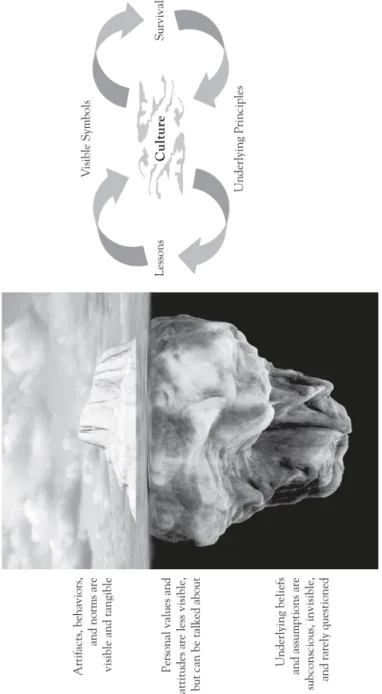
Consider the iceberg image presented in Figure 1.1. Only about 10 percent of an iceberg is visible above the water; 90 percent is below the surface. But the inertia of the part that is beneath the surface is what will sink your ship. Similarly, it is often the parts of the culture that we can't see that will get us into trouble. This figure also reminds us that the culture is learned—it is built up from the accumulated principles that we learn as we survive together over time. The lessons from the past shape our survival strategies for the future. Winston Churchill said something similar about architecture: “We shape our buildings; thereafter they shape us.”7
Figure 1.1 Culture Reflects the Lessons Learned Over Time
So our mindset and worldview shape the way that we use the lessons of the past to forge the strategies of the future. How well are business leaders doing? Well, the record is not all that encouraging. Phil Rosenzweig's best seller The Halo Effect8 explains that when successful corporations become legends, their business practices are imitated for both good reasons and bad. Neither researchers nor executives have done particularly well at separating the principles and practices that truly impact business performance from those that are simply imitated because a corporation enjoyed great success and everyone now wants to be like them. Telling fashion from function is often harder than it looks.
There's a long tradition of studying “superstitious learning,” which probably has its roots in Malinowski's study of the “cargo cult” of the Trobriand Islanders in Papua New Guinea nearly one hundred years ago.9 Richard Feynman tells the story with an example from the end of World War II:
During the war they saw airplanes land with lots of good materials, and they want the same thing to happen now. So they've arranged to imitate things like runways, to put fires along the sides of the runways, to make a wooden hut for a man to sit in, with two wooden pieces on his head like headphones and bars of bamboo sticking out like antennas—he's the controller—and they wait for the airplanes to land. They're doing everything right. The form is perfect. It looks exactly the way it looked before. But it doesn't work. No airplanes land.10
You may be thinking “Surely modern corporate ‘tribes’ must do far better at separating fact from fiction and deciding what really works than the ancient tribes of Papua New Guinea!” Well, let's not jump to conclusions. Many of the recent accounts of the subprime mortgage crisis emphasize the growing power of the system that was created.11 Mortgage loan officers made a bigger bonus if they booked more subprime loans. Fee income from new loans was high enough that even bad loans were good business for the banks. These government-guaranteed loans were sold to other banks, who created securities that were certified AAA grade. Investors around the world grabbed these up because they paid a higher rate of return. This system created an insatiable demand for banks to find even more prospective buyers who would borrow beyond their means in hopes of “flipping” their new home to take advantage of rising real estate prices before their balloon payment came due. This system paid off so well that in the short term everyone kept looking for the next deal long after the system had stopped paying off. Thus we see how ritual can become separated from reality even in the most sophisticated organizations.12
How Corporate Culture Impacts Business Performance
Over the past twenty years, we've studied the link between organizational culture and business performance. We've been trying to understand the cultural traits that explain the difference between high- and low-performing organizations.13 These studies have examined the link between the four basic traits in our model—mission, adaptability, involvement, and consistency—and performance measures such as profitability, sales growth, quality, innovation, and market value. Out of this research, we've developed a way to measure culture, and we've created a widely used Culture Survey designed to help organizations focus on the issues that need attention and move beyond a discussion of employee satisfaction, engagement, and morale, to better understand the actions they can take to build their organizations for the future. Figure 1.2 shows what we've found out about “What Counts.”
Figure 1.2 What Counts
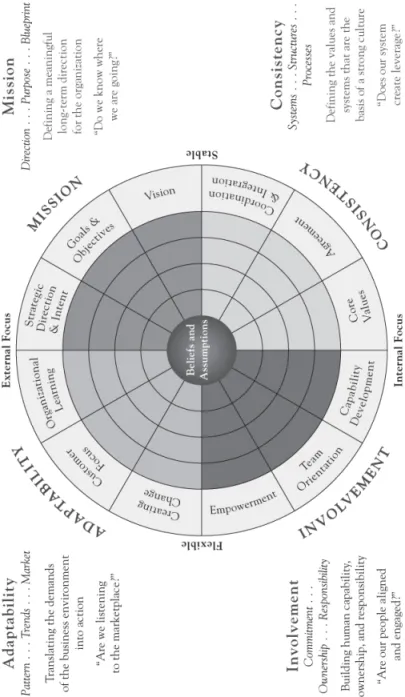
•Mission. Successful organizations have a clear sense of purpose and direction that allows them to define organizational goals and strategies and to create a compelling vision of the organization's future. Leaders play a critical role in defining mission, but a mission can only be reached if it is well understood, top to bottom. A clear mission provides purpose and meaning by defining a compelling social role and a set of goals for the organization. We focus on three aspects of mission: strategic direction and intent, goals and objectives, and vision.
•Adaptability. A strong sense of purpose and direction must be complemented by a high degree of flexibility and responsiveness to the business environment. Organizations with a strong sense of purpose and direction often are the least adaptive and the most difficult to change. Adaptable organizations, in contrast, quickly translate the demands of the organizational environment into action. We focus on three dimensions of adaptability: creating change, customer focus, and organizational learning.
•Involvement. Effective organizations empower and engage their people, build their organization around teams, and develop human capability at all levels. Organizational members are highly committed to their work and feel a strong sense of engagement and ownership. People at all levels feel that they have input into the decisions that affect th...
Table of contents
- Cover
- Praise Page
- Series Page
- Title Page
- Copyright
- Foreword
- Dedication
- Preface
- Chapter 1: Building a High-Performance Business Culture
- Chapter 2: Supporting the Front Line
- Chapter 3: Creating Strategic Alignment
- Chapter 4: Creating One Culture Out of Many
- Chapter 5: Exporting Culture Change
- Chapter 6: Building a Global Business in an Emerging Market
- Chapter 7: Building a Global Business from an Emerging Market
- Chapter 8: Building for the Future: Trading Old Habits for New
- Appendix : Denison Organizational Culture Survey: Overview and Resource Guide
- Acknowledgments
- The Authors
- Index
Trusted by 375,005 students
Access to over 1.5 million titles for a fair monthly price.
Study more efficiently using our study tools.
Frequently asked questions
Yes, you can cancel anytime from the Subscription tab in your account settings on the Perlego website. Your subscription will stay active until the end of your current billing period. Learn how to cancel your subscription
No, books cannot be downloaded as external files, such as PDFs, for use outside of Perlego. However, you can download books within the Perlego app for offline reading on mobile or tablet. Learn how to download books offline
Perlego offers two plans: Essential and Complete
- Essential is ideal for learners and professionals who enjoy exploring a wide range of subjects. Access the Essential Library with 800,000+ trusted titles and best-sellers across business, personal growth, and the humanities. Includes unlimited reading time and Standard Read Aloud voice.
- Complete: Perfect for advanced learners and researchers needing full, unrestricted access. Unlock 1.5M+ books across hundreds of subjects, including academic and specialized titles. The Complete Plan also includes advanced features like Premium Read Aloud and Research Assistant.
We are an online textbook subscription service, where you can get access to an entire online library for less than the price of a single book per month. With over 1.5 million books across 990+ topics, we’ve got you covered! Learn about our mission
Look out for the read-aloud symbol on your next book to see if you can listen to it. The read-aloud tool reads text aloud for you, highlighting the text as it is being read. You can pause it, speed it up and slow it down. Learn more about Read Aloud
Yes! You can use the Perlego app on both iOS and Android devices to read anytime, anywhere — even offline. Perfect for commutes or when you’re on the go.
Please note we cannot support devices running on iOS 13 and Android 7 or earlier. Learn more about using the app
Please note we cannot support devices running on iOS 13 and Android 7 or earlier. Learn more about using the app
Yes, you can access Leading Culture Change in Global Organizations by Daniel Denison,Robert Hooijberg,Colleen Lief,Nancy Lane in PDF and/or ePUB format, as well as other popular books in Business & Organisational Behaviour. We have over 1.5 million books available in our catalogue for you to explore.