eBook - ePub
Broadband Optical Access Networks
- English
- ePUB (mobile friendly)
- Available on iOS & Android
eBook - ePub
Broadband Optical Access Networks
About this book
Broadband optical access network is an ideal solution to alleviate the first/last mile bottleneck of current Internet infrastructures. Richly illustrated throughout to help clarify important topics, Broadband Optical Access Networks covers the architectures, protocols enabling technologies of broadband optical access networks, and all current and future competing technologies for access networks. This comprehensive work presents the evolution of optical access networks, including reach extension, bandwidth enhancement, and discusses the convergence of optical and wireless technologies for broadband access, making it an invaluable reference for researchers, electrical engineers, and graduate students.
Information
CHAPTER 1
BROADBAND ACCESS TECHNOLOGIES: AN OVERVIEW
In past decades we witnessed the rapid development of global communication infrastructure and the explosive growth of the Internet, accompanied by ever-increasing user bandwidth demands and emerging multimedia applications. These dramatic changes in technologies and market demands, combined with government deregulation and fierce competition among data, telcom, and CATV operators, have scrambled the conventional communication services and created new social and economic challenges and opportunities in the new millennium. To meet those challenges and competitions, current service providers are striving to build new multimedia networks. The most challenging part of current Internet development is the access network. As an integrated part of global communication infrastructure, broadband access networks connect millions of users to the Internet, providing various services, including integrated voice, data, and video. As bandwidth demands for multimedia applications increase continuously, users require broadband and flexible access with higher bandwidth and lower cost. A variety of broadband access technologies are emerging to meet those challenging demands. While broadband communication over power lines and satellites is being developed to catch the market share, DSL (digital subscriber line) and cable modem continue to evolve, allowing telecom and CATV companies to provide high-speed access over copper wires. In the meantime, FTTx and wireless networks have become a very promising access technologies. The convergence of optical and wireless technologies could be the best solution for broadband and mobile access service in the future. As new technology continues to be developed, the future access technology will be more flexible, faster, and cheaper. In this chapter we discuss current access network scenarios and review current and emerging broad access technologies, including DSL, cable modem, optical, and wireless solutions.
1.1 COMMUNICATION NETWORKS
Since the development of telegraph and telephone networks in the nineteenth century, communication networks have come a long way and evolved into a global infrastructure. More than ever before, communications and information technologies pervade every aspect of our lives: our homes, our workplaces, our schools, and even our bodies. As part of the fundamental infrastructure of our global village, communication networks has enabled many other developments—social, economic, cultural, and political—and has changed significantly how people live, work, and interact.
Today’s global communication network is an extremely complicated system and covers a very large geographic area, all over the world and even in outer space. Such a complicated system is built and managed within a hierarchical structure, consisting of local area, access area, metropolitan area, and wide area networks (as shown in Figure 1.1. All the network layers cooperate to achieve the ultimate task: anyone, anywhere, anytime, and any media communications.
FIGURE 1.1 Hierarchical architecture of global communication infrastructure.
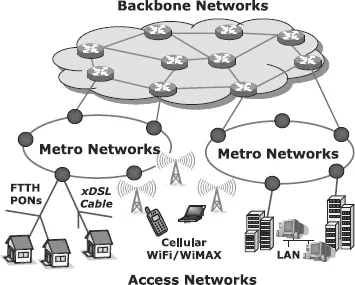
Local Area Networks Local area networks (LANs) mainly connect computers and other electronic devices (servers, printers, etc.) within an office, a single building, or a few adjacent buildings. Therefore, the geographical coverage of LANs is very small, spanning from a few meters to a few hundred meters. LANs are generally not a part of public networks but are owned and operated by private organizations. Common topologies for LANs are bus, ring, star, or tree. The most popular LANs are parts of the Ethernet, supporting a few hundred users with typical bit rates of 10 or 100 Mb/s.
Access Networks The computers and other communication equipment of a private organization are usually connected to a public telecommunication networks through access networks. Access networks bridge end users to service providers through twist pairs (phone line), coaxial cables, or other leased lines (such as OC3 through optical fiber). The typical distance covered by an access network is a few kilometers up to 20 km. For personal users, access networks use DSL or cable modem technology with a transmission rate of a few megabits per second; for business users, networks employ point-to-point fiber links with hundreds of megabits or gigabits per second.
Metropolitan Area Networks Metropolitan area networks (MANs) aggregate the traffic from access networks and transport the data at a higher speed. A typical area covered by a MAN spans a metropolitan area or a small region in the countryside. Its topology is usually a fiber ring connecting multiple central offices, where the transmission data rate is typically 2.5 or 10 Gb/s.
Wide Area Networks Wide area networks (WANs) carry a large amount of traffic among cities, countries, and continents. MAN multiplexes traffic from LANs and transports the aggregated traffic at a much higher data rate, typically tens of gigabits per second or higher using wavelength-division multiplexing (WDM) technology over optical fibers. Whereas a WAN covers the area of a nation or, in some cases, multiple nations, a link or path through a MAN could be as long as a few thousand kilometers. Beyond MANs, submarine links connect continents. Generally, the submarine systems are point-to-point links with a large capacity and an extremely long path, from a few thousand up to 10,000 km. Because these links are designed for ultralong distances and operate under the sea, the design requirements are much more stringent than those of their terrestrial counterparts. Presently, submarine links are deployed across the Pacific and Atlantic oceans. Some shorter submarine links are also widely used in the Mediterranean, Asian Pacific, and African areas.
Service Convergence Historically, communication networks provide mainly three types of service: voice, data, and video (triple play). Voice conversation using plain old telephony is a continuous 3.4-kHz analog signal carried by two-way, point-to-point circuits with a very stringent delay requirement. The standard TV signal is a continuous 6-MHz analog signal usually distributed with point-to-multipoint broadcasting. Data transmission is typically bursty with varying bandwidth and delay requirements. Because the traffic characteristics of voice, data, and video and their corresponding requirements as to quality of service (QoS) are fundamentally different, three major types of networks were developed specifically to render these services in a cost-effective manner: PSTN (public-switched telephone networks) for voice conversation, HFC (hybrid fiber coax) networks for video distribution, and the Internet for data transfer. Although HFC networks are optimized for video broadcasting, the inherent one-way communication is not suitable for bidirectional data or voice. PSTN adopts circuit switching technology to carry information with specific bandwidth or data rates, such as voice signals. However, circuit-switched networks are not very efficient for carrying bursty data traffic. With packet switching, the Internet can support bursty data transmission, but it is very difficult to meet stringent delay requirements for certain applications. Therefore, no single network can satisfy all the service requirements.
Emerging multimedia applications such as video on demand, e-learning, and interactive gaming require simultaneous transmission of voice, data, and video. Driven by user demands and stiff competition, service providers are moving toward a converged network for multimedia applications, which will utilize Internet protocol (IP) technologies to provide triple-play services. As VoIP (voice over IP) has been developed in the past few years and more recently IP TV has become a mature technology, all network services will converge into an IP-based service platform. Furthermore, the integration of optical and wireless technologies will make quadruple play (voice, data, video, and mobility) a reality in the near future.
1.2 ACCESS TECHNOLOGIES
Emerging multimedia applications continuously fuel the explosive growth of the Internet and gradually pervade every area of our lives, from home to workplace. To provide multimedia service to every home and every user, access networks are built to connect end users to service providers. The link between service providers and end users is often called the last mile by service providers, or from an end user’s perspective, the first mile. Ideally, access networks should be a converged platform capable of supporting a variety of applications and services. Through broadband access networks, integrated voice, data, and video service are provided to end users. However, the reality is that access networks are the weakest links in the current Internet infrastructure. While national information highways (WANs and MANs) have been developed in most parts of the globe, ramps and access routes to these information highways (i.e., the first/last mile) are mostly bike lanes or at best, unpaved roads, causing traffic congestion. Hence, pervasive broadband access should be a national imperative for future Internet development. In this section we review current access scenarios and discuss the last-mile bottleneck and its possible solutions.
1.2.1 Last-Mile Bottleneck
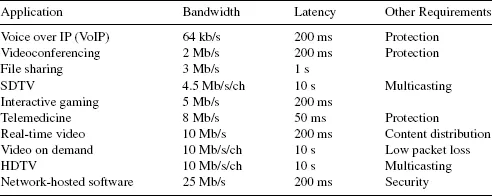
Due to advances in photonic technologies and worldwide deployment of optical fibers, during the last decade the telecommunication industry has experienced an extraordinary increase in transmission capacity in core transport networks. Commercial systems with 1-Tb/s transmission can easily be implemented in the field, and the state-of-the-art fiber optical transmission technology has reached 10 Tb/s in a single fiber. In the meanwhile, at the user end, the drastic improvement in the performance of personal computers and consumer electronic devices has made possible expanding demands of multimedia services, such as video on demand, video conferencing, e-learning, interactive games, VoIP, and others. Table 1.1 lists common end-user applications and their bandwidth requirements. As a result of the constantly increasing bandwidth demand, users may require more than 50 Mb/s in the near future. However, the current copper wire technologies bridging users and core networks have reached their fundamental bandwidth limits and become the first-last-mile bottleneck. Delays in Web page browsing, data access, and audio/video clip downloading have earned the Internet the nickname “World Wide Wait.” How to alleviate this bottleneck has been a very challenging task for service providers.
TABLE 1.1 Multimedia Applications and Their Bandwidth Requirements
1.2.2 Access Technologies Compared
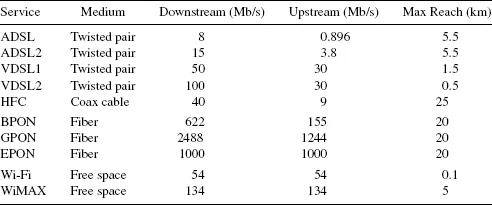
For broadband access services, there is strong competition among several technologies: digital subscriber line, hybrid fiber coax, wireless, and FTTx (fiber to the x, x standing for home, curb, neighborhood, office, business, premise, user, etc.). For comparison, Table 1.2 lists the bandwidths (per user) and reaches of these competing technologies. Currently, dominant broadband access technologies are digital subscriber loop and coaxial cable. For conventional ADSL (asymmetric DSL) technology, the bandwidth available is a few Mb/s within the 5.5-km range. Newer VDSL (very high-speed DSL) can provide 50 Mb/s, but the maximum reach is limited to 1.5 km. On the other hand, coaxial cable has a much larger bandwidth than twist pairs, which can be as high as 1 Gb/s. However, due to the broadcast nature of CATV system, current cable modems can provide each user with an average bandwidth of a few Mb/s. While DSL and cable provide wired solutions for broadband access, Wi-Fi (wireless fidelity), and WiMAX (worldwide interoperability for microwave access) provide mobile access in a LAN or MAN network. Even though a nominal bandwidth of Wi-Fi and WiMAX can be relatively higher (54 Mb/s in 100 m for Wi-Fi and 28 Mb/s in 15 km for WiMAX), the reach of such wireless access is very limited and the actual bandwidth provided to users can be much lower, due to the interference in wireless channels. As a LAN technology, the primary use of Wi-Fi is in home and office networking. To reach the central office or service provider, multiple-hop wireless links with WiMAX have to be adopted. An alternative technology that is also under development is MBWA (mobile broadband wireless access, IEEE 802.20), which is very similar to WiMAX (IEEE 802.16e). Compared to the fixed access solutions, the advantages of the wireless technologies are easy deployment and ubiquitous or mobile access, and the disadvantages are unreliable bandwidth provisioning and/or limited access range.
TABLE 1.2 Comparison of Bandwidth and Reach for Popular Access Technologies
The bandwidth and/or reach of the copper wire and wireless access technology is very limited due to the physical media constraints. To satisfy the future use demand (>30 Mb/s), there is a strategic urgency for service providers to deploy FTTx networks. Currently, for cost and deployment reasons, FTTx is competing with other access technologies. Long term, however, only optical fiber can provide the unlimited capacity and performance that will be required by future broadband services. FTTx has long been dubbed as a future-proof technology for the access networks. A number of optical access network architectures have been standardized (APON, BPON, EPON, and GPON), and cost-effective components and devices for FTTx have matured. We are currently witnessing a worldwide deployment of optical access networks and a steady increase in FTTx users.
1.3 DIGITAL SUBSCRIBER LINE
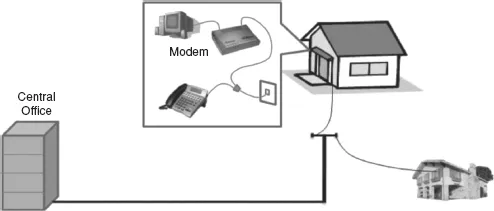
Digital subscriber line (also called digital subscriber loop) is a family of access technologies that utilize the telephone line (twisted pair) to provide broadband access service. While the audio signal (voice) carried by a telephony system is limited from 300 to 3400 Hz, the twisted pair connecting the users to the central office is capable of carrying frequencies well beyond the 3.4-kHz upper limit of the telephony system. Depending on the length and the quality of the twisted pair, the upper limit can extend to tens of megahertz. DSL takes advantage of this unused bandwidth and transmits data using multiple-frequency channels. Thus, some types of DSL allow simultaneous use of the telephone and broadband access on the same twisted pair. Figure 1.2 shows the typical setup of a DSL configuration. At the central office, a DSLAM (DSL access multiplexer) sends the data to users via downstream channels. At the user side, a DSL modem functions as a modulator/demodulator (i.e., receives data from DSLAM and modulates user data for upstream transmission).
FIGURE 1.2 DSL access networks.
1.3.1 DSL Standards
DSL comes in different flavors, supporting various downstream/upstream bit rates and access distances. DSL standards are defined in ANSI T1, and ITU-T Recommendation G.992/993. Table 1.2 lists various DSL standards and their performance. Collectively, these DSL technologies are referred to as xDSL. Two commonly deployed DSL standards are ADSL and VDSL.
As its name suggests, ADSL supports asymmetrical transmission. Since the typical ratio of traffic asymmetry is about 2:1 to 3:1, ADSL becomes a popular choice for broadband access. In addition, there is more crosstalk from other circuits at the DSLAM end. As the upload signal is weak at the noisy DSLAM end, it makes sense technically to have upstream transmission at a lower bit rate. Depending on the length and quality (such as the signal-to-noise ratio) of the twisted pair, the downstream bit rate can be as high as 10 times the upstream transmission. The maximum reach of ADSL is 5500 m. While ADSL1 can support a downstream bit rate up to 8 Mb/s and an upstream data rate up to 896 kb/s, ADSL2 supports up to 15 Mb/s downstream and 3.8 Mb/s upstream.
To support higher bit rates, the VDSL standard was developed after ADSL. Trading transmission distance for data rate, VDSL can support a much higher data rate but with very limited reach. VDSL1 standards specify data rates of 50 Mb/s for downstream and 30 Mb/s for upstream transmission. The maximum reach of VDSL1 is limited to 1500 m. The newer version of VDSL standards, VDSL2, is an enhancement of VDSL1, supporting a data rate up to 100 Mb/s (with a transmission distance of 500 m). At 1 km, the bit rate will drop to 50 Mb/s. For reaches longer than 1.6 km, the VDSL2 performance is close to ADSL. Because of its higher data rates and ADSL-like long reach performance, VDSL2 is considered to be a very promising solution for upgrading existing ADSL infrastructure.
ADSL and VDSL are designed for residential subscribers with asymmetric bandwidth demands. For business users, symmetrical connections are generally required. Two symmetrical DSL standards, HDSL and SHDSL, are developed for business customers. While HDSL supports a T1 line data rate at 1.552 Mb/s (including 8 kb/s of overhead) with a reach of about 4000 m, SHDSL can provide a 6.696-Mb/s data rate with a maximum reach of 5500 m. However, HDSL and SHDSL do not support simultaneous telephone service, as mos...
Table of contents
- Cover
- Half Title page
- Title page
- Copyright page
- Foreword
- Preface
- Acknowledgments
- Chapter 1: Broadband Access Technologies: An Overview
- Chapter 2: Optical Communications: Components and Systems
- Chapter 3: Passive Optical Networks: Architectures and Protocols
- Chapter 4: Next-Generation Broadband Optical Access Networks
- Chapter 5: Hybrid Optical Wireless Access Networks
- Index
Trusted by 375,005 students
Access to over 1.5 million titles for a fair monthly price.
Study more efficiently using our study tools.
Frequently asked questions
Yes, you can cancel anytime from the Subscription tab in your account settings on the Perlego website. Your subscription will stay active until the end of your current billing period. Learn how to cancel your subscription
No, books cannot be downloaded as external files, such as PDFs, for use outside of Perlego. However, you can download books within the Perlego app for offline reading on mobile or tablet. Learn how to download books offline
Perlego offers two plans: Essential and Complete
- Essential is ideal for learners and professionals who enjoy exploring a wide range of subjects. Access the Essential Library with 800,000+ trusted titles and best-sellers across business, personal growth, and the humanities. Includes unlimited reading time and Standard Read Aloud voice.
- Complete: Perfect for advanced learners and researchers needing full, unrestricted access. Unlock 1.5M+ books across hundreds of subjects, including academic and specialized titles. The Complete Plan also includes advanced features like Premium Read Aloud and Research Assistant.
We are an online textbook subscription service, where you can get access to an entire online library for less than the price of a single book per month. With over 1.5 million books across 990+ topics, we’ve got you covered! Learn about our mission
Look out for the read-aloud symbol on your next book to see if you can listen to it. The read-aloud tool reads text aloud for you, highlighting the text as it is being read. You can pause it, speed it up and slow it down. Learn more about Read Aloud
Yes! You can use the Perlego app on both iOS and Android devices to read anytime, anywhere — even offline. Perfect for commutes or when you’re on the go.
Please note we cannot support devices running on iOS 13 and Android 7 or earlier. Learn more about using the app
Please note we cannot support devices running on iOS 13 and Android 7 or earlier. Learn more about using the app
Yes, you can access Broadband Optical Access Networks by Leonid G. Kazovsky,Ning Cheng,Wei-Tao Shaw,David Gutierrez,Shing-Wa Wong in PDF and/or ePUB format, as well as other popular books in Technology & Engineering & Electrical Engineering & Telecommunications. We have over 1.5 million books available in our catalogue for you to explore.