- English
- ePUB (mobile friendly)
- Available on iOS & Android
eBook - ePub
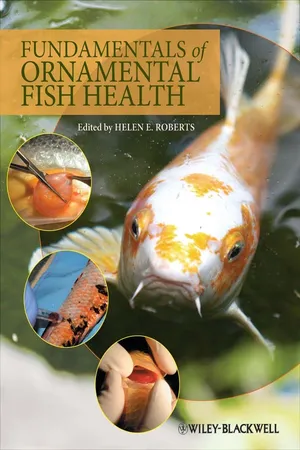
Fundamentals of Ornamental Fish Health
About this book
Fundamentals of Ornamental Fish Health is a complete guide to managing the health and well-being of ornamental aquatic animals. Grounded in the foundations of fish medical care, the book summarizes nonlethal aquatic diagnostics and medicine, putting the information within a clinical context. Providing a comprehensive overview of the subject, Fundamentals of Ornamental Fish Health equips aquatic animal health professionals with all the information needed to competently and effectively treat these patients, from transporting and examining fish to diagnostic techniques and the identification and treatment of specific diseases and syndromes.
Information
Fish Health
Chapter 6
Biosecurity and Ornamental Fish
Introduction
Biosecurity is a common topic in discussions of fish health and well-being. Definitions may vary, but all focus around this basic concept: Biosecurity consists of the practices and procedures used to prevent the introduction, emergence, spread, and persistence of infectious agents and disease within and around fish production and holding facilities. Furthermore, these practices help eliminate conditions that can enhance disease susceptibility among the fish. In short, biosecurity precautions are put in place to exclude and contain fish pathogens. Biosecurity practices are applicable to all levels of the ornamental fish industry: producers, exporters, importers, wholesalers, retailers, and hobbyists. Proper use of biosecurity measures will help prevent the introduction of infectious disease in a fish facility and will also help minimize the risk of diseases being passed from producer to hobbyist.
Infectious disease is a constant threat to ornamental fish, whether as individuals or as a group. An infectious disease outbreak in a group of fish can, and will, occur at any time. Prompt diagnosis and treatment are means of controlling these infections. The preventive measures found in a facility’s biosecurity program complement this by stopping the spread of the disease within the facility. But as important, the biosecurity measures will minimize the likelihood of introduction and spread of the pathogen and eliminate the conditions that enhance disease susceptibility among fish.
While more often associated with intensive types of animal production, the principles of biosecurity are applicable to any level of animal husbandry, from high-density, high-volume production units to backyard ponds and aquaria. While specific features of a biosecurity program may vary between a fish aquaculture facility and a hobbyist’s aquarium, the basic principles of biosecurity apply to any unit under consideration.
It is crucial that those charged with the care and handling of animals understand, implement, and adhere to the policies and procedures of a sound biosecurity program. The success or failure of an animal-related business will depend on the attention to basic biosecurity concepts. Biosecurity is not to be feared or avoided. It is an essential component of a facility’s business plan. It requires effort and action by management and employees, including planning, implementation, training, auditing, and revision as circumstances change. A good biosecurity program does not have to be burdensome or confusing. It will result in greater success for an ornamental fish business and increased satisfaction for aquarium and pond fish owners.
Space limits this chapter to only a brief review of the basic principles of biosecurity and related husbandry practices. The reader is encouraged to consult more detailed references devoted to biosecurity standards for aquaculture (Lee and O’Bryen, 2003; Scarfe et al., 2006).
Biosecurity practices
Important and consistent biosecurity methods and protocols help protect a fish-holding facility against pathogen entry and spread. Basic biosecurity procedures are uniform across the industry, but the biosecurity plan will be customized to meet the special needs of each business. Each facility manager will modify and adjust biosecurity measures as needs change and finances allow.
Designing and implementing biosecurity practices can be simplified if you consider some basic themes: pathogen exclusion, pathogen containment, and basic best health practices.
Pathogen exclusion
The goal of pathogen exclusion is to prevent the entrance of an infectious agent into a facility, thereby preventing infection and possibly disease in a group of fish. Recognizing and understanding the various routes by which an infectious agent can enter a pristine fish tank or pond allows you to plan defensive measures that will block that entry.
Fish-associated entry
An obvious route of entry of pathogens into a facility is via the incoming fish. These animals may be asymptomatic carriers of a pathogen or may have frank disease. It can be very difficult to determine if one is receiving healthy fish, and rarely can a manager be totally confident that the fish he has received are in fact healthy. To help minimize opportunities for diseased fish to enter a facility, consider the following as you select a supplier:
- Is there a long business relationship with this supplier? Have there been any health problems among the purchased fish? A long track record of providing healthy fish is an obvious step toward preventing the entrance of unwanted and undetected pathogens.
- Can the supplier provide references from satisfied customers? Is there a history of selling quality products? As with any business, a list of satisfied customers goes a long way to build and validate consumer confidence.
- Does the supplier receive fish from multiple sources? Are fish from the same source in separate containment systems, or do they mix fish from multiple sources? The optimal approach would be to use a limited number of trusted fish sources and to hold the fish from each source separately.
- Does the supplier conduct disease screening? For which diseases? What tests do they use? Screening is essential to assess disease prevalence in a group of fish and helps identify silent carriers of disease. Be aware that not all test techniques are equal, and some tests will not pick up asymptomatic carriers of disease.
- Does the supplier work with a veterinarian or fish health professional? In what capacity? Does the veterinarian come in only when health problems arise, or are they present or available to assist with health screening of new shipments as well as conduct reviews of husbandry and biosecurity practices? The latter indicates a high priority placed on healthy fish.
- Does the supplier keep species separate? Again, species in separate systems prior to shipment allows for easy identification, isolation, or removal of sick animals.
- Does the supplier have a biosecurity program? Are they willing to share the details with their clients? Be extremely cautious if the answer is “no.” Such a lack of transparency may indicate that the supplier has no biosecurity program or may have significant disease problems within the facility.
- Are the fish “certified” to be free of disease? Customers need to be very careful if they hear this statement or receive a document attesting to such a fact. Typically, fish farms or fish lots are certified free of specific diseases. They are not certified or guaranteed to be healthy. In order to be certified as being free of a specific disease, fish must be sampled and tested in accordance with specific protocols established and accepted by state, national, or international authorities. For a fish farm to be certified free of a specific disease, multiple years of highly regulated testing under specified environmental conditions are required. And in some cases, no disease free certification exists (Yanong, 2001a; OIE, The World Animal Health Organization, 2006).
Water-associated entry
The presence and persistence of pathogens in water makes this medium a potential source of pathogen entry into a fish facility. Water supply is a major consideration when designing a biosecurity program based on pathogen exclusion.
Many facilities utilize municipal water. This is generally one of the safest sources of pathogen-free water as it is treated to minimize the chances of contamination. The primary concern with municipal water is water quality; facility managers must ensure that the water is properly treated to eliminate chlorine or chloramines before use in the holding systems. Another potential problem with municipal water is that it may come from multiple sources during the course of the year. Water may come from a reservoir during part of the year and from wells at other times. This can result in some dramatic water quality shifts that may compromise fish and predispose them to disease.
Wells are another good source of water for many facilities. Wells may be periodically treated with chlorine to eliminate bacterial contamination. However, the water should be regularly tested for bacterial contamination as well as heavy metals and chlorine. Be aware that well water often contains high levels of dissolved gasses, which can lead to supersaturation that can compromise fish. Installation of degassing towers will generally eliminate this problem.
Surface water runs a high risk of containing pathogens. These water sources can be home to fish, invertebrates, birds, and mammals that might be carrying pathogens or possibly toxins. The potential for contamination by sewage overflow must be considered as well. If a facility relies upon surface water, assessing and treating the water source is recommended. This would include a visual assessment of the source and the animals living in it, testing the water for bacterial or chemical contamination, and potentially treating the incoming water with prefiltration and ultraviolet light, ozone, or chlorine (Strange, 2008).
Shipping water presents a great risk. It comes from an unknown source, perhaps already contaminated by pathogens. Fish have been sealed in the water, in some cases for 12–36 hours, contaminating it with fecal material that may promote pathogen growth. Diseased fish or carriers release pathogens into the water. Water chemistry deteriorates during shipping, with high ammonia, high carbon dioxide, and low pH. Shipping water should not mix with water of any holding system except that of quarantine.
Food-associated entry
Fish food cannot only serve as a source of pathogens, but poor or contaminated diets can also compromise the fish and make them more susceptible to infection by pathogens. In most cases, good-quality commercial diets will satisfy the basic nutritional requirements of ornamental fish and are unlikely to host infectious agents. As with fish suppliers, one should consider reputation and history of service when selecting food suppliers. The food should be carefully inspected to ensure that there is no spoilage. Live foods deserve special consideration as there is a higher potential for harboring pathogens, and caution is warranted. Pretreatment or quarantine of the live food animals may be considered.
Contamination and spoilage of poor-quality feeds, before or after purchase, are valid concerns. Precautions can be taken to minimize these hazards. Commercial food should be purchased in quantities that will be used within 6 months. Once food is purchased, it should be divided into airtight containers that contain only a few days worth of food. This...
Table of contents
- Cover
- Title
- Copyright
- Acknowledgments
- Contributor List
- Basics of Fish Keeping
- Fish Health
- Fish Medicine
- Index
Trusted by 375,005 students
Access to over 1.5 million titles for a fair monthly price.
Study more efficiently using our study tools.
Frequently asked questions
Yes, you can cancel anytime from the Subscription tab in your account settings on the Perlego website. Your subscription will stay active until the end of your current billing period. Learn how to cancel your subscription
No, books cannot be downloaded as external files, such as PDFs, for use outside of Perlego. However, you can download books within the Perlego app for offline reading on mobile or tablet. Learn how to download books offline
Perlego offers two plans: Essential and Complete
- Essential is ideal for learners and professionals who enjoy exploring a wide range of subjects. Access the Essential Library with 800,000+ trusted titles and best-sellers across business, personal growth, and the humanities. Includes unlimited reading time and Standard Read Aloud voice.
- Complete: Perfect for advanced learners and researchers needing full, unrestricted access. Unlock 1.5M+ books across hundreds of subjects, including academic and specialized titles. The Complete Plan also includes advanced features like Premium Read Aloud and Research Assistant.
We are an online textbook subscription service, where you can get access to an entire online library for less than the price of a single book per month. With over 1.5 million books across 990+ topics, we’ve got you covered! Learn about our mission
Look out for the read-aloud symbol on your next book to see if you can listen to it. The read-aloud tool reads text aloud for you, highlighting the text as it is being read. You can pause it, speed it up and slow it down. Learn more about Read Aloud
Yes! You can use the Perlego app on both iOS and Android devices to read anytime, anywhere — even offline. Perfect for commutes or when you’re on the go.
Please note we cannot support devices running on iOS 13 and Android 7 or earlier. Learn more about using the app
Please note we cannot support devices running on iOS 13 and Android 7 or earlier. Learn more about using the app
Yes, you can access Fundamentals of Ornamental Fish Health by Helen E. Roberts in PDF and/or ePUB format, as well as other popular books in Medicine & Veterinary Medicine. We have over 1.5 million books available in our catalogue for you to explore.