Written by a university lecturer with more than forty years experience in plasma technology, this book adopts a didactic approach in its coverage of the theory, engineering and applications of technological plasmas.
The theory is developed in a unified way to enable brevity and clarity, providing readers with the necessary background to assess the factors that affect the behavior of plasmas under different operating conditions. The major part of the book is devoted to the applications of plasma technology and their accompanying engineering aspects, classified by the various pressure and density regimes at which plasmas can be produced. Two chapters on plasma power supplies round off the book.
With its broad range of topics, from low to high pressure plasmas, from characterization to modeling, and from materials to components, this is suitable for advanced undergraduates, postgraduates and professionals in the field.
eBook - ePub
Introduction to Plasma Technology
Science, Engineering, and Applications
- English
- ePUB (mobile friendly)
- Available on iOS & Android
eBook - ePub
About this book
Information
Chapter 1
Plasma, an Overview
1.1 Introduction
This chapter introduces the different areas of plasma, the unique aspects of the subject, definitions, the use of simple ballistic and statistical models and the defining characteristics of plasmas.
The influence of plasma technology has penetrated almost every aspect of human activity during the last few years. Some of the different areas of plasma technology, applications and areas of operation are shown in Table 1.1. Despite the widespread use of many of the applications, the subject of plasma has developed a mystique which has given it a reputation of being complex and impenetrable. Aspects of plasmas which make the subject different from many other areas of physics and engineering are introduced in this chapter.
Table 1.1 Some applications of plasmas.
| Low-pressure non-equilibrium plasma | Atmospheric non-equilibrium plasmas | High-current equilibrium plasmas |
| Plasma processes used in electronics fabrication Glow discharge diode Magnetron Induction coupled plasmas Electron cyclotron resonance reactor Helical reactor Helicon reactor Low-pressure electric discharge and plasma Lamps Low-pressure mercury vapour lamp Cold cathode low-pressure lamps Electrodeless low-pressure discharge lamps Plasma display panels Gas lasers Free electron and ion beams Electron and ion beam evaporation Ion beam processes High-power electron beams Glow discharge surface treatment Propulsion in space | Atmospheric pressure discharges Corona discharges Corona discharges on power lines Electrostatic charging processes Electrostatic precipitators Electrostatic deposition Dielectric barrier discharges Manufacture of ozone Surface treatment using barrier discharges Partial discharges Surface discharges Atmospheric pressure glow discharges Surface treatment of films and textiles to change surface properties Sterilization of medical equipment and disinfection Surgery Diesel exhaust treatment Biomedical applications Surface modification to improve adhesion, hydrophobic properties, wetting | Arc welding Metal inert gas welding Tungsten inert gas welding Submerged arc welding Plasma torch Electric arc melting Three-phase AC arc furnace DC arc furnaces Electric arc smelting Plasma melting furnaces Vacuum arc furnaces Arc gas heaters Electric discharge augmented fuel flames Induction coupled arc discharges High-pressure discharge lamps Ion lasers Arc interrupters Vacuum circuit breakers and contactors Magnetoplasmadynamic power generation Generation of electricity by nuclear fusion Natural phenomena Lightning Applications in space |
Plasma comprises, in its simplest form, the two elementary particles that make up an atom: electrons and ions. Over 99% of the universe is believed to be plasma, as opposed to condensed matter (solids, liquids and gases) such as comets, planets or cold stars. The term plasma was first used by Langmuir in 1927 and derives its name from the Greek to shape or to mould and the analogy with biological plasma, which is an electrolyte, and describes the self-regulating behaviour of plasma in contrast to the apparently random behaviour of fluids.
The science of plasma encompasses space plasmas, kinetic plasmas and technological plasmas and ranges over enormous variations of parameters such as pressure, distance and energy. One method of distinguishing different areas of plasma technology that is often used is as hot or cold plasmas (Table 1.2) depending on the relative value of the ion temperature Ti to the electron temperature Te. Although widely and conveniently used to describe individual areas, they accentuate the differences, and the anomaly of a plasma at several thousand degrees kelvin being described as cold is not always helpful! Other common descriptions used are glow, corona, arc and beams. These artificial definitions often present obstacles to those entering the field or to those already engaged in it. The subject of plasma is better described as a continuum in terms primarily of the potential energy of electrons Te and ions Ti and the electron number density ne, and one of the objectives of this book is to emphasize the similarities rather than the differences.
Table 1.2 Temperature and pressure ranges of hot and cold plasmas.
| Low-temperature thermal cold plasmas | Low-temperature non-thermal cold plasmas | High-temperature hot plasmas |
| Te ≈ Ti ≈ T < 2 × 10⁴ K | Ti ≈ T ≈ 300 K Ti  | Ti ≈ Te > 106 K |
| Arcs at 100 kPa | Low pressure ∼100 Pa glow and arc | Kinetic plasmas, fusion plasmas |
| From Ref. [1]. | ||
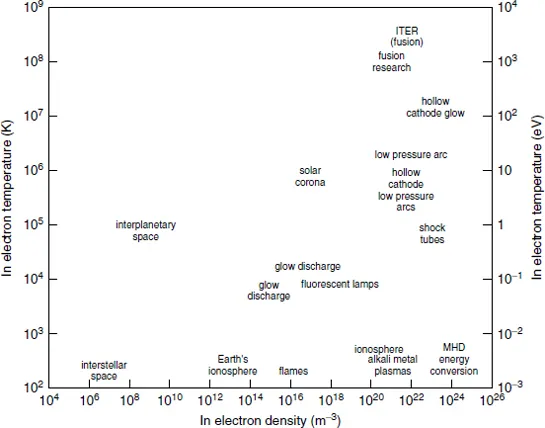
The reason for plasmas’ unique characteristics and relevance to high-energy processes is apparent from Figure 1.1, where the electron temperature Te is shown for different plasma processes as a function of electron number density of the electrons. Energy and temperature are related by the Boltzmann constant, kB:
Figure 1.1 Plasma applications at different currents and gas pressures.

where kB = 1.38 × 10⁻²³ J K−1 [1]. In a cold plasma such as a neon lamp, the kinetic energy equates almost entirely to the electron energy and, although the mean electron temperature may be several times room temperature, the number of hot electrons is only a tiny fraction of the total and their thermal mass is small compared with an atom or molecule, so that the average temperature increase is small. The potential and energy of ...
Table of contents
- Cover
- Half Title page
- Related Titles
- Title page
- Copyright page
- Preface
- Symbols, Constants and Electronic Symbols
- Chapter 1: Plasma, an Overview
- Chapter 2: Elastic and Inelastic Collision Processes in Weakly Ionized Gases
- Chapter 3: The Interaction of Electromagnetic Fields with Plasmas
- Chapter 4: Coupling Processes
- Chapter 5: Applications of Nonequilibrium Cold Low-pressure Discharges and Plasmas
- Chapter 6: Nonequilibrium Atmospheric Pressure Discharges and Plasmas
- Chapter 7: Plasmas in Charge and Thermal Equilibrium; Arc Processes
- Chapter 8: Diagnostic Methods
- Chapter 9: Matching, Resonance and Stability
- Chapter 10: Plasma Power Supplies
- Index
Trusted by 375,005 students
Access to over 1.5 million titles for a fair monthly price.
Study more efficiently using our study tools.
Frequently asked questions
Yes, you can cancel anytime from the Subscription tab in your account settings on the Perlego website. Your subscription will stay active until the end of your current billing period. Learn how to cancel your subscription
No, books cannot be downloaded as external files, such as PDFs, for use outside of Perlego. However, you can download books within the Perlego app for offline reading on mobile or tablet. Learn how to download books offline
Perlego offers two plans: Essential and Complete
- Essential is ideal for learners and professionals who enjoy exploring a wide range of subjects. Access the Essential Library with 800,000+ trusted titles and best-sellers across business, personal growth, and the humanities. Includes unlimited reading time and Standard Read Aloud voice.
- Complete: Perfect for advanced learners and researchers needing full, unrestricted access. Unlock 1.5M+ books across hundreds of subjects, including academic and specialized titles. The Complete Plan also includes advanced features like Premium Read Aloud and Research Assistant.
We are an online textbook subscription service, where you can get access to an entire online library for less than the price of a single book per month. With over 1.5 million books across 990+ topics, we’ve got you covered! Learn about our mission
Look out for the read-aloud symbol on your next book to see if you can listen to it. The read-aloud tool reads text aloud for you, highlighting the text as it is being read. You can pause it, speed it up and slow it down. Learn more about Read Aloud
Yes! You can use the Perlego app on both iOS and Android devices to read anytime, anywhere — even offline. Perfect for commutes or when you’re on the go.
Please note we cannot support devices running on iOS 13 and Android 7 or earlier. Learn more about using the app
Please note we cannot support devices running on iOS 13 and Android 7 or earlier. Learn more about using the app
Yes, you can access Introduction to Plasma Technology by John Ernest Harry in PDF and/or ePUB format, as well as other popular books in Physical Sciences & Nuclear Physics. We have over 1.5 million books available in our catalogue for you to explore.