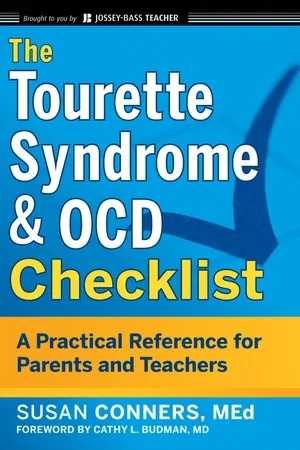
The Tourette Syndrome and OCD Checklist
eBook - ePub

The Tourette Syndrome and OCD Checklist

A Practical Reference for Parents and Teachers

  1. English
  2. ePUB (mobile friendly)
  3. Available on iOS & Android
eBook - ePub

The Tourette Syndrome and OCD Checklist

A Practical Reference for Parents and Teachers

About this book

Up-to-date, reliable information about Tourette Syndrome and related disorders for teachers and parents

Children with TS are often teased and punished for the unusual yet uncontrollable symptoms of their disorder. Academic failure is common. The Tourette Syndrome/OCD Checklist helps parents and teachers to better understand children and youth with TS and/or OCD and provide the support and interventions these children need. Presented in a simple, concise, easy-to-read checklist format, the book is packed with the latest research, practical advice, and information on a wide range of topics.

  • Provides a wealth of information on Tourette Syndrome, Obsessive-Compulsive Disorder, and related conditions
  • Includes strategies for discipline and behavior management, advice on supporting and motivating kids with TS and OCD, homework tips, and more
  • Shows how to educate peer students about TS and OCD

Loaded with practical information, strategies, and resources, this book helps parents and teachers to better understand Tourette Syndrome and OCD and shows how every individual can reach their potential in school and in life.

Frequently asked questions

Yes, you can cancel anytime from the Subscription tab in your account settings on the Perlego website. Your subscription will stay active until the end of your current billing period. Learn how to cancel your subscription.
At the moment all of our mobile-responsive ePub books are available to download via the app. Most of our PDFs are also available to download and we're working on making the final remaining ones downloadable now. Learn more here.
Perlego offers two plans: Essential and Complete
  • Essential is ideal for learners and professionals who enjoy exploring a wide range of subjects. Access the Essential Library with 800,000+ trusted titles and best-sellers across business, personal growth, and the humanities. Includes unlimited reading time and Standard Read Aloud voice.
  • Complete: Perfect for advanced learners and researchers needing full, unrestricted access. Unlock 1.4M+ books across hundreds of subjects, including academic and specialized titles. The Complete Plan also includes advanced features like Premium Read Aloud and Research Assistant.
Both plans are available with monthly, semester, or annual billing cycles.
We are an online textbook subscription service, where you can get access to an entire online library for less than the price of a single book per month. With over 1 million books across 1000+ topics, we’ve got you covered! Learn more here.
Look out for the read-aloud symbol on your next book to see if you can listen to it. The read-aloud tool reads text aloud for you, highlighting the text as it is being read. You can pause it, speed it up and slow it down. Learn more here.
Yes! You can use the Perlego app on both iOS or Android devices to read anytime, anywhere — even offline. Perfect for commutes or when you’re on the go.
Please note we cannot support devices running on iOS 13 and Android 7 or earlier. Learn more about using the app.
Yes, you can access The Tourette Syndrome and OCD Checklist by Susan Conners in PDF and/or ePUB format, as well as other popular books in Education & Inclusive Education. We have over one million books available in our catalogue for you to explore.

Information

Publisher
Jossey-Bass
Year
2011
Print ISBN
9780470623336
eBook ISBN
9781118075296
Edition
1
Chapter 1
Basic Information About TS, OCD, and Associated Disorders
1.1 What Is Tourette Syndrome (TS)?
  • Tourette Syndrome (TS; sometimes also known as Tourette's Disorder) is a complex neurobiological movement disorder resulting from a chemical imbalance in the brain.
  • It is characterized by involuntary movements and vocalizations referred to as motor and vocal tics.
  • TS occurs three to four times more frequently in boys than girls.
  • At present there is no cure for TS.
  • TS is hereditary.
  • TS is not a degenerative disorder and does not get progressively worse.
  • Several genes most likely cause TS, and to date only one has been identified. The genetic basis of tic disorders and TS is currently being intensely studied.
  • There is currently no medical test that will clinically diagnose TS.
Although it is well documented that TS is a neurological disorder, onlookers sometimes mistakenly believe that TS symptoms are intentional behaviors.
  • Tourette symptoms are sometimes misinterpreted as emotional, psychiatric, or behavioral problems. At school, children may be reprimanded and punished for their symptoms, and some are even asked not to return to school.
As with Parkinson's disease, dopamine, a brain chemical involved with movement, is believed to be prominently involved in Tourette Syndrome. (But having TS does not mean that the patient will develop Parkinson's.)
  • With Parkinson's, the brain is no longer producing enough dopamine, so people with Parkinson's exhibit slowed-down movements such as tremors, slurred speech, and muscle rigidity.
  • Because of the involvement of dopamine and the involuntary movements and vocalizations that people with TS exhibit, TS can be easily seen as truly neurological. (Again I emphasize that TS does not lead to Parkinson's.)
  • Because there is currently no medical test to diagnose TS, it is identified by the presence of these five observable diagnostic criteria:
    • Multiple motor tics
    • At least one vocal tic
    • Waxing and waning of symptoms
    • Childhood onset of symptoms
    • Symptoms lasting for at least one year
Although educators cannot formally diagnose TS, it is extremely important for them to know where the diagnosis comes from, what they are looking for, and what they may see with a child with whom they are working who has TS.
  • Educators can be key in helping to identify a child with TS.
  • They can often be a resource to the family by providing them with TS literature and by helping them to locate a knowledgeable physician in their area to obtain a proper diagnosis.
1.2 Manifestations of Motor Tics
A motor tic is defined as a rapid, repetitive movement of any voluntary muscular group in your body. There are two categories of motor tics: simple and complex.
  • Simple motor tics are the easiest to recognize because they look like tics. They affect just one muscular group.
  • Over the years people have referred to these movements as twitches or nervous habits, thus equating them with a psychological problem. The official term for them is tics.
  • Simple motor tics rarely interrupt a classroom, so they often go unnoticed by teachers. Simple motor tics include:
    • Rapid eye blinking
    • Head jerking
    • Facial grimaces
    • Arm flailing
    • Finger tapping
    • Neck twisting
    • Nose twitching
    • Hand and finger movements
    • Lip smacking
    • Leg jerks
    • Hair tossing
  • Although these simple movements may not disturb other students, they can be very interfering to the child who has TS.
  • Imagine constantly shaking your head back and forth and trying to read or twisting your wrists over and over again and trying to write.
  • These tics can occur in bouts that sometimes seem purposeful, and children are sometimes unjustly accused of performing their tics to get attention or to get a laugh from other students.
  • Complex motor tics are intricate and complicated movements, and the list of them is seemingly endless. Almost any simple or complex movement can be a motor tic.
  • These complex movements involve more than one muscular group and don't always look like what most people would define as a tic.
  • These tics are the most difficult to recognize and the most misunderstood. Examples of complex motor tics are:
    • Hopping
    • Knee bending
    • Whole body bending
    • Twirling
    • Clapping
    • Touching objects and/or other people
    • Obscene gestures
    • Stomach crunching
    • A series of what look like simple motor tics
    • Self-abusive tics such as hitting oneself in the head or hitting one's leg against a desk
    • Handstands and cartwheels
See the Appendix at the end of the book for many more examples of complex motor tics.
1.3 Manifestations of Vocal Tics
  • Vocal tics can often be the most problematic type of tic. They are called vocal tics because you hear them. A vocal tic can be defined as follows:
    • The repeated uttering of a sound, word, or phrase
    • A noise that someone makes over and over again
    • A change in speech pattern or voice inflection, stuttering, or speaking with an accent
  • Vocal tics, like motor tics, are divided into simple and complex types. Simple vocal tics involve noisemaking, while complex vocal tics are usually something linguistically meaningful that a person says—a word, a phrase, a complete sentence, or an atypical speech pattern.
  • Examples of simple vocal tics are:
    • Constant sniffing
    • Throat clearing
    • A squeaking sound
    • Snorting
    • Howling
    • Barking
    • Grunting
    • Humming
    • Hissing
    • Screeching
    • Sighing
    • Coughing
  • Examples of complex vocal tics are:
    • Vocal repetition of a phrase or word. (One of my favorites was a boy who would repeat, “chickens are fuzzy, chickens are fuzzy” and “I have a chicken in my pants.”)
    • Changes in tone or volume of speech in the middle of a sentence
    • Stuttering
    • The urge to speak...

Table of contents

  1. Cover
  2. Praise for The Tourette Syndrome and OCD Checklist
  3. Jossey-Bass Teacher
  4. Title Page
  5. Copyright
  6. Dedication
  7. About This Book
  8. About the Author
  9. Foreword
  10. Preface
  11. Introduction
  12. Section One: Basic Information About TS, OCD, and Associated Disorders
  13. Section Two: Understanding the Impact of TS and OCD
  14. Section Three: Checklists for Parents
  15. Section Four: Checklists for Teachers
  16. Section Five: Other Helpful Checklists for Parents and Teachers
  17. Appendix: Real-Life Scenarios
  18. Index