AWARDS: Silver Living Now Book Award, Mature Living/Aging 2014 (Silver)
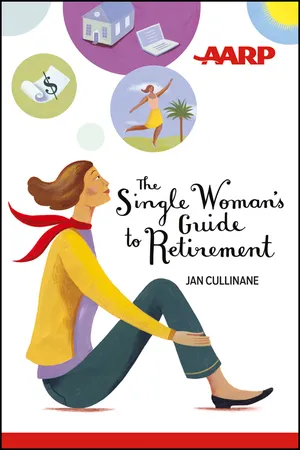
If you're one of the 25 million single women over the age of 45 living in the United States today, AARP's The Single Woman's Guide to Retirement is your new best friend. Walking you through the challenges of retired or pre-retired life, from managing your finances to staying healthy in body, mind, and spirit, dealing with divorce, and even looking for love or work, the book covers the issues that really matter to you. Whether you're looking for a retirement home or planning a cruise, this book is packed with specific details to help take the guesswork out of retirement. Author and retirement expert Jan Cullinane has gathered real-life stories from women just like you to illustrate your options and give you fresh new ideas about how to make the most of your retirement years.
- English
- ePUB (mobile friendly)
- Available on iOS & Android
eBook - ePub
The Single Woman's Guide to Retirement
About this book
Information
Chapter 1
Retirement and the Single Woman
Do one thing every day that scares you.
—Eleanor Roosevelt

Sex and the Single Girl, Helen Gurley Brown’s 1962 blockbuster book, encouraged single women to become strong and independent and to live life to the fullest. More than 50 years later, that’s still excellent advice. Let’s substitute “retirement” for “sex” and “woman” for “girl.” Retirement and the Single Woman doesn’t sound quite as titillating, does it? The term “girl” no longer applies, and although sex is important, there are additional vital issues to discuss when it comes to this transition called retirement. But, as in Brown’s book, strength, independence, and a satisfying life are still noble goals for single women.
In this chapter, we’ll take a look at what makes this demographic important and growing. If you’re not a numbers person, you’ll at least be happy to note that a lot more research is now being done on women in general and single women in particular. This certainly has not been the case in the past.
What would you rather do, plan a two-week vacation or plan for retirement? It’s easier and a lot more fun preparing to bask in the sun on a tropical island or to tour Tuscany than to look ahead to the next 30 or so years of your life. It’s something that we can’t ignore and should be excited about doing, if we have the right tools and mind-set. That is the purpose of this book—to help you plan a fun, rewarding, and successful retirement, to give you specific thoughts and ideas on how to do this, and to hear from real single women about their real-life experiences.
We can now expect to live, on average, to the ripe old age of 81. Of course, longevity is affected by lifestyle, age, and genetic factors (I just completed a life-expectancy calculator that said I should plan to live to 97). The good news is that we can live a long time. The scary news is that we can live a long time, so we had better be prepared. And getting ready for retirement is a lot more than just about money, although being financially secure is an important consideration. It’s also about what to do with 168 hours a week. It’s about maybe working, maybe relocating, perhaps reinventing yourself, ideally deepening connections, possibly taking care of elderly parents, maybe about never-having-left-the-coop children or boomerang children, and about trying to stay as healthy as possible. It’s a new life chapter, and one we should welcome.
You may be asking yourself if you should retire. How do you know when it’s the right time to retire from a primary career? Think about your answers to these three questions: Do I have enough? Have I had enough? Do I have enough to do? If the response is a resounding and unqualified “yes” to all three, you’re probably ready to retire. If you’re unsure, or just for fun, take the “Are You Ready for Retirement Quiz” in Appendix 1 at the end of this chapter. The quiz addresses areas you should consider when deciding whether or not it’s the right time for you to retire.
For More Information
To get an idea of your life expectancy, check out www.livingto100.com or http://apps.bluezones.com/vitality. Fun and easy, and you receive immediate feedback on your input.
A few years ago, TV and newspapers announced with much fanfare that a little more than half of all women (and 70 percent of African American women) in the United States were living in a home without a spouse. Although the U.S. Census data applied to women age 15 years and older and included a small number of husbands who were in jail, in the military, or out of town working, this reflects a big shift from previous decades. Married couples became a minority of all households in 2005, demonstrating that single women are a demographic to be seriously addressed.
By the way, I recognize that some women prefer the term “unmarried” to “single” because they may have children or a significant other, or they are widowed or divorced, but for simplicity’s sake, we’ll use “single” in this book to include all of the above.
The 5Ds
The number of mature single women is huge (more than 25 million over the age of 45) and growing. The reason for this increase can be attributed to what I call the 5Ds: Death of a spouse (women outlive men by an average of five years); Divorce (25 percent of all divorces are between couples over 50, according to the National Center for Marriage and Family Research); Delayed marriage (the median age for a woman’s first marriage is 26 today, compared to the early 20s after World War II); Dumped (in a relationship heading to the altar, but derailed by either side); and just Don’t want to be married (never-married boomers—those born between 1946 and 1964—make up 10 percent of single women).
More women are taking longer to find their “soul mate,” seeking more pleasure out of life, and emphasizing career and education over marriage. Single women are just as happy, productive, and socially engaged as their married counterparts. The 19th-century stereotype of the severe, unattractive, hair-in-a-bun, glasses-on-a-chain spinster is at long last dead.
Did You Know?
Among adults age 46–64, about a third are single (divorced, separated, never married, or widowed), according to Bowling Green State University demographers. And most of these single people are living alone.
Fun Fact
Did you know there’s a “National Singles and Unmarried Americans Week”? It’s celebrated the third full week in September and was started in Ohio in the 1980s.
A Time magazine cover recently asked “Who Needs Marriage?” Among those who were unmarried, almost half of those surveyed agreed that the institution of marriage was no longer viable (reminds me of the famous quote attributed to Groucho Marx: “Marriage is a great institution . . . but who wants to live in an institution?”).
What Makes Single Women Special?
As with any large group, it’s impossible and foolhardy to make generalizations, but, there are some general characteristics of this demographic:
- Economics. Single women are now in a better position than ever to support themselves, although it is also true that more than half of all poor adult women are single. Women currently make $0.81 for every $1.00 a man makes, even when controlling for experience and education. This discrepancy is shrinking (it was $0.76 in 2000), but gender inequity persists. Women are overrepresented in lower-paying jobs such as those in sales, service, teaching, and nursing, and underrepresented in the more lucrative science, technology, engineering, and math (STEM) careers. Women are also more likely to take time out of the workforce for caregiving. As women continue to make gains in salary and education, they will be in a better position to choose the kind of life they want. And it’s never too late. After 20 years of being married and a stay-at-home mom to her four children and being the “woman behind the man,” Sylvia M. was divorced from her husband. She went back to school, got an accounting degree, and passed the CPA exam. She is now working for a small CPA firm, loving her life, and making more (a lot more!) than her ex-husband.Presently, about 1 in 10 people over the age of 65 live in poverty. That’s a big improvement from the 1970s, when it was about one in four. When we narrow those statistics from the U.S. Census, the numbers are disconcerting. The poverty rate for single women over 65 is 17 percent. Breaking that down in more detail, single African-American women over 65 have a poverty rate of 32 percent, single Hispanic women 44 percent, and white women 15 percent. Why? Lower-income jobs, fewer employee benefits, fewer pensions, lower Social Security payments, and smaller investment income all contribute. The “Dollars and Sense” chapter will help ensure you aren’t part of these glum statistics.
The Million-Dollar Difference?
What if women were better negotiators? Fascinating research by Linda Babcock shows that “women who consistently negotiate their salary increases earn at least $1 million more during their careers than women who don’t.” She also found that “by not negotiating a first salary, an individual stands to lose more than $500,000 by age 60.”
Women undervalue themselves, often feeling grateful to be offered a job, and underestimate their market value by up to 30 percent. We offer the asking price for a home about three times more frequently than men, and pay an average of $200 more for a car. We (along with our daughters and granddaughters) need to ...
Table of contents
- Cover
- Contents
- Title
- Copyright
- Preface
- Acknowledgments
- Chapter 1: Retirement and the Single Woman
- Chapter 2: Deciding What to Do with 168 Hours a Week
- Chapter 3: Working in Retirement: An Oxymoron?
- Chapter 4: Fitness in Body, Mind, and Spirit
- Chapter 5: Where Is Your Heart? Exploring Options for Living
- Chapter 6: A Place to Call Home: What Are Your Choices?
- Chapter 7: Divorce, Death, Dating, Dependency, and Deepening Connections
- Chapter 8: Dollars and Sense
- References
- About the Author
- Index
Trusted by 375,005 students
Access to over 1.5 million titles for a fair monthly price.
Study more efficiently using our study tools.
Frequently asked questions
Yes, you can cancel anytime from the Subscription tab in your account settings on the Perlego website. Your subscription will stay active until the end of your current billing period. Learn how to cancel your subscription
No, books cannot be downloaded as external files, such as PDFs, for use outside of Perlego. However, you can download books within the Perlego app for offline reading on mobile or tablet. Learn how to download books offline
We are an online textbook subscription service, where you can get access to an entire online library for less than the price of a single book per month. With over 1.5 million books across 990+ topics, we’ve got you covered! Learn about our mission
Look out for the read-aloud symbol on your next book to see if you can listen to it. The read-aloud tool reads text aloud for you, highlighting the text as it is being read. You can pause it, speed it up and slow it down. Learn more about Read Aloud
Yes! You can use the Perlego app on both iOS and Android devices to read anytime, anywhere — even offline. Perfect for commutes or when you’re on the go.
Please note we cannot support devices running on iOS 13 and Android 7 or earlier. Learn more about using the app
Please note we cannot support devices running on iOS 13 and Android 7 or earlier. Learn more about using the app
Yes, you can access The Single Woman's Guide to Retirement by Jan Cullinane in PDF and/or ePUB format, as well as other popular books in Personal Development & Personal Finance. We have over 1.5 million books available in our catalogue for you to explore.