![]()
SESSION 1
Standards A Foundation for Interoperability
Standards – A Foundation for Interoperability
Martin Zelm, Kurt Kosanke: Standards for Enterprise Interoperation – How to Improve?
I-VLab Standards Group Coordinator, CIMOSA
David Chen: Framework for Enterprise Interoperability and Maturity Model
University of Bordeaux
Nenad Ivezic, Jungyub Woo: Testing Interoperability Standards – a Test Case Generation Methodology
NIST
Brian Elvesaeter, Arne Berre: OMG Specifications for Interoperability
SINTEF
Piero de Sabbata, Nicola Gessa, Arianna Brutti, Cristiano Novelli, Angelo Frascella, Gianluca D’Agosta: Standards Creation and Adoption for SME Networks of the European Textile-Clothing and Footwear Industry
ENEA
Tim McGrath: The European Public Procurement Initiative and Standards for Information Exchange
Document Engineering Services
Georgios Kapogiannis and Colin Piddington: Challenges in Project Management
THINKlab, Future Workspaces Research Centre, University of Salford and TANet/CONTROL2K, UK
Standards Workshop Chairs’ Message
The objective of this workshop was to increase awareness and understanding of interoperability standards. Standards play a fundamental role in achieving Enterprise Interoperability (EI) within and between enterprises. Interoperability works not only between information objects at the level of IT systems but also at the level of processes, resources, people and organizations. The six papers from standards initiatives identify issues related to enterprise interoperability. In the discussions, several proposals to improve the development and implementation of EI standards have been made, and will be followed via I-VLab and elsewhere:
– The standards development process of formal SDOs must receive full support from both national governments and from the European Union organizations to become more effective. Otherwise results obtained in R&D projects will be lost after completion of the project.
– Universities must strengthen their active involvement in the research and development of standards. A strong collaboration between research and standardization organizations is recommended, which should be supported by information dissemination and efforts to demonstrate results to increase public awareness and acceptance of both R&D and standardization results.
– The development of open, application-oriented EI standards in industry consortia (such as OMG or OASIS) is moving faster and with strong involvement from all stakeholders involved. However, governance of the implementation is limited to those involved, hence, such standards lack global acceptance.
– SME collaboration networks prefer sector-specific standards. This should be reflected in the classification of standards, as well as types of horizontal and vertical standards. The implementation of standards in SME networks is still in an early phase and often does not comply with the specifications.
Martin Zelm, CIMOSA Association, Germany
David Chen, University of Bordeaux, France
![]()
Standards for Enterprise Interoperation How to Improve?
Martin Zelm* — Kurt Kosanke**
c/o CIMOSA Association
* Hempenkamp 26
22359 Hamburg
Germany
** Stockholmer Str. 7
71034 Boeblingen
Germany
ABSTRACT. Interoperation is the ability of two or more systems, applications or system components to exchange and use the exchanged information. This is especially important for enterprises engaged in collaboration and co-operation, which need a seamless exchange of products and services. Interoperation can be greatly enhanced through the use of global standards. The paper addresses standardization aspects in Enterprise Interoperation (EI). It presents an overview of EI standards and proposes a content-oriented category of such standards positioned in a layered hierarchy. Furthermore, the standards development process has been analyzed and proposals for improvement are made.
KEYWORDS: enterprise interoperation, categories of interoperability standards, standard development process
1. Introduction
The increasing use of Information and Communication Technology (ICT) in business enterprises has caused a steep growth of business applications within those enterprises and across their industries. Due to the large variety of business applications, both vendors and users are urgently attempting to resolve this heterogenity in inter-organizational communication by interfacing and integrating the different applications [1].
Enterprises today face an even more challenging problem brought about by business globalization. This global environment has increased dramatically the need for intra-organizational communication, co-ordination, co-operation and collaboration. The corresponding need for interoperation of the related ICT-based business and technical processes has led to huge R&D efforts in both academia and industry, which in turn has initiated numerous standardization efforts in Standards Development Organizations (SDOs) and industry consortia. However, the large number of resulting standards often overlap or even contradict each other.
Companies that apply successful standards can gain significant competitive advantage. However, the choice of standards and their implementation have become a critical part of managing the IS function of an enterprise and developing its application software. At the same time, the scope, pace and success rate of standardization processes in SDOs have experienced problems [3]. Characterizing standards according to their application area will provide more clarity and better understanding of the role of standards in supporting enterprise interoperation on the different levels of the business.
2. General needs
The developers of technical standards for interoperation are generally concerned with interface standards, which detail how products or parts thereof interconnect with one another. In the vast field of standards, categories are important for an improved understanding of the context in which those standards are to be used.
One common category of interoperability standards makes a distinction between Core Standards and Content Standards [7]. Core standards define the basic concepts on a high level of abstraction to be employed in content standards. There is only a small quantity of such standards developed by worldwide SDOs as ISO/IEC, UN/CEFACT, W3C. There is consensus that core standards should remain stable or undergo only slight modifications. Content standards are to be employed by ICT users whether in an industry domain or in an application area. They can be directly deployed in software development and are intended to ensure the seamless exchange of information. There are many of these standards, often developed by user consortia and usually they are not really compliant with each other.
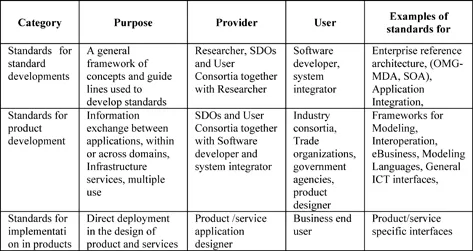
Another categorization could be made via a hierarchy of standards by organizing the standards according to their area of use. Such a hierarchy identifies levels for: i) standards for the development of standards, ii) standards for product development guidelines/constraints and iii) standards to be implemented in marketable products or services. This distinction separates the core standards mentioned above into two distinct levels, but defines content standards as standards to be implemented in products or product relevant standards.
The highest level of this hierarchy provides general standards, which identify basic concepts, their relationships and rules to guide their application in the standards development work. Examples are ISO/IEC 42010 “Systems and Software Engineering — Architectural Description” and ISO 15704 “Reference-base for Enterprise Architectures and Models” [5]. Such general frameworks are usually results of R&D work in both industry and academia and are brought into standardization by people involved in the R&D work. Such people have to stay involved in the full standardization process to achieve the successful completion of those standards.
The next lower level of the hierarchy identifies standards that define standardized means used to represent the content of implementable standards and guidelines for their development. However, such means usually cover a wide range of application areas and therefore these standards usually have multiple uses. Examples are standards for explicit usage for encoding data formats, like ISO/IEC 19776-1:2009: “Extensible Mark-up Language” (XML) or infrastructure standards like OMGs “Web Services for Business Process Execution Language” (WS-BPEL), or stan...