- A book about how local space, place, environment and landscape are shaped by military presence, and about how wider geographies are touched by militarism.
- Sets a new agenda for the study of military geography with its critical analysis of the ways in which military control over space is legitimized.
- Explores the ways in which militarism and military activities control development, the use of space and our understanding of place.
- Focuses on military lands, establishments and personnel in contemporary peacetime settings.
- Uses examples from Europe, North America and Australasia.
- Draws on original research into the mechanisms by which the British government manages the defence estate.
- Illustrated with maps, plans and other figures.
- English
- ePUB (mobile friendly)
- Available on iOS & Android
eBook - ePub
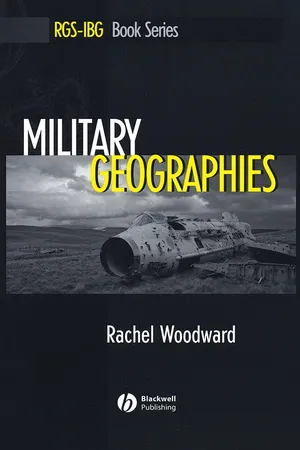
Military Geographies
About this book
Military Geographies is about how local space, place, environment and landscape are shaped by military presence, and about how wider geographies are touched by militarism.
Information
Chapter One
Military Geography, Militarism’s Geographies
Military Geographies are Everywhere
I stood at the fence and looked in through the wire. On the other side lay a broad strip of grass. A little further on and to the left, sat red-and whitepainted wooden baffle boards, mounted with lights. Further on from that, the dull, grey strip of runway stretched off into the distance. At the far end huddled a collection of structures and objects in shades of green, grey and black, unidentifiable from this distance. Occasional pops from rifle fire, perhaps, competed with the traffic noise from the road beside me. Crows hopped around on the empty runway. I poured a cup of coffee from my vacuum flask, watched and waited. Engine noise grew louder and then a dark blue pick-up truck with US-style police lights and a foreign numberplate came driving swiftly up the service road alongside the runway, slowing as it rounded the end, and then halting, to my right. I’d been seen, a coffeetoting speck beyond the perimeter fence at the bottom of the runway. The pick-up drove right to left in front of me, 30 m distant, two beret-topped heads swivelled in my direction, watching me as I watched them. The truck drove on to the baffle boards, executed a quick three-point turn and came back, left to right. It paused, watching. Another three-point turn, another traverse in front of me, another pause, engine running. I drank my coffee and ate a chocolate bar, wrapper stowed carefully in my pocket (the sign in a nearby lay-by, where I had parked, warned ‘Civic Amenities Act 1967 No Litter Penalty £100’). My focus swam with the effort of switching, from watching wire 30 cm from my nose and buildings 3 km distant. I refilled my cup, balancing it on the final post of a smaller fence perpendicular to the wire barrier (‘MoD Keep Out’) mindful of the sign on the larger fence (‘Ministry of Defence (Air) Anyone Attempting to Enter will be Detained and Arrested’). My movements sparked activity; the truck did another sweep, left to right, three-point turn, right to left, pause, engine idling, watching me as I watched them, drinking my coffee. They watched, I watched, and I realized that this was a stand-off; they were waiting for me to do something. This is their job; waiting for people do to things. Well, this is my job. I watched back as I finished my coffee, capped flask with cup, turned and walked back to my car, feeling their eyes on my back.
As I sat taking off my boots, a police car passed me, turned next left and appeared to double back through some bracken. I drove off and followed it, past another fence and another sign (‘Wildlife Protection Area; Please Don’t Park on Verge’) ending up in an aircraft viewing area at the far edge of the runway (‘MoD accepts no responsibility for loss or damage to property’) beyond the boundary marked out by the perimeter fence. The carpark was half-filled by the cars of a collection of middle-aged male aviation enthusiasts on a Sunday outing, who clustered around the police car. I parked, got out my road atlas, and wound down the window so that I could hear what the policeman was saying. ‘Anyone near that fence line is suspect…’ he was telling the plane spotters; their expressions mixed worry that they’d strayed over the line, with concern for the fight against whichever evil infiltrator might dare to stand near the fence in a suspicious way.
This Sunday lunchtime security encounter could have happened anywhere; Tom Vanderbilt and Richard Misrach describe similar events during their travels around Nevada (Vanderbilt, 2002; Misrach, 1990). In fact, it was at RAF Lakenheath, home of the United States Air Force 48th Fighter Wing, a base for F15 jets and the 5,000 US military personnel and 2,000 US and British civilians who service them, located on the A1065, 80 km or so north-east of Cambridge, England. A place where looking through fences causes Sunday lunchtime security jitters amongst those charged with the defence of this military space. Where every fence, every road, every boundary bears a sign marking out this military territory. Where the US Air Force works, rests and plays (a golf course is strategically placed between the main road and important structures), endlessly rehearsing to perfect its fighting capabilities, a little piece of America in the middle of the Cambridgeshire countryside. Where the British police close public highways with concrete blocks by military order. Where a church stands forlorn and isolated in a field of maize, broken belfry windowframes waving in the wind, the roof sagging, deconsecrated by military order. Where wildlife is protected by military order. Where military orders create their own geographies, where these geographies of military activity are writ large on the physical and social landscape, where these geographies exert webs of moral control and where I, for a fraction of time, caused a security alert, because I violated this order by standing on a scrap of grass, next to a public highway, looking through a fence.
This book is about the military geographies of places like Lakenheath. It is about how militarism and military activities create spaces, places, environments and landscapes with reference to a distinct moral order. It is also about how wider geographies are touched and moulded, more indirectly, by militarism and the activities of military forces. This book is about how military geographies are constituted and expressed. Its central theme is that militarism and military activities in nonconflict situations exert control over space in ways and through means which frequently render this control invisible, in contrast to the more obvious controls exerted by military forces during and following armed conflicts. This control is both material and discursive.
The definition of militarism used here is of militarism as ‘an extension of military influence to civilian spheres, including economic and sociopolitical life’ (Thee, 1980, p.15). Militarism at its most extreme is an ideology which subordinates civic or governmental ideals to the military, and promotes a policy of aggressive military preparedness, but militarism may not necessarily be manifest in these ways. Militarism as the extension of military influence into economic, social and political life is culturally, locationally and temporally specific. The intention of this book is not to define typologies of militarism from which different geographical consequences can be read, or systematically to document militarism’s geographies in states around the world. Rather, the intention is to describe and explain how some specific geographies – configurations of entities and social relations across space – are shaped by militarism, with a view to explaining how the controls exerted by militarism operate across a range of contexts. Militarism and the controls it exerts is essentially geographical, in that it is expressed in and constitutive of space, place and landscape, and those outcomes are variable, nuanced and fluid, rather than uniform in cause and effect and immutable in consequence. Military geographies are everywhere. They – and their study – are inherently political, in that they are about the imposition, negotiation and (sometimes) the challenging and checking of control over people, place and space. Understanding the patterns of entities and social relations across space – across the globe – requires taking account of military power and its role in shaping these patterns. Militarism’s geographies are about the control of space, about creating the necessary preconditions for military activities.
Military geographies are everywhere; every corner of every place in every land in every part of this world of ours is touched, shaped, viewed and represented in some way by military forces and military activities. Military geographies are made by a bewildering range of actions – a soldier’s footprint, a landowner’s custody, an invader’s force, an occupier’s presence. The manufacture of weapons, the destruction caused by armed conflict, the construction of military facilities, and the pollution of conventional and nuclear weapons all mark the earth. Military activities, an endless cycle of preparations for waging war, and war itself, define countless lives. People fight, flee, defend, work, live, conquer, celebrate, suffer and die, scratching their progress and their demise onto place under circumstances defined by militarism in its various national guises. Castles and bastles, forts and ports, depots and silos, bases and training spaces are built, used and relinquished. Military geographies are representational as well as material and experiential. Military maps and information systems name, claim, define and categorize territory. Infantry and artillery and armoured regiments analyze terrain. Spy planes and satellites scan from above, watching. Military geographies surround us, are always with us.1
Yet this is not a book about war and geography. War – an increasingly catch-all term for the active, direct engagement between armed forces in conflict – is the most obvious manifestation of military activity and militarism. It is the culmination of these. It is the most visible and destructive of a range of military activities inspired or guided by militarism. It is the end product of these military activities and expression. This book is not about the geographies of armed conflict, or military operations other than war, or the logics, motivations and explanations for warfare. Rather, it looks at how the continual preparations which states make in order to be able to wage war and engage in military operations shape wider economic, social, environmental and cultural geographies, and produce their own ordering of space. This choice is deliberate, guided by an interest in the geographies of those activities which make armed conflict possible. This is not to imply that the geographies of armed conflict are not of significant concern to warrant study, but instead to argue that a wider set of geographies shaped by preparations for war and by militarism and military control merit consideration in their own right. Furthermore, given the rich contemporary literatures emerging in critical geopolitics, given political geography’s long engagement with the causes and consequences of struggles over territory and sovereignty, and given an even older fascination amongst some geographers with matters of terrain and tactics, I have been reluctant to revisit the well-trodden ground of war and its geography.2 War and its geography constitute the apex of a pyramid; this book is concerned by the imprint marked by that pyramid’s base.
The Invisibility of Military Geographies
This book focuses on the geographies constituted and expressed by the material practices of military activities and the discursive strategies of militarism. These are the baseline and backroom activities which structure and facilitate armed conflict. They have received far less sustained scholarly attention than conflicts themselves. As O´ Tuathail (1996) remarks, contemporary geography rarely gives militarism the attention it deserves, despite the profound and destructive influence of militarism on the twentieth century.
The absence of ‘military geographies’ within standard introductory undergraduate texts in human geography would seem to bear this out. Early on the life in this book, restless in my University’s library, I browsed through some definitional geography texts and their indexes in search of my favourite keywords – ‘war’, ‘military’, ‘defence’ and ‘army’ – and anything else that took my fancy. This impulsive and nonscientific exercise was revealing in its own way.
The Student’s Companion to Geography (Rogers and Viles, 2003) contained nothing. This ‘essential resource for those studying geography at university...[with] contributions from leading geographers from around the world provide[s] a whole range of information on what today’s geography is all about...’, judging by the blurb on the back cover. It certainly looks like a really useful book. But not if you’re looking for geography’s disciplinary engagement with militarism and its consequences. My keywords are absent. The second edition of The Dictionary of Human Geography (Johnston, Gregory and Smith, 1986) contained no military anything – no armies, navies, airforces, soldiers. One index reference for ‘defence, national’ referred back to an entry on ‘public goods’. ‘Air space and concept of boundary’ referred back to the ‘boundaries’ entry (which also includes territorial waters). ‘War, representation of demographic consequences’ referred back to a population pyramid for France in 1984 showing clearly the low birth rate following the end of the 1914–18 war. In the fourth edition of The Dictionary of Human Geography (Johnston, Gregory, Pratt and Watts, 2000), military geography still doesn’t get its own entry; we move straight from migration to mimesis. From the index, ‘War: boundary dispute as cause’ leads us to ‘sovereignty’; ‘war: geographers’ role during’ leads us to ‘Applied Geography’ and a discussion about geographers’ roles in military intelligence activities; ‘war: and sense of place’ leads us to battlefields and ‘war memorials’ leads us to ‘monuments’. I’m more lucky with A Feminist Glossary of Human Geography (McDowell and Sharp, 1999). There between migration and mimesis, sits ‘military/militarism’, which outlines the arguments for understanding the gendering of militarism through the construction and representation of gender identities and potential enhancement or limitation of women’s roles that this brings. In Geographies of Global Change: Remapping the World (Johnston, Taylor and Watts, 2002) I find even more: ‘military Keynesianism’, ‘military, technoscientific’, ‘war memorials’, ‘weapons’, ‘armaments industry’, and a whole section on geopolitical change. It’s a start.
This exercise is indicative of the peripherality of militarism and its geographies within the disciplinary structures which define academic geography. It is there, within the spaces defined by political geography and its concerns with territoriality and sovereignty. It is there in feminist critiques of the social construction of gender relations. But military geographies as the object of sustained scholarly interest within the discipline appear to be absent.
Appearances are deceptive. The connections between geography as an academic discipline concerned with descriptions of the world, and military issues, are drawn explicitly in Military Geography. Military Geography has disciplinary status primarily in North American geography, via the Association of American Geographers’ Military Geography Speciality Group (MGSG).3 For the MGSG, Military Geography is ‘… the application of geographic information, tools, and techniques to military problems’, focussing on the range of military scenarios from peacetime to war (Palka and Galgano, 2000, p.xi). It is concerned primarily with how military activities and armed conflict are shaped by terrain and environment. Military Geography has a long history, its roots tangled up with the imperial ambitions and military requirements that late-nineteenth-century Geography emerged to serve. Yet as an academic discipline, Military Geography has failed to evolve. The application of topographical and environmental knowledge to the conduct of military campaigns, and the strategic and tactical considerations to be taken into account, were set out by T. Miller Maguire in 1899 (Maguire, 1899). Over the twentieth century and into the twentyfirst this understanding of Military Geography held fast (see Peltier and Pearcy, 1966; O’Sullivan and Miller, 1983; O’Sullivan, 1991; Winters et al, 1998; Palka and Galgano, 2000; O’Sullivan, 2001).
What explains this evolutionary stasis? Palka and Galgano’s lament is telling:
The demise of military geography among universities and academics coincided with the widespread social and political unrest that occurred in America during the mid-1960s and early 1970s. During that era, anti-war sentiments and a general mistrust of the federal government prompted geographers to become increasingly concerned with being socially, morally, and ecologically responsible in their research efforts and professional affiliations with government agencies. Contributing to the war effort in Vietnam came to be regarded as irresponsible by many members of the AAG. The controversy surrounding the Vietnam War cast a persistent shadow on military geography as an academic discipline throughout the 1970s. (Palka and Galgano, 2000, pp. 3–4)
Controversy surrounding US military engagement in Vietnam was essential in shaping contemporary Anglo–American geography. Opposition to the war politicized a small group of geographers working in (primarily) British and American universities in the late 1960s and early 1970s. ‘Radical Geography’ as a disciplinary marker for a politicized Leftist human geography emerged as a movement bent on transforming the scope of the conventional discipline. This group criticized the discipline as irrelevant to pressing political issues of the time such as the movement for civil rights, opposition to the Vietnam War and protest at the irreversible consequences of environmental pollution (Peet, 2000). Suggestions for the politicization of Military Geography were there; an influential collection of essays on Radical Geography (Peet, 1977) includes a chapter by Lacoste (1977) on the need to link geographical discourse with political and military interests, an argument which forms the basis of his analysis of the links between topography, environment and military campaigns in North Vietnam. It is an essay of its time. ‘Many geographers today honestly consider their ‘‘science’’ as detached knowledge’, notes Lacoste, an observation hardly possible in the contemporary discipline with its concerns about relevance and political engagement. The discipline of Geography has gone on to embrace radical and critical approaches, informed by structuralist and poststructuralist social theory. The study of armed conflicts and their geographies has moved on from topographical and environmental concerns, via the concerns of political geography to the critiques of critical geopolitics. Military Geography has been left standing, the subdisciplinary label indicative of an applied, largely atheoretical spatial science, unconcerned with a wider conceptualization of the geographies constituted and expressed by militarism and military activities, and bounded closely by US military and state discourses of state, nationhood, sovereignty and security.
Does any of this matter? Are dictionary entries and the disciplinary framework of the AAG important here? On the one hand, no, they are not. The disciplinary name-tags which we give to scholarly endeavour are just that, labels to stick on for ease of identification. Within a social science that is increasingly inter-disciplinary (or even post-disciplinary), the content and intent of scholarship is more important than the demarcation of artificial boundaries with which we can categorize that scholarship. Yet labels are useful, sometimes. Naming things is a political strategy. Naming things makes them visible, draws attention to the content and intent of that scholarship. So, on the other hand, the identification tags and disciplinary definitions are useful. ‘Military geographies’ is, for me, a useful label, and one which will be used throughout this book. It is useful because it grants visibility to the geographies of militarism and military activities which are traced in this book, geographies which, in my view, should form a more central part of the contemporary geographical project as currently researched and taught in Anglophone Geographic communities. It is useful because it provides at the very least a brand name with which to market this scholarly enterprise within the discipline. The label is useful also because it makes military geographies an issue. As I go on to argue in subsequent chapters, discourses of militarism legitimize and naturalize the activities undertaken by the state in preparation for armed conflict. This naturalizing obscures their geographies and consequences from critical gaze, and facilitates the military control of space. This normalizing legitimizes secrecy about land uses in the name of national defence and national security. Talking explicitly about military geographies makes these things an issue.
Doing Military Geography
This book, then, is about the geographies of militarism and military activities – their impacts on space, place, environment and landscape. The ideas driving the analysis are straightforward.
In the beginning, there is description. In doing geography, we write about the earth, and that writing necessarily requires us to document what is there and what is where. This is an important task in its own right, but also has its limits. Description of what is where doesn’t automatically bring with it an explanation of what happens as a consequence of things being where they are. Explanation follows from description – the ‘why?’ of ‘where?’. This involves explanation of location and explanation of process and change. So far so good; as far as writing these military geographies is concerned, this would involve choosing places or themes to look at, describing the material form and lived experience of those military geographies, and seeking explanations for these geographies with the help of the insights from contemporary social scientific research and social theory.
In doing this, my attempts to think through and write out military geographies kept getting snagged and held back by military explanations of its own geographies. Each journey through a particular theme stumbled into arguments originating in military organizations and armed forces. These were insistent arguments, about why military geographies appear as they do. They were often very seductive justifications as to why these military geographies should be so, and had to be so. Representation seemed to be an important theme in military geographies, as the means by which the mechanisms and strategies of military control were explained, normalized and naturalized. Representation as a strategic military act emerged as a central problematic to the writing of military geographies.4 These military representations constitute some of the many discursive practices of militarism. Writing military geographies seemed more and more to be about understanding representation as a practice of militarism, and less and less about explanation rooted in more abstract structural conceptions of militarism as an ideology.
Three observations follow from this. The first observation is that this focus on representation brings the situated nature of knowledge to the fore. I don’t look down the wrong end of the barrel of a gun on a regular basis. This fact about my situation or positionality seems to me significant in my prioritizing representation as I do. The second observation is that this representational approach emphasizes the specificity in time and space of militarism and its geographies. Military geographies are always shifting and changing; the ones I focus on are contemporary, reflecting research and fieldwork conducted from 1996 to 2002. The third observation is that this understanding of military geographies as changeable brings with it possibilities for negotiation and challenge. This makes the writing of military geographies less concerned with just understanding geographies of militarism and more aware of our responsibilities to think coherently and critically about the moral authority on which military geographies are based. Ultimately, the study of military geographies involves a moral decision. If we study the ways in which military activities inscribe themselves onto space, place, environment and landscape, should we ignore or accept unquestioned the politics of that process? There are those, I’m sure, who would argue for the possibility of objective, politically neutral military geography. I am not one of them. Studying military geographies means making a moral judgement about the need to think critically about militarism. It involves questioning the moral authority of militarism, the rights and wrongs of the use of violence in pursuit of political and economic ends, and the morality of the consequences of military preparedness. Whether the outcome of that critical analysis is to our collective liking, and whether we agree with this moral understanding of the forces shaping military geographies, is a different matter. The point, to me, is that military geographies are not politically neutral, and our study of military geographies should not pretend otherwise.
These observations influenced the themes that I chose for study in this book. The themes are geographies of control over space, military economic geographies, military environmentalism, militarized landscapes, and challenges to military geographies. They were all chosen for what they could illustrate about the influen...
Table of contents
- Cover
- Series Page
- Title page
- Copyright
- Figures
- Acknowledgements
- Preface
- Abbreviations
- Chapter One: Military Geography, Militarism’s Geographies
- Chapter Two: Military Space
- Chapter Three: Military Economic Geographies
- Chapter Four: Militarized Environments
- Chapter Five: Military Landscapes
- Chapter Six: Challenging Military Geographies
- Chapter Seven: The Study of Military Geographies
- Notes
- Bibliography
- Index
Trusted by 375,005 students
Access to over 1.5 million titles for a fair monthly price.
Study more efficiently using our study tools.
Frequently asked questions
Yes, you can cancel anytime from the Subscription tab in your account settings on the Perlego website. Your subscription will stay active until the end of your current billing period. Learn how to cancel your subscription
No, books cannot be downloaded as external files, such as PDFs, for use outside of Perlego. However, you can download books within the Perlego app for offline reading on mobile or tablet. Learn how to download books offline
Perlego offers two plans: Essential and Complete
- Essential is ideal for learners and professionals who enjoy exploring a wide range of subjects. Access the Essential Library with 800,000+ trusted titles and best-sellers across business, personal growth, and the humanities. Includes unlimited reading time and Standard Read Aloud voice.
- Complete: Perfect for advanced learners and researchers needing full, unrestricted access. Unlock 1.5M+ books across hundreds of subjects, including academic and specialized titles. The Complete Plan also includes advanced features like Premium Read Aloud and Research Assistant.
We are an online textbook subscription service, where you can get access to an entire online library for less than the price of a single book per month. With over 1.5 million books across 990+ topics, we’ve got you covered! Learn about our mission
Look out for the read-aloud symbol on your next book to see if you can listen to it. The read-aloud tool reads text aloud for you, highlighting the text as it is being read. You can pause it, speed it up and slow it down. Learn more about Read Aloud
Yes! You can use the Perlego app on both iOS and Android devices to read anytime, anywhere — even offline. Perfect for commutes or when you’re on the go.
Please note we cannot support devices running on iOS 13 and Android 7 or earlier. Learn more about using the app
Please note we cannot support devices running on iOS 13 and Android 7 or earlier. Learn more about using the app
Yes, you can access Military Geographies by Rachel Woodward in PDF and/or ePUB format, as well as other popular books in Social Sciences & Urban Sociology. We have over 1.5 million books available in our catalogue for you to explore.