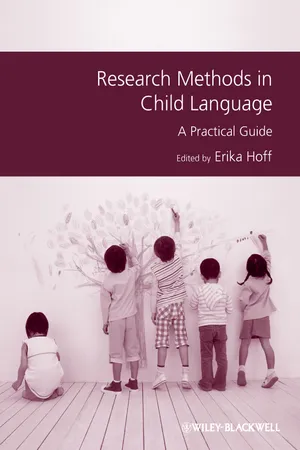
- Presents a comprehensive survey of laboratory and naturalistic techniques used in the study of different domains of language, age ranges, and populations, and explains the questions addressed by each technique
- Presents new research methods, such as the use of functional Near Infrared Spectroscopy (fNIRS) to study the activity of the brain
- Expands on more traditional research methods such as collection, transcription, and coding of speech samples that have been transformed by new hardware and software
- English
- ePUB (mobile friendly)
- Available on iOS & Android
eBook - ePub
About this book
This is a comprehensive and accessible guide to the methods researchers use to study child language, written by experienced scholars in the study of language development.
Information
Part I
Studying Infants and Others Using Nonverbal Methods
1
Habituation Procedures
Christopher T. Fennell
Summary
In this chapter, the habituation technique will be described in detail, with a focus on infant visual habituation tasks. This easy-to-implement procedure can be used to measure many domains of early language development; however, it has been primarily used to test questions of language discrimination and word learning. In a typical experiment, an infant sits on a parent’s lap, or in an infant seat, listening to a repeated sound or word, which can be paired with a visual display. Once her response (e.g., sucking, heart rate, orienting behavior) decreases to a preset criterion, a test trial is presented where the sound or word changes. An increase in response indicates successful discrimination and potential learning of the sound or word. Key advantages of habituation tasks are their use of autonomic responses, broad age range from fetuses to adults, and applicability to multiple populations, including typically and atypically developing children.
“Your child will get bored, and that’s ok.” Many of us who use habituation to study language development state this to the parents of our participants. In a world of infant videos, playgroups, and exciting toys, the idea that we can glean rich knowledge from purposefully boring an infant can seem strange. Yet, this statement essentially encapsulates the habituation task, a procedure that has answered fundamental questions about early language acquisition and continues to be of great use to the field of developmental psycholinguistics.
Research Aim
The concept of habituation has a long history in psychology, with forefathers like Wundt and Thorndike exploring human adaptation to a recurring stimulus. Simply defined, habituation is the progressive reduction of an organism’s behavior in response to a repeated stimulus. Importantly, the reduction in behavioral response is thought to demonstrate both memory encoding of the stimulus and potential learning. However, as Cohen (2004) and others have stated, the decrease of a response over time may not involve true habituation. The organism may just be fatiguing in general, which may be especially true of infants and children. Thus, habituation procedures require the introduction of a stimulus change after the habituation phase ends. If the organism demonstrates an increase in target behavior in response to the change, the researcher can now state with greater confidence that participants remembered and learned the habituation stimulus on some level. This particularly allows for tests of discrimination by using a similar, but novel, stimulus at test.
Despite its long history, it was not until Fantz’s (1964) seminal article that infant habituation was broadly introduced into psychological research (see also Golinkoff and Hirsh-Pasek, Chapter 5 this volume). Over the past three and a half decades, there has been an explosion of infant habituation studies, with such pioneers as Leslie Cohen contributing much to our understanding of using this technique with this population. In language development research, habituation tasks have tested such diverse aspects of infants’ language abilities as their ability to tell one language from another, the specificity of their phonological representations (e.g., discriminating a /b/ sound from a /d/), their ability to learn word–object associations (e.g., pairing a novel word with a novel object), and their ability to learn grammatical rules (e.g., learning a word order pattern where nonsense syllables follow an ABA configuration like wo fe wo, and then noticing violations of that arrangement – an ABB pattern like li gi gi).
Why have infant habituation procedures enjoyed such broad use? First, while the response measured could be theoretically any form of behavior, it often involves an autonomic physiological response such as sucking, heart rate, or orienting behavior (e.g., looking). This is critical because overt conscious behaviors are harder, and sometimes impossible, to elicit in the prenatal through infant phases of development, exactly when important language abilities are unfolding. Further, these autonomic responses are valid measures across wide populations of participants, including different species, both typically and atypically developing populations, and – most importantly for developmental studies – a wide range of age groups, from fetuses to adults. Using the same task across ages is optimal, as it is difficult to track development when using a variety of different methodologies, each with its own task demands. Another strength is the breadth of possible stimuli; any repeated stimulus is a potential candidate, including phonemes, stress patterns, words, signs, sentences, etc. Finally, and perhaps most importantly, habituation reflects the cognitive structure of the infant mind. Infants’ ability to habituate and react to novel stimuli is so fundamental that it is part of neonatal assessment (Brazleton Scale) and correlates with later cognitive skills (Berg and Sternberg, 1985).
Procedure
In my own research, I have found the habituation task to be invaluable. I examine infants’ abilities to detect and use the smallest meaningful units of sound in a language: phonemes. For example, /b/ and /d/ are English phonemes because they denote meaningful differences in words, like “bad” and “dad.” I and my colleagues, chief among them Janet Werker, have used visual habituation tasks to investigate whether infants can discriminate two phonemes in speech perception and if they can then use that same phonological information when acquiring words in the lab. It is a testament to the power of the task that we can use the same procedure to answer both phonetic and lexical questions over various points of development.
It is no surprise that habituation tasks are commonly used to investigate phoneme distinction in infants, as they are designed to be tests of discrimination. But, why choose habituation over other available methodologies? The main advantage of habituation over its main competitor, the conditioned head turn procedure (CHT), is its use of autonomic responses. CHT, on the other hand, involves an initial phase where infants, via operant conditioning, are rewarded for turning their heads when hearing a stimulus change. This places extra demands on infants and the experimental setup, as CHT requires two experimenters and more equipment (i.e., a reward stimulus – usually an animated toy that is triggered by the first experimenter). Further, CHT cannot be reliably used under 6 months of age, yet a large portion of language development, especially that concerning phoneme perception, occurs prior to this age. However, one advantage of CHT over habituation is that one can meaningfully interpret a single individual’s data, as there are multiple change trials. Thus, one can see if an infant can reliably discriminate two stimuli, which is of great importance for clinical applications. The visual habituation task, however, typically involves only one change trial (the novel trial). It is therefore difficult to interpret an individual’s data, as she may have had increased, decreased, or equivalent looking times to the novel stimulus compared to a habituation stimulus for any number of reasons (e.g., fatigue, distraction, etc.). For this reason, we can only interpret group data in habituation studies.
Another alternative test of infant phoneme discrimination is the event related potential (ERP) methodology, which measures electrical neural responses to stimuli via electroencephalography (EEG) (see Kovelman, Chapter 4 this volume). There is a standard ERP produced, called the mismatch negativity response, when we detect a change in auditory stimulus. However, more expensive resources and longer experimenter training are required to use ERP than to use the habituation method. Further, there is an added level of difficulty in setup and a corresponding higher level of attrition.
Having chosen a habituation task to test phonological discrimination, for example, it is important to select the appropriate response behavior. Early infant habituation researchers used heart rate and sucking behaviors as dependent variables, demonstrating that these responses decreased as an auditory, olfactory, or visual stimulus repeated. While these measures are less common in modern research, they are both valid, especially with certain populations. For example, during the fetal period, heart rate is one of the few possible behavioral measures. Kisilevsky et al. (2009) demonstrated that fetuses will show a novelty response of increased heart rate to maternal speech after being familiarized to a female stranger’s speech. In the neonatal and early infancy period, sucking can be preferable to orienting behaviors, such as head turning and looking, given that the very young infant has limited head control and an underdeveloped visual system. Indeed, the first study to demonstrate that young infants can categorically perceive phonemes used a habituation paradigm with sucking as the dependent measure (Eimas et al., 1971). In another example, Shi, Werker, and Morgan (1999) used this response to establish that newborns can discriminate a spoken list of grammar words (e.g., “in,” “on”) from a list of nongrammatical, or content, words (e.g., “mommy,” “chair”). However the major drawback of using heart rate and sucking measures is that they require monitoring equipment to be in contact with infants’ bodies: an electrocardiogram or a pacifier outfitted with a pressure transducer. These can be expensive and subject to equipment problems. Sucking is also limited in terms of the age range: a 20-month-old may not easily accep...
Table of contents
- Cover
- Table of Contents
- Series
- Title
- Copyright
- List of Figures
- List of Plates
- Notes on Contributors
- Acknowledgments
- Preface
- Part I: Studying Infants and Others Using Nonverbal Methods
- Part II: Assessing Language Knowledge and Processes in Children Who Talk
- Part III: Capturing Children’s Language Experience and Language Production
- Part IV: Studying Multiple Languages and Special Populations
- Plates
- Index
- End User License Agreement
Trusted by 375,005 students
Access to over 1.5 million titles for a fair monthly price.
Study more efficiently using our study tools.
Frequently asked questions
Yes, you can cancel anytime from the Subscription tab in your account settings on the Perlego website. Your subscription will stay active until the end of your current billing period. Learn how to cancel your subscription
No, books cannot be downloaded as external files, such as PDFs, for use outside of Perlego. However, you can download books within the Perlego app for offline reading on mobile or tablet. Learn how to download books offline
Perlego offers two plans: Essential and Complete
- Essential is ideal for learners and professionals who enjoy exploring a wide range of subjects. Access the Essential Library with 800,000+ trusted titles and best-sellers across business, personal growth, and the humanities. Includes unlimited reading time and Standard Read Aloud voice.
- Complete: Perfect for advanced learners and researchers needing full, unrestricted access. Unlock 1.5M+ books across hundreds of subjects, including academic and specialized titles. The Complete Plan also includes advanced features like Premium Read Aloud and Research Assistant.
We are an online textbook subscription service, where you can get access to an entire online library for less than the price of a single book per month. With over 1.5 million books across 990+ topics, we’ve got you covered! Learn about our mission
Look out for the read-aloud symbol on your next book to see if you can listen to it. The read-aloud tool reads text aloud for you, highlighting the text as it is being read. You can pause it, speed it up and slow it down. Learn more about Read Aloud
Yes! You can use the Perlego app on both iOS and Android devices to read anytime, anywhere — even offline. Perfect for commutes or when you’re on the go.
Please note we cannot support devices running on iOS 13 and Android 7 or earlier. Learn more about using the app
Please note we cannot support devices running on iOS 13 and Android 7 or earlier. Learn more about using the app
Yes, you can access Research Methods in Child Language by Erika Hoff in PDF and/or ePUB format, as well as other popular books in Languages & Linguistics & Linguistics. We have over 1.5 million books available in our catalogue for you to explore.