![]()
CHAPTER 1
INFORMATION AND COMMUNICATION TECHNOLOGIES FOR EVERYONE
INNOVATIVE WAYS TO REACH THE MAJORITY OF THE WORLD
Information and communication technologies (ICTs) have revolutionized our lives by changing the ways we live, play, work, communicate, learn, manage our finances, and stay healthy. But for people living in the poorer areas of our planet—usually areas with insufficient infrastructure, environmental challenges, weak governance, and few resources—this is not the case. The majority of the world’s people—the four billion at the bottom of the global economic pyramid—remain largely unable to capitalize on the ICT revolution.
Why? There are many reasons, but the primary ones are:
- Technology is usually not affordable; it’s too expensive in relation to their purchasing power.
- Technology is often not relevant to their needs.
- Technology may not be accessible because the context in which it was designed—for a literate, affluent, educated population—is very different.
What if we could change all this? What if ICTs were affordable, relevant, and accessible? What impact would that have on reducing poverty and improving lives? What barriers need to be overcome before that can happen? What innovation is required? What partnerships need to be forged? Are there lessons from other arenas such as consumer products that might be applied? What could multinational corporations (MNCs), nongovernmental organizations (NGOs), governments, and most important, individual entrepreneurs do to facilitate the process?
A COMPUTER FOR EVERY CHILD—A GREAT IDEA, BUT . . .1
The vision of One Laptop per Child (OLPC) generated significant enthusiasm. It was seductive to imagine solving the world’s education problems by giving an inexpensive $100 PC to every child. However, the impact fell short of the lofty expectations. The cost, low by developed countries’ standards, still represented a big fraction of the annual income of the target audience. It was still a PC, which meant it needed a usable electric grid, which is unreliable in most developing countries. It also needed literate people to use it, which made it inaccessible to more than 40 percent of the population in some countries. Furthermore, these machines are sophisticated and powerful, and require high expertise to maintain and service them, which was another missing element. And most important, the magic of hardware comes to life through great software. Since the purchasing power of this group was perceived as low, vendors did not invest in creating compelling software applications for them, further reducing the case for buying the laptops.
After many years and millions of dollars of investment by the countries least able to afford it, the outcomes have fallen short of the expectations. Few machines were built and sold. The ones that were built will probably face a limited future since there is no ecosystem and capacity to repair and maintain them. The impact, such as it was, was instead felt in developed economies where the specter of OLPC forced PC makers to reduce costs and come out with a new and competitive category of Netbooks.
These are some of the questions and possible solutions we explore in this book, drawing from actual successes and failures from the field.
What Are the Needs of This Group?
Poverty is more than just a lack of money—it is a lack of opportunity, rights, and resources. It is created by ill health and poor or no health care, inadequate housing and transportation, illiteracy, and racial and gender discrimination. It can be affected by things as personal as one’s actions and as uncontrollable as the weather. Poverty is caused by things as small as lacking a few dollars of credit and as large as war, national debt and international trade policies.
—Shannon Daley-Harris, Jeffrey Keenan, and Karen Speerstra, Our Day to End Poverty
Every day, facts wash into our minds and seep out again nearly as quickly. Throughout this book, we’ve highlighted some of the facts you might wish to remember. But one fact that has been bandied about for the past few years bears considering here: Nearly half of the world lives on less than $2 a day. They live on today’s food, today’s energy, today’s clothing, and today’s chances of staying alive.
They need to augment their meager incomes. They need to provide food and shelter. They need to take care of their health and the health of their children. They need to educate their families and learn more themselves. They need to learn to survive in a world short of resources and becoming more constrained each day.
But as we learned from The Next 4 Billion,2 there are still four billion consumers. They buy things, albeit usually at much higher cost than need be.
People at the base of the economic pyramid are customers with the power to choose—not simply “beneficiaries.”
—Ashish Karamchandani, Michael Kubzansky, and Paul Frandano, “Emerging Markets, Emerging Models”
Billions of consumers will be reached only by using innovative techniques and different business models from the ones in use in the rest of the world. As Prahalad and Hammond have said, “to reach them, CEOs must shed old concepts of marketing, distribution and research.”3
Can ICT Really Help?
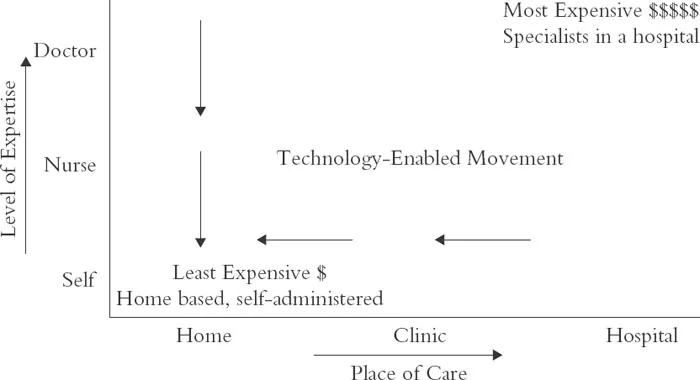
Yes it can—by reducing transaction costs and by reducing the level of skills required to deliver services. Take, for example, efforts to provide health-care services at a fraction of the cost of similar services in the developed world.
As Figure 1.1 illustrates, costs of health-care services provided are largely determined by the location where those services are provided and by the skill level of the person providing those services.4 Services provided in a hospital tend to cost more than those provided by clinics. Similarly, doctors cost a lot more than nurses. One way to reduce costs is to provide the same service, with similar health outcomes, in a cheaper place, and performed by a less skilled person. As we show in Chapter 2 on health care, ICTs can help achieve that goal. This is critical in an inequitable world where there will never be enough doctors or hospitals for everyone.
This cost reduction in providing essential services is really key to providing affordable access in tightly resource-constrained environments, as is the ability to provide sophisticated services with less trained people. Pursuing this vision has forced technologists, businesses, academics, leaders, and practitioners alike to think and act more creatively. We have had to move away from our trusted old business models based on wealthy customers’ ability to purchase goods and services. Technology must be designed to respect the constraints of the environment and the needs of different groups. When they are ignored, the product or service is doomed to fail.
The fact of the matter is that in this world of limited resources we will never have enough doctors, teachers, or bankers to meet the needs of all people in the world. We have no option but to explore (1) ICT and other innovations targeted at poor populations, (2) new partnerships between the for-profit and not-for-profit entities, and (3) new business models. While it’s certainly true that many multinational corporations have found ways to reach poorer consumers—look at fast foods and soft drinks—for-profit businesses cannot, or often will not, solve the challenges of reaching this huge base of potential customers on their own. Innovative partnerships with NGOs, international organizations, and local efforts must all be part of the solution.
That’s what this book is all about. Many researched efforts have performed well; some have failed miserably; other ICT methods we have yet to discover may provide positive solutions for many regions. Take, for example, KioskNet.
KIOSKNET TO THE RESCUE5
Internet kiosks, or telecenters, provide a great service for people who don’t have any other way to send and receive emails and photos or videos—when they work.
Unfortunately, within a few months of installation, all but a few fail. Frustrated users stop coming and, of course, investors become extremely skeptical. Computer kiosks are now empty for several reasons. Weak infrastructure offers intermittent electricity at best, and generators are expensive and require further maintenance. Dial-up often malfunctions in poor rural areas due to floods, landslides, wind-driven misaligned antennas, and faulty construction. Empty kiosks can be partially blamed on unstable software, malfunctioning PCs, and very few available high-cost technicians. No wonder that kiosk companies and collaborating partners become discouraged.
This seems like another good idea rapidly decaying by the wayside. Or is it? Enter KioskNet.
After a conference conversation in 2006, Professor Srinivasan Keshav of Canada’s University of Waterloo and his colleagues set out to outfit existing kiosks with cutting-edge wireless technology. KioskNet—a Microsoft-funded three-year research project—now involves more than 20 researchers and various collaborating supporters.
Take some solar panels to recharge the kiosk battery, they suggested. Add a recycled PC, a car battery to power the kiosk during power outages, and a controller box, and—here’s the interesting part—pick up the data accumulated in the kiosk server by using a computer mounted in a bus or truck that passes by on a regular basis. The “kiosk ferry” then drives by a “gateway” computer, which is always connected to the Internet, and transfers the kiosk data as well as picks up any data intended for the kiosks along the bus/truck ferry’s route. It’s a process called “Mechanical Backhaul” and was pioneered by the Massachusetts Institute of Technology’s (MIT’s) DakNet project for delivering data, but the MIT folks may not have thought of mounting it on an old car or bus. A small rechargeable computer inside the ferry has a WiFi card and storage and a routing protocol.
How about maintenance for outpost kiosk locations often plagued by heat and dust? Kiosk controllers need upgrading and patching from time to time and even semi–field technicians are few and far between. Researchers have devised a threefold backup centralized management and maintenance subsystem that zips and can send updates over one of three channels. It’s robust and tolerant and it works.
And here’s the best part: The KioskNet project gives away the software to make this work with no patent or copyright restrictions.
Of course, there is still the heat and dust, but creativity knows no bounds and those problems also can be solved by thinking “outside the kiosk,” as Keshav and his colleagues have proven.
It’s an exciting time to be facing the challenge of feeding, housing, and keeping healthy and safe the four billion and still protect the fragile environment we all call home. There are, however, many difficulties ahead.
WHAT ARE THE BARRIERS TO SUCCESS?
Many once believed that once everyone had access to the Internet, information and communication channels would become universally available. Not true.
Not all e-mail accounts are equal because not all social networks are equal.
—Kentaro Toyama, NetHope Summit, Redmond, WA, May 20, 2009
They also paid attention only to one-time costs when in reality even low-cost PCs at about $100 per child escalate up to another $250 per year per child when you add in replacement software, breakage, theft, connectivity charges and power, administration expenses, and teacher training.
Many businesses hoping to serve the four billion people at the bottom of the economic pyramid are unaware of the opportunities as well as the problems. For one thing, they have not fostered innovation that meets very different cultural needs. They may have overlooked, for example, that they’re designing ICTs for people who can’t read or write well and who may be living in an environment where electricity is at best only sporadically available. The businesses may not use appropriate business models since the ability to purchase technology goods is far lower than their usual customers’. They may be unaware of how to price, how to market, how to distribute, and how to nurture a sustainable chain of supply. And they may underestimate how long it will take to enter the market; in other words, they may lack foresight, experience, and patience.
Of course there are many other factors keeping our well-intentioned efforts from succeeding, such as lack of...