![]()
Part I
Building Blocks
![]()
1
Interest Rate
In this chapter we review the idea of interest rate and the closely related concepts of compounding and discounting.
1-1 Measuring Time
In finance the standard unit of time is the year. But can we safely assume that a year has 365 days? What about the 366 days of a leap year? What fraction of a year does the first six months represent: 0.5, or 181/365 (except, again, for leap years)?
Financial markets have regulations and conventions to answer these questions. The problem is that these conventions tend to vary by country. Worse still, within a given country different conventions may apply to different financial products.
We leave it to readers to become familiar with these day count conventions while in this book we will use the following rule, which professionals call 30/360 (Table 1-1 below). Note that the initial date starts at noon and the final date ends at noon; thus, there is only one whole day between 2 February 2012 and 3 February 2012.
Table 1-1 The 30/360 rule for measuring time
| 1. Count the number of whole years | Y | 3 (from 15 January 2012 to 15 January 2015) |
| 2. Count the number of remaining whole months and divide by 12 | M/12 | 1/12 (from 15 January 2015 to 15 February 2015) |
| 3. Count the number of remaining days (the last day of the month counting as the 30th unless it is the final date) and divide by 360 | D/360 | 28/360 (under the 30/360 convention there are 16 days from 15 February 2015 to 1 March 2015 at noon and 12 days from 1 March 2015 to 13 March 2015) |
| TOTAL | Y + M/12 + D/360 | 3 + 1/12 + 28/360 = 3.161111… |
From this rule we obtain the following simplified measures:
| Semester (half year) | 0.5 year |
| Quarter (three months) | 0.25 year |
| Month | 1/12 year |
| Week | 7/360 year |
| Day | 1/360 year |
In practice…
The Excel function DAYS360(Start_date, End_date) counts the number of days on a 30/360 basis.
1-2 Interest Rate
In business life one can encounter two types of individuals whose interests are by definition opposed to each other:
- Investors, who have money and want to get richer while they remain idle;
- Entrepreneurs, who don't have money but want to become rich using the money of others.
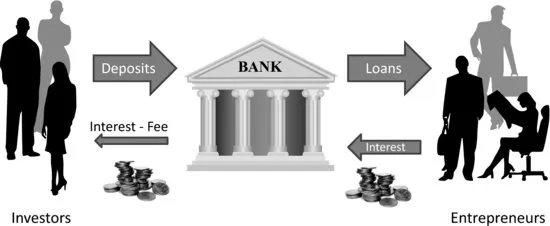
Banks help to reconcile these two interests by acting as intermediaries, placing the money of the investor at the entrepreneur's disposal while taking the risk of bankruptcy (see Figure 1.1). In exchange, the bank demands that the entrepreneur pay interest at regular intervals, which serves to pay for the bank's service and the investor's capital.
1-2.1 Gross Interest Rate
Consider an investor who deposits $100 and receives a total interest of $12 over 2 years. His gross 2-year interest rate is then 12%. Generally, if I is the total interest paid on a capital K, the gross interest rate over the period in consideration is defined as:
Examples
- €10 of interest paid over one year on a capital of €200 corresponds to a 5% annual gross interest rate.
- $10 of interest paid every year for five years on a capital of $200 corresponds to a 25% gross interest rate over five years, which is five times the above annual rate.
We must emphasize that an interest rate is meaningless if no time period is specified: a 5% gross interest rate every six months is far more lucrative than every year.
This rate is called ‘gross’ because it does not take int...