![]()
PART 1
Models and Tools
![]()
Chapter 1
Model Use: From a Decision-Making Problem to a Set of Research Problems1
1.1. Introduction: why model?
We “model” constantly in the course of everyday life: for each entity we encounter, be it an object, a person, or a process, we create an associated mental image that enables us to give meaning to its existence and behavior. As Valéry states in [VAL 77], “we only think using models”. A model is a formal representation of an object or a set of associated phenomena, which we attempt to circumscribe. It may be seen as an analytical tool used to describe, in a reduced and formalized manner, a particular observed object. In this way, the model acts as an intermediary between the object and the questions we ask to understand the object. Thus, the value of the model resides not in its “reality”, but in its use to explain a given object or a set of phenomena: it takes on a heuristic role in the process of generating knowledge about a given object.
We thus see that the concept of models is part of a “simplification/abstraction” dichotomy, containing aspects of both symbolic representation and reduction of the complexity of the observed object. However, although the model is only a partial representation of this object, or of a certain “reality” of the object (which implies that a large number of possible models exist for a given object), it enables us, in relation to our aims, to reduce this “reality” to a limited number of viewpoints that are intelligible and coherent for the modeler. For this reason, an “intentional” aspect is always present in the creation of a model. Modeling is a subjective activity, involving choices to which the user commits himself/herself. Another expression of this duality is given by Nouvel, who describes modeling as a “negligence strategy” [NOU 02]. Negligence, or the fact of not taking certain aspects of the object into account, is used intentionally to highlight other aspects of this same object. Depending on the refinement of the initial information at the base of the construction of the model, the model will appear, according to Terrasse [TER 05], as the result of a sophisticated strategy or as a form of negligence controlled by abstraction or simplification. Thus, the model plays a triple role, being subjective, projective, and intentional.
However, depending on the construction of the model and the aims of the user, a model may give a simplified or idealized vision of the reality being represented. For example, a model — in the fashion sense of the term — is chosen because he/she represents an ideal form, albeit one which is not representative of the average human physique. According to Thom [THO 03], it is thus easy, through excessive idealization or simplification, to pass from model use into the realm of “magical thinking”. Depending on the degree of freedom allowed, the model may evolve and may be perceived in very different ways. Care is needed to avoid confusing properties of the model with those of the real world, particularly in the context of competitive intelligence where digital artifacts, approximations, extractions, and data visualizations are frequent sources of errors and illusions.
Although a model is, by its very nature, simplistic and “fake”, it allows us to find answers to certain questions. A model is put to use through a process of questioning and testing. This process shows up misunderstandings and inadequate formulations that force us to reconsider the model, to look for other interactions, and/or plan new processes of observation. A main positive attribute of the model is the fact that it is a construct. Thus, we do not seek to know whether the model is “right”, but to analyze its contribution to a process of understanding (and in our particular context, mutual understanding between a watcher and a decision maker) the object constituted by the decision-making problem. Does this mean, then, that a “good” model is a useful model? This is what we will attempt to demonstrate in this chapter, showing the usefulness of a model-based approach in the process of transforming and resolving a decision problem in the context of information gathering.
In the context of this resolution, the watcher acts as the modeler of his/her own activities, both in determining what actions are necessary for the resolution of the information problem and in reducing their cognitive load, which, thanks to a support model, may be concentrated on the essential, but also because the information problem is itself a model of the larger decision problem. This model, created by the watcher, acts as an intermediary, as a pivotal document, and as a support for social and cognitive exchanges between the watcher and the decision maker and between all actors and the model. The resolution of the decision problem will not involve comings and goings between actors and the real world, but follows a more complex pattern of three-way interactions between the actors, the model, and the context of the problem.
Based on Roy’s work [ROY 85], we define the assistance provided by the watcher in resolving the decision problem in the competitive intelligence process as the activity which, based on clearly defined but not necessarily completely formalized models1, helps us to obtain aspects of a response to questions posed by the decision maker in this process, to work together to clarify or simply to favor a behavior in a way that increases the coherence between the evolution of resolution on the one hand, and the aims and preference system of the decision maker for whom the watcher is working on the other hand.
The model that we will now present aims, in addition to promoting the transition from a decision problem to an information-gathering problem and the various comings and goings involved (as the problem does not have a single final definition), to act as an event memory, as past events and analogy play an important role in the decision process. In designing the model, we have aimed to remain as close as possible to Ockham’s principle, that is, to avoid needless multiplication of elements of the model, while striving to be as faithful as possible to Boileau’s formula in describing the model.
1.2. General presentation of the Watcher Information Search Problem model
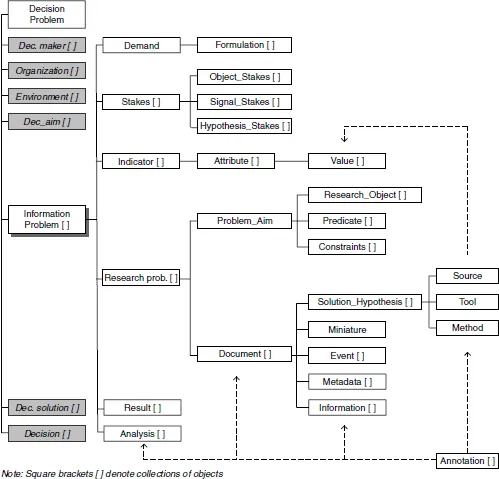
The Watcher Information Search Problem (WISP) model is made up of a collection of 27 interlinked elements that correspond to different “objects” handled by the watcher in the course of the watching process. These objects, which act as both containers and links, enable the watcher to organize and coordinate different steps of the transformation process — from registering the request to the presentation of results. Each of these objects has a number of attributes (title, date, reference, etc.) that describe its characteristics and promote “cognitive traceability” [KIS 09] of information, activity monitoring, and reuse (Figure 1.1).
Although this model is presented as a flow chart in Figure 1.1, the WISP is not fixed, as its name suggests (taking the meaning of the word “wisp”, and not just the WISP acronym). It is flexible and adaptable and allows for the addition of new elements, such as annotations. The square brackets [ ], which follow certain labels, indicate that the element is, in fact, a collection, that is, a group of objects. For example, the element <Demand> is associated with a collection of objects, <Formulation>, which correspond to the registration of different formulations and reformulations of the demand produced by the decision maker and by the watcher.
1.3. Dimensions and aspects of the model
The WISP model is a three-dimensional, multifaceted model that incorporates the notion of the following points of view:
– an analytical dimension, which encompasses the understanding of demand, stakes, and context, the definition of information indicators and all knowledge creation and analysis operations that may be carried out by studying the memorized elements;
– a methodological dimension which, at the first level, is constituted by the capacity for transformation of the decision problem into an information problem (then into research problems), and on a second level by research strategies through which information is identified and knowledge acquired;
– an operational dimension, corresponding to the selection of action plans and the implementation of different steps of resolution of the methodology associated with the WISP model.
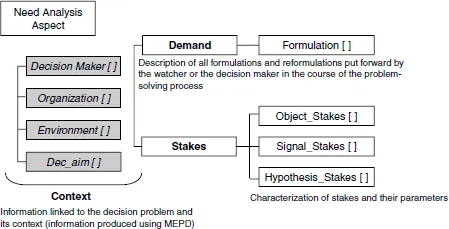
The “Need” aspect permits decision-based characterization of the expression of need (the formulated demand) suitable for the stakes and the context of the decision problem being considered; it is made up of the set of information produced by the model to explain the decision problem, the demand, and the associated stakes (Figure 1.2).
The “Project” aspect links the demand to its transformation into information indicators, information problems, and their solutions, and the analysis and presentation of results to the decision maker (Figure 1.3).
The “Research” aspect connects information-gathering problems (through the formulation of the watcher’s research aims and activities) with information elements (solutions) to show the value of indicators (Figure 1.4).
Finally, the “Knowledge” aspect is made up of annotations and analyses of both the results and the process itself by the watcher and by the decision maker. These aspects can be used to determine the boundaries of the model depending on different points of view, and in learning to use the m...