- English
- ePUB (mobile friendly)
- Available on iOS & Android
eBook - ePub
About this book
Providing extensive coverage, including conducting, insulating and electroactive films, this handbook and ready reference deals with introductory topics and fundamentals as well as advanced insights. Clearly structured, in the first part of the book readers learn the fundamentals of electropolymerizatoin for all important types of polymers, mechanisms of film formation and functionalization, while the second part covers a wide range of applications in biochemistry, analytics, photovoltaics, energy and the environment as well as actuators.
Information
1
Electropolymerized Films of π-Conjugated Polymers. A Tool for Surface Functionalization: a Brief Historical Evolution and Recent Trends
1.1 Introduction
Electrodeposition of conducting polymer films at the surface of an electrode has opened a field at the convergence between two rich domains: electrochemistry of modified electrode[1–3] and conjugated systems[4]. Consequently, applications of modified electrodes in electrocatalysis, electrochromism, energy storage, electroanalysis, and sensors have been enriched by the specific properties of intrinsically conducting polymers (ICPs), for example, electrochemically tunable doping and de-doping (equivalent to adjustable redox states), polymeric matrix affording electrical wiring, use as immobilized redox mediators, and the capacity to induce new functionalities by the use of specific gratings. Reciprocally, electrochemistry has opened up the route to easy-to-handle polymer films in a manner similar to the way that polyacetylene, (CH) x, prepared as a film by a modification of the Natta reaction [5], resulted in the discovery, in 1977, of the doping effect as presented in the seminal paper of Shirakawa and coworkers [6]. In addition, this cross-fertilization enlarged the panel of new ICP-based materials, such as electrogenerated composites [7], and strengthened or brought in new applications such as energy conversion and storage (Chapter 11); electrotriggered drug delivery [8]; soft actuators (Chapter 11); chemical, bio-, and gas sensors (Chapters 8–10); biocompatible films [9]; and artificial muscles (Chapter 12).
Considering the intense and widespread research activities in these fields, the aim of this historical survey is not to cover the entire field of the various electropolymerization facets detailed in the following chapters, but to give an overview of the successive contributions to and acquisition of knowledge.
The electropolymerization reported here is restricted to oxidative condensation; as a matter of fact, it should be mentioned that as early as in 1983, Fauvarque [10] reported the synthesis of poly(p-phenylene) film by electroreduction-assisted catalysis by Ni(0) complex. In the first part, electropolymerization is described in the context of π-conjugated polymers. Four generations have been distinguished in this saga: the “era of physicists,” the “era of electrochemists,” the “era of polymerists,” and the “era of molecular electronics.” This division appears a little artificial, since the progress in each of these eras resulted from mutual enrichment between these scientific communities; however, this book provides an enlightening presentation of each determining step of the evolution. The “era of electrochemists” starts with the early use of electropolymerization in the 1980s. The second part presents the major milestones reached by the process of electropolymerization in the light of the functionalization of surfaces for the electrodeposition of increasingly sophisticated conjugated architectures endowed with specific functionalities from sensors to active photovoltaic layers. Recent trends in the use of the electropolymerization concerning the elaboration of nanowires or nanotubes of ICPs for sensors or molecular electronics, nanostructured materials (interpenetrated networks with ICPs, carbon nanotubes/ICPs combination, etc.) are not presented here.
It is emphasized that the compilation of bibliographic data has been a very difficult task, since it is pointless to duplicate all the references that are given in the other chapters; so the selection here is a mix of citations of pioneering teams with key contributions made in the 1980s–1990s, easily accessible reviews, and recent representative publications on the new trends in the field.
1.2 Electropolymerization: Epistemological Analysis within the ICP Saga
It is possible to distinguish four generations in the still active saga of ICPs.
The first generation, the “era of physicists,” corresponds to their historical identification as synthetic or organic metals, and parallel to the development of mixed valence crystals in the family of TTF-TCNQ [11, 12], the domain of electroconductive polymers appeared driven by the interest of physicists in the semiconducting/conducting or even supraconducting conductivity transition. Polysulfurnitride, (SN)x, was investigated in the early 1960s and the metallic properties were studied in the 1970s [13], with a superconducting transition below 0.3 K evidenced in 1975 [14], and the “doping effect” of halogens reported in 1977 [15]. Similarly, (CH) x, the first chemically unsophisticated representative of the π-conjugated structure, that is, with alternative C–C single and double bonds, was extensively investigated after the discovery of halogen doping in 1977 [6]. It must be emphasized at this point that the preparation of (CH) x as an easy-to-handle film [16, 17] instead of a pressed pellet of powder considerably boosted the field and allowed to carry out electrochemical doping on (CH) x films as electrodes [18]. The chemical modification of poly(p-phenylene) [19] by AsF 5 or alkali metals was reported soon after in 1979.
The second generation of ICPs, the “era of electrochemists,” began with the electropolymerization of aromatic heterocycles and derivatives. In addition to the “easy-to-handle effect” previously illustrated by (CH) x, electropolymerization is based on a new concept of oxidative condensation through the generation of radical cations (Chapter 2). Early work in 1916 [20] and 1937 [21] on chemically prepared “neri di pirrolo” had not been aware of the electronic properties of these powders of poly(oxipyrrole). Chemical oxidation of aniline, reported by Buvet and coworkers in 1968 [22, 23], and of pyrrole, reported by Hautiére Christofini in 1973 [24], was recognized to provide electrically conductive materials. Electropolymerization allowed handling polypyrrole [25, 26], polyaniline [27–29], and poly(p-phenylene) [30] films, resulting in completely new polymers films, some of the better known being the polythiophene [31, 32], polyfluorene [33], and polycarbazole [34] classes. Consequently, in early 1980s, the electrochemist community was drawn to use electrochemistry not only as a tool to prepare ICP films [35] but also as a methodology (Chapter 3) to investigate the doping/dedoping process electrochemically tuned with the associated movements of ionic dopants and the concomitant evolution of the electronic structure using electron spin resonance (ESR) spectroscopy [36], UV–vis [37] and surface IR [38] spectrophotometries, ellipsometry [39–41], quartz crystal microbalance (QCM) [42], and mirage effect [43], coupled with voltamperometric methods. In addition to the use of ICPs as substitutes for metals, new ICP applications, traditionally falling into the field of electrochemistry such as electrocatalysis [44, 45], sensors [46–51], biosensors (Chapters 8–10), energy storage (e.g., batteries [52–56] and supercapacitors [57, 58]) (Chapter 11), anticorrosion deposits onto metals [59–61] and semiconductors [62–65], and electrochromism [66–69], were rapidly developed. However, the concept of functionalization was the key breakthrough [45, 70–73]. It is possible to deposit a polymer film including functional moieties into the polymeric backbone in just one step. The tremendous progress in research on sensors and biosensors (Chapters 8–10) originates with the study of sensitive layers based on (bio)functionalized ICP films.
The third generation, the “era of polymerists,” emerged from the inputs of chemists, particularly the macromolecularists, to the ICP domains. The intrinsic advantage of electropolymerization – a straightforward deposition of a redox and an electroconducting film of an electrocontrollable thickness, with tunable interfacial properties for numerous electrochemical applications – is counterbalanced by the complete insolubility of the deposit. Thus, the determination of classical characterization parameters for polymers such as the average chain length, dispersion, crystallinity, and the handling by spin or dip coating for large-scale applications are both impeded. Chemists have played an important role in the development of new routes in chemical synthesis, providing structurally well-defined conducting polymers. In the large family of ICPs, polythiophenes have been by far the more studied, and as early as in 1980, Yamamoto [74] reported the Ni-catalyzed condensation of 2,5-dibromothiophene. Three main properties have been tuned via structural and chemical modifications: the gap, the solubility, and the conductivity. The existence of low-gap thiophene-based ICPs [75, 76] such as poly(isothianathene) was reported in 1984 by Wudl [77], polyfused heterocycles such as poly(thienothiophene) was reported by Taliani in 1986 [78, 79], and poly(dithienylethylene) and related systems by Roncali [80] in 1997. Poly(ethylenedioxithiophene) (PEDOT), reported by Heinze et al. in 1994 [81] and Reynolds et al. in 1996 [82] and considered as one of the most stable ICPs, is now commercially available and is used in numerous applications. Soluble poly(3-alkylthiophenes) (P3-ATs) were first reported by Elsenbaumer in 1986 [83]. Regioregularity with the so-called McCullough method [84] reported in 1993 in the P3-ATs family has been the cornerstone for the development of applications in organic electronics (vide infra). While classical polymerizations by oxidative coupling using Fe(III) salts provides polymers with 3,4-and 2,5-linkage defects, low molecular weights, and weak conductivities (in the range of 0.1–1 Scm−1), the metal-catalyzed C–C coupling of heterocycles (e.g., Suzuki-, Sonogashira-, and Stille-type reactions) allows to improve their conductivities by more than 2 orders of magnitude [85]. In addition to processable ICP-based materials [86], the above-mentioned chemical methods were also used for the step-by-step synthesis of well-defined length oligothiophene [87]. Considerable progress has been made from the simple sexithiophene reported in 1989 by Garnier et al. [88] to the sophisticated oligothiophene-based nanoarchitectures reported in the recent remarkable review by Bäuerle et al. [89].
The fourth generation covers the wide domain of organic electronics in its extended acceptation and can be considered as a “renaissance” of the ICP domain of applications by the fruitful cross-fertilization between synthetic chemistry and electronics. It is contemporary to the third generation, and mainly concerns organic light-emitting diodes (OLEDs), ICP-based photovoltaic devices, organic thin film transistors (OTFTs), and molecular electronics. After the first report by Garnier on OTFTs based on sexithiophene [88] in 1989, a significant step in 1990 was the description by Friend and coworkers of the electroluminescent device based on poly(p-phenylene vinylene) (PPV), placed between an indium tin oxide (ITO) and an Al electrode [90]. Polymer light-emitting diodes were extended to different classes [91] of conjugated polymers such as poly(carbazole)s, poly(fluorene)s, PPVs, and poly(thiophene)s. The reverse phenomenon of photovoltaic cells based on ICPs [92] was soon reported, with the next decisive step resulting in the ultrafast photoinduced electron transfer from ICPs to the C 60 fullerene, developed independently by Sariciftci et al. [93] and Yoshino et al. [94] in 1992. These fields are well detailed in the second volume of the third edition of the Handbook of Conducting Polymers, edited by Skotheim T A, Reynolds in 2007. Interestingly, we will see in the second part of the following that, in spite of the leading processes of dip or spin coatings to implement ICPs in electronic devices, electropolymerization is still being developed as an alternative method for the fine control of thickness for numerous applications [95–97].
1.3 Electropolymerization: from Pristine Heterocyclic to Sophisticated Functional and Conjugated Architectures
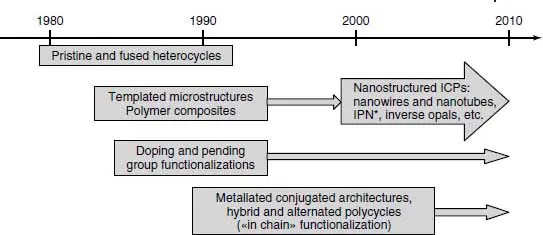
Having, very briefly, traced almost 30 years of scientific venture on ICPs, which have replaced electropolymerization as one of the most important inputs, this section examines more specifically the evolution of this methodology (Figure 1.1) in the context of functionalization of surfaces.
Figure 1.1 Some key milestones in the evolution of electropolymerized heterocycles in the saga of ICPs. These successive main steps are not independent but mutually enriched. *IPN, Interpenetrated network.
1.3.1 Electropolymerization of Pristine Aromatic Heterocycles
The first electropolymerization experiment reported in 1968 by Dall’oxlio [25] on pyrrole in water medium was not the trigger event; as a matter of fact, except for aniline in acidic media, pristine pyrrole, and, as reported later, for thiophene and derivatives in m...
Table of contents
- Cover
- Further Reading
- Title Page
- Copyright
- Preface
- List of Contributors
- Chapter 1: Electropolymerized Films of π-Conjugated Polymers. A Tool for Surface Functionalization: a Brief Historical Evolution and Recent Trends
- Chapter 2: Mechanisms of Electropolymerization and Redox Activity: Fundamental Aspects
- Chapter 3: Electrochemical Impedance Spectroscopy (EIS) for Polymer Characterization
- Chapter 4: Recent Trends in Polypyrrole Electrochemistry, Nanostructuration, and Applications
- Chapter 5: Electropolymerized Azines: a New Group of Electroactive Polymers
- Chapter 6: Electropolymerization of Phthalocyanines
- Chapter 7: Imprinted Polymers
- Chapter 8: Gas Sensing with Conducting Polymers
- Chapter 9: Chemical Sensors Based on Conducting Polymers
- Chapter 10: Biosensors Based on Electropolymerized Films
- Chapter 11: Inherently Conducting Polymers via Electropolymerization for Energy Conversion and Storage
- Chapter 12: Electrochemomechanical Devices: Artificial Muscles
- Index
Trusted by 375,005 students
Access to over 1.5 million titles for a fair monthly price.
Study more efficiently using our study tools.
Frequently asked questions
Yes, you can cancel anytime from the Subscription tab in your account settings on the Perlego website. Your subscription will stay active until the end of your current billing period. Learn how to cancel your subscription
No, books cannot be downloaded as external files, such as PDFs, for use outside of Perlego. However, you can download books within the Perlego app for offline reading on mobile or tablet. Learn how to download books offline
Perlego offers two plans: Essential and Complete
- Essential is ideal for learners and professionals who enjoy exploring a wide range of subjects. Access the Essential Library with 800,000+ trusted titles and best-sellers across business, personal growth, and the humanities. Includes unlimited reading time and Standard Read Aloud voice.
- Complete: Perfect for advanced learners and researchers needing full, unrestricted access. Unlock 1.5M+ books across hundreds of subjects, including academic and specialized titles. The Complete Plan also includes advanced features like Premium Read Aloud and Research Assistant.
We are an online textbook subscription service, where you can get access to an entire online library for less than the price of a single book per month. With over 1.5 million books across 990+ topics, we’ve got you covered! Learn about our mission
Look out for the read-aloud symbol on your next book to see if you can listen to it. The read-aloud tool reads text aloud for you, highlighting the text as it is being read. You can pause it, speed it up and slow it down. Learn more about Read Aloud
Yes! You can use the Perlego app on both iOS and Android devices to read anytime, anywhere — even offline. Perfect for commutes or when you’re on the go.
Please note we cannot support devices running on iOS 13 and Android 7 or earlier. Learn more about using the app
Please note we cannot support devices running on iOS 13 and Android 7 or earlier. Learn more about using the app
Yes, you can access Electropolymerization by Serge Cosnier,Arkady Karyakin in PDF and/or ePUB format, as well as other popular books in Technology & Engineering & Materials Science. We have over 1.5 million books available in our catalogue for you to explore.