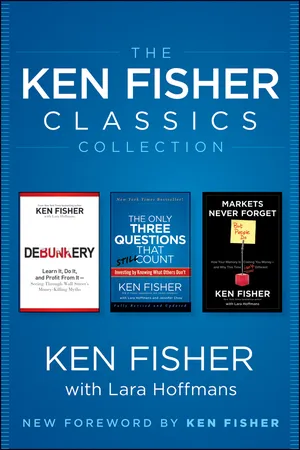
![]()
![]()
CONTENTS
Preface
Acknowledgments
Chapter 1: Question One: What Do you Believe that is Actually False?
If you Knew it was Wrong, you Wouldn’t BelieveIt
The Mythological Correlation
Always Look at it Differently
When you Are Really, Really Wrong
Chapter 2: Question Two: What Can you Fathom that Others Find Unfathomable?
Fathoming the Unfathomable
Ignore the Rock in the Bushes
Discounting the Media Machine and Advanced Fad Avoidance
The Shocking Truth About Yield Curves
What the Yield Curve is Trying to Tell you
The Presidential Term Cycle
Chapter 3: Question Three: What the Heck is My Brain Doing to Blindside Me Now?
It’s Not Your Fault—Blame Evolution
Cracking the Stone Age Code—Pride and Regret
The Great Humiliator’s Favorite Tricks
Get Your Head Out of the Cave
Chapter 4: Capital Markets Technology
Building and Putting Capital Markets Technology Into Practice
It’s Good While it Lasts
Forecast With Accuracy, Not Like a Professional
Better Living Through Global Benchmarking
Chapter 5: When There’s No There, There!
Johns Hopkins, My Grampa, Life Lessons and Pulling a Gertrude
In the Center Ring—Oil Versus Stocks
Sell in May Because the January Effect Will Dampen Your Santa Claus Rally Unless There is a Witching Effect
Chapter 6: No, It’s Just The Opposite
When you Are Wrong—Really, Really, Really Wrong
Multiplier Effects and the Heroin-Addicted iPod Borrower
Let’s Trade This Deficit for that One
The New Gold Standard
Chapter 7: Shocking But True
Supply and Demand . . . and That’s It
Weak Dollar, Strong Dollar—What Does it Matter?
Chapter 8: The Great Humiliator and Your Stone Age Brain
That Predictable Market
Anatomy of a Bubble
Some Basic Bear Rules
What Causes a Bear Market?
Chapter 9: Putting it All Together
Stick With Your Strategy and Stick it to Him
Four Rules that Count
Finally! How to Pick Stocks that Only Win
When the Heck Do you Sell?
Conclusion
Appendix A
Appendix B
Appendix C
Appendix D
Appendix E
Appendix F
Appendix G
Appendix H
Appendix I
About the Authors
Index
![]()
![]()
Copyright © 2012 by Fisher Investments. All rights reserved.
This book is a revised edition of The Only Three Questions That Still Count: Investing By Knowing What Others Don’t published by John Wiley & Sons, Inc., 2007
Published by John Wiley & Sons, Inc., Hoboken, New Jersey.
Published simultaneously in Canada.
No part of this publication may be reproduced, stored in a retrieval system, or transmitted in any form or by any means, electronic, mechanical, photocopying, recording, scanning, or otherwise, except as permitted under Section 107 or 108 of the 1976 United States Copyright Act, without either the prior written permission of the Publisher, or authorization through payment of the appropriate per-copy fee to the Copyright Clearance Center, Inc., 222 Rosewood Drive, Danvers, MA 01923, (978) 750-8400, fax (978) 646-8600, or on the Web at www.copyright.com. Requests to the Publisher for permission should be addressed to the Permissions Department, John Wiley & Sons, Inc., 111 River Street, Hoboken, NJ 07030, (201) 748-6011, fax (201) 748-6008, or online at http://www.wiley.com/go/permissions.
Important Disclaimers: This book reflects personal opinions, viewpoints and analyses of the authors and should not be regarded as a description of advisory services provided by Fisher Investments or performance returns of any Fisher Investments client. Fisher Investments manages its clients’ accounts using a variety of investment techniques and strategies not necessarily discussed in this book. Nothing in this book constitutes investment advice or any recommendation with respect to a particular country, sector, industry, security or portfolio of securities. All information is impersonal and not tailored to the circumstances or investment needs of any specific person.
Limit of Liability/Disclaimer of Warranty: While the publisher and author have used their best efforts in preparing this book, they make no representations or warranties with respect to the accuracy or completeness of the contents of this book and specifically disclaim any implied warranties of merchantability or fitness for a particular purpose. No warranty may be created or extended by sales representatives or written sales materials. The advice and strategies contained herein may not be suitable for your situation. You should consult with a professional where appropriate. Neither the publisher nor author shall be liable for any loss of profit or any other commercial damages, including but not limited to special, incidental, consequential, or other damages.
For general information on our other products and services or for technical support, please contact our Customer Care Department within the United States at (800) 762-2974, outside the United States at (317) 572-3993 or fax (317) 572-4002.
Wiley also publishes its books in a variety of electronic formats. Some content that appears in print may not be available in electronic books. For more information about Wiley products, visit our web site at www.wiley.com.
ISBN 978-1-118-11508-4; ISBN 978-1-118-22421-2 (ebk); ISBN 978-1-118-23755-7 (ebk); ISBN 978-1-118-26246-7 (ebk)
![]()
PREFACE
Who Am I to Tell You Something That Counts?
Who am I to tell you anything, much less anything that counts? Or that there are only three questions that count and I know what they are? Why should you bother reading any of this? Why listen to me at all?
As I update this book in 2011 for its second edition, I’ve been in the investment industry for nearly 40 years. I founded and am CEO of what is among the world’s largest independent discretionary money management firms, serving tens of thousands of high net worth individuals and an impressive roster of institutions—major corporate and public pension plans and endowments and foundations—spanning the globe. I’ve written Forbes’s “Portfolio Strategy” column for over 27 years, making me the fourth longest-running columnist in Forbes’s long history. I write regular columns in Britain and Germany. And now, I’ve written eight books, five of which (including this one) were national bestsellers. Along the way, and without really aiming at it, I made the Forbes 400 list of richest Americans.
That’s a lot for one lifetime and one professional career. But I’m here to tell you the prime cumulative lesson of my long career is when it comes to investing, there are only three questions that count. And my view on that hasn’t changed since I first penned this book.
In reality, there really is only one question that counts. Or, at least, only one question that really counts. But I don’t know how to express that one question in a way you can easily use for everyday investing decisions. If broken down into three subparts, I know how.
And what is that only question that counts? Finance theory is quite clear the only rational basis for placing a market bet is if you believe somehow, some way, you know something others don’t know. The only question that counts is: What do you know that others don’t?
Most people don’t know anything others don’t. Most folks don’t think they’re supposed to know something others don’t. We’ll see why. But saying you must know something others don’t isn’t at all novel. Pretty much everyone who took a basic college investment class was told this, although most people conveniently forget this truism.
Without answering the question—what do you know that others don’t—investing with an aim to do as well or better than the market is futile. I’ll say that another way. Markets are pretty efficient at pricing all currently known information into today’s prices. There is nothing new about that statement. It’s an established pillar of finance theory and has been repeatedly verified over the decades. If you make market decisions based on the same information others have (or have access to), you will overall fail relative to what the markets would have rendered you on their own without any decision making on your part. If you try to outguess where the market will go or what sectors will lead and lag or what stock to buy based on what you read in newspapers or chatter about with your friends and peers—it doesn’t matter how smart or well trained you are—you will sometimes be right or lucky or both, but likely more often wrong or unlucky or both, and overall do worse than if you didn’t make such bets at all.
I bet you hate hearing that. But I already told you I didn’t know how to express that truism as a single question in a way useful to you. What I can do is show you how to know things other people don’t know.
Polling for Perfect Truth
Why is knowing something others don’t so important? Financial markets are “discounters” of widely known information—whatever information we commonly have access to has already been reflected in today’s prices before we can articulate our knowledge of it. See it this way—compare markets to political elections that aren’t discounters of known information.
You know professional pollsters can build a sample of about 1,000 people sufficiently representative of America’s voters to foresee the immediate outcome of a national election within a predictable few percentage points. That technology is mature and time-tested. You’re quite used to it. When a professional poll is done the night before the election, we know w...