eBook - ePub
Pharmacogenetics and Individualized Therapy
- English
- ePUB (mobile friendly)
- Available on iOS & Android
eBook - ePub
Pharmacogenetics and Individualized Therapy
About this book
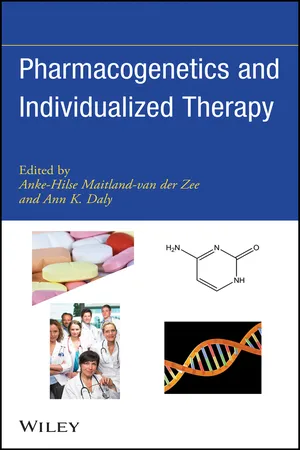
This resource provides thorough coverage of pharmacogenetics and its impact on pharmaceuticals, therapeutics, and clinical practice. It opens with the basics of pharmacogenetics, including drug disposition and pharmacodynamics. The following section moves into specific disease areas, including cardiovascular, psychiatry, cancer, asthma/COPD, adverse drug reactions, transplantation, inflammatory bowel disease, and pain medication. Clinical practice and ethical issues make up the third section, with the fourth devoted to technologies like genotyping, genomics, and proteomics. In the fifth part, chapters discuss the impact of key regulatory issues on the pharmaceutical industry.
Information
Chapter 1
Pharmacogenetics: A Historical Perspective
1.1 Introduction
It has been known for thousands of years that some individuals show toxic responses following consumption of fava beans, especially in countries bordering the Mediterranean. This is probably the earliest pharmacogenetic observation, although the biological basis for this has been established only quite recently (see Section 1.2). The foundation for much of modern pharmacogenetics came from experiments on chemical metabolism during the 19th century. These studies included the establishment that benzoic acid undergoes conjugation with glycine in vivo in both humans and animals, that benzene is oxidized to phenol in both dogs and humans and that some compounds can undergo conjugation with acetate (for a review, see Ref. 1).
1.2 Early Pharmacogenetics Studies (from 1900 to 1970)
The development of genetics and Mendelian inheritance together with observations by Archibald Garrod on the possibility of variation in chemical metabolism in the early 20th century has been well reviewed elsewhere see [2]. Probably the first direct pharmacogenetic study was reported in 1932 when Synder's study on the ability to taste phenylthiocarbamide within families showed that this trait was genetically determined [3]. The gene responsible for this variation and common genetic polymorphisms have only recently been identified (for a perspective, see Ref. 4). Although not a prescribed drug, phenylthiocarbamide shows homology to drugs such as propylthiouracil.
The initial drug-specific pharmacogenetics observations appeared in the literature during the 1950s. These were concerned with three widely used drugs at that time, that are all still used today: isoniazid, primaquine, and succinylcholine. The earliest observation concerned primaquine, which was found by Alf Alving to be associated with acute hemolysis in a small number of individuals [5]. Subsequent work by Alving and colleagues found that this toxicity was due to absence of the enzyme glucose-6-phosphate dehydrogenase in red blood cells of affected individuals [6]. The molecular genetic basis of this deficiency was later established by Ernest Beutler and colleagues in 1988 [7].
Isoniazid was first used against tuberculosis in the early 1950s, although it had been developed originally a number of years previously as an antidepressant. As reviewed recently, its use in tuberculosis patients represented an important advance in treatment of this disease [8]. Variation between individuals in urinary excretion profiles was described by Hettie Hughes [9], who soon afterwards also found an association between the metabolic profile and the incidence of a common adverse reaction, peripheral neuritis, with those showing slow conversion of the parent drug to acetylisoniazid more susceptible [10]. Further studies by several different workers, particularly Mitchell and Bell [11], Harris [12], and David Price Evans [13], led to the conclusion that isoniazid acetylation was subject to a genetic polymorphism and that some individuals (~10% of East Asians but 50% of Europeans) were slow acetylators. Slow acetylation was shown to be a recessive trait. As summarized in Section 1.4, the biochemical and genetic basis of slow acetylation is now well understood.
Also during the 1950s, a rare adverse response to the muscle relaxant succinylcholine was found to be due to an inherited deficiency in the enzyme cholinesterase [14]. Succinylcholine is used as a muscle relaxant during surgery, and those with the deficiency show prolonged paralysis (succinylcholine apnea). This observation was then further developed by Werner Kalow, who showed that the deficiency is inherited as an autosomal recessive trait and devised a biochemical test to screen for the deficiency, as he described in a description of his early work [15]. The gene encoding this enzyme, which is now usually referred to as butyrylcholinesterase, has been well studied, and a number of different mutations responsible for the deficiency have been identified. However, the original biochemical test is still the preferred method for identifying those affected by succinylcholine apnea due to the rarity of both the problem and the number of different mutations.
While these initial studies showing the clear role for genetics in determining adverse responses to primaquine, isoniazid, and succinylcholine were in progress, the general importance of the area was increasingly recognized. Arno Motulsky published a key review on the relationship between biochemical genetics and drug reactions that highlighted the adverse reactions to primaquine and succinylcholine in 1957 [16]. The term pharmacogenetics was first used in 1959 by Friedrich Vogel in an article on human genetics written in German [17] and was soon adopted by others working in the field.
1.3 Pharmacogenetics of Drug Oxidation
As described in Section 1.1, studies in the 19th century had demonstrated oxidation of benzene to phenol in vivo [1]. Pioneering studies on drug metabolism, especially those in the laboratories of the Millers and of Brodie and Gillette during the 1950s, showed that many drugs undergo oxidative metabolism in the presence of NADPH and molecular oxygen in liver microsomes [18, 19]. In 1962, Omura and Sato described cytochrome P450 from a rat liver microsome preparation as a hemoprotein that showed a peak at 450 nm in the presence of carbon monoxide and dithionite [20]. Shortly afterwards Ron Estabrook, David Cooper, and Otto Rosenthal showed that cytochrome P450 had steroid hydroxylase activity [21], and further studies confirmed its role in the metabolism of drugs such as codeine, aminopyrene, and acetanilide [22]. At this time, it was still assumed that cytochrome P450 was a single enzyme, but evidence for multiple forms emerged in the late 1960s [23, 24] with purification of a range of rat and rabbit enzymes achieved during the 1970s [25, 26].
Independent metabolism studies on two newly developed drugs sparteine and debrisoquine in Germany by Michel Eichelbaum and in the United Kingdom by Robert Smith in the mid 1970s resulted in findings indicating that some individuals were unable to oxidize these drugs, although the majority of individuals showed normal metabolism [27, 28]. These studies estimated that 10% of Europeans showed absence of activity, and the term poor metabolizer was first used. At this time, the enzymes responsible for this absence of activity were not known, but further studies confirmed that the deficiency in metabolism of both drugs cosegregated [29] and that the trait was inherited recessively [30]. It became clear that a number of different drugs, including tricyclic antidepressants, were also metabolized by this enzyme [31]. Studies on human liver microsomes confirmed that the enzyme responsible was a cytochrome P450 [32, 33], and this enzyme was then purified to homogeneity [34]. The availability of antibodies to the purified protein facilitated the cloning of the relevant cDNA by Frank Gonzalez and colleagues, who initially termed the gene CYPIID1 [35]. On the basis of emerging data for cytochrome P450 genes in humans and other animal species, it was decided subsequently that the gene encoding the debrisoquine/sparteine hydroxylase should be termed CYP2D6. Studies on human genomic DNA led to the identification of several polymorphisms in CYP2D6 associated with the poor metabolizer phenotype, including the most common splice site variant, a large deletion, and a small deletion [36–40]. A major additional contribution to the field was made in 1993 by Johansson, Ingelman-Sundberg, and colleagues, who described the phenomenon of ultrarapid metabolizers with one or more additional copies of CYP2D6 present [41]. These ultrarapid metabolizers had been previously identified on the basis of poor response to tricyclic antidepressants, and this was one of the first accounts of copy number variation in the human genome. Agreement regarding the current nomenclature for variant alleles in CYP2D6 and other cytochromes P450 was reached in 1996 [42].
In an approach similar to that used in the discovery of the CYP2D6 polymorphism, Kupfer and Preisig found that some individuals showed absence of metabolism of the anticonvulsant S-mephenytoin [43]. It was demonstrated that S-mephenytoin metabolism did not cosegregate with that of debrisoquine and sparteine, as this polymorphism was due to a separate gene defect. Identification of the gene responsible for S-mephenytoin hydroxylase proved difficult initially, probably because the relevant enzyme was expressed at a low level in the liver. The gene, now termed CYP2C19, was cloned by Goldstein and Meyer and colleagues in 1994, and the two most common polymorphisms associated with absence of S-mephenytoin hydroxylase activity were identified [44, 45].
A number of other cytochrome P450 genes are now known to be subject to functionally significant polymorphisms. In the case of one of these, CYP2C9, which metabolizes a range of drugs, including warfarin, tolbutamide, and nonsteroidal antiinflammatory drugs, some evidence for the existence of a polymorphism appeared in 1979 when a trimodal distribution in the metabolism of tolbutamide was reported [46]. Subsequently, it was shown that tolbutamide metabolism was distinct from debrisoquine metabolism [47]. The enzyme involved was purified and cloned and later named CYP2C9 [48, 49]. Analysis of CYP2C9 cDNA seq...
Table of contents
- Cover
- Title Page
- Copyright
- Preface
- Contributors
- Chapter 1: Pharmacogenetics: A Historical Perspective
- Part I: Pharmacogenetics: Relationship to Pharmacokinetics and Pharmacodynamics
- Part II: Pharmacogenetics: Therapeutic Areas
- Part III: Pharmacogenetics: Implementation in Clinical Practice
- Part IV: Developments in Pharmacogenetic Research
- Part V: Pharmacogenetics: Industry and Regulatory Affairs
- Part VI: Conclusions
- Color Plates
- Index
Trusted by 375,005 students
Access to over 1.5 million titles for a fair monthly price.
Study more efficiently using our study tools.
Frequently asked questions
Yes, you can cancel anytime from the Subscription tab in your account settings on the Perlego website. Your subscription will stay active until the end of your current billing period. Learn how to cancel your subscription
No, books cannot be downloaded as external files, such as PDFs, for use outside of Perlego. However, you can download books within the Perlego app for offline reading on mobile or tablet. Learn how to download books offline
Perlego offers two plans: Essential and Complete
- Essential is ideal for learners and professionals who enjoy exploring a wide range of subjects. Access the Essential Library with 800,000+ trusted titles and best-sellers across business, personal growth, and the humanities. Includes unlimited reading time and Standard Read Aloud voice.
- Complete: Perfect for advanced learners and researchers needing full, unrestricted access. Unlock 1.5M+ books across hundreds of subjects, including academic and specialized titles. The Complete Plan also includes advanced features like Premium Read Aloud and Research Assistant.
We are an online textbook subscription service, where you can get access to an entire online library for less than the price of a single book per month. With over 1.5 million books across 990+ topics, we’ve got you covered! Learn about our mission
Look out for the read-aloud symbol on your next book to see if you can listen to it. The read-aloud tool reads text aloud for you, highlighting the text as it is being read. You can pause it, speed it up and slow it down. Learn more about Read Aloud
Yes! You can use the Perlego app on both iOS and Android devices to read anytime, anywhere — even offline. Perfect for commutes or when you’re on the go.
Please note we cannot support devices running on iOS 13 and Android 7 or earlier. Learn more about using the app
Please note we cannot support devices running on iOS 13 and Android 7 or earlier. Learn more about using the app
Yes, you can access Pharmacogenetics and Individualized Therapy by Anke-Hilse Maitland-van der Zee, Ann K. Daly, Anke-Hilse Maitland-van der Zee,Ann K. Daly in PDF and/or ePUB format, as well as other popular books in Medicine & Pharmacology. We have over 1.5 million books available in our catalogue for you to explore.