- Spans the fields of anthropology, education, applied linguistics, and human development
- Includes the latest developments in second and heritage language socialization, and literary and media socialization
- Discusses socialization across the entire life span and across institutional settings, including families, schools, work places, and churches
- Explores data from a multitude of cultures from around the world
eBook - ePub
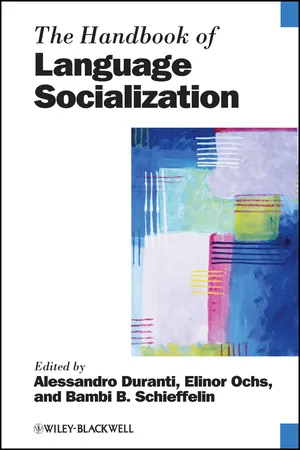
The Handbook of Language Socialization
- English
- ePUB (mobile friendly)
- Available on iOS & Android
eBook - ePub
The Handbook of Language Socialization
About this book
Documenting how in the course of acquiring language children become speakers and members of communities, The Handbook of Language Socialization is a unique reference work for an emerging and fast-moving field.
Information
1
The Theory of Language Socialization
Scope of Language Socialization
Language socialization arose out of an anthropological conviction that language is a fundamental medium in children’s development of social and cultural knowledge and sensibilities, a domain that the field of language acquisition does not capture. While the study of child language encompasses developmental pragmatics (Ochs and Schieffelin 1979), the scope of pragmatics tends to be limited to what Malinowski (1935) called ‘the context of situation,’ with an interest in verbal acts, activities, turns, sequences, stances, style, intentionality, agency, and the flow of information. Instead, the study of language socialization examines how children and other novices apprehend and enact the ‘context of situation’ in relation to the ‘context of culture.’ In so doing, language socialization research integrates discourse and ethnographic methods to capture the social structurings and cultural interpretations of semiotic forms, practices, and ideologies that inform novices’ practical engagements with others. While language acquisition research privileges mother–child conversation as a site of observation, language socialization research extends the object of inquiry to the range of adult and child communicative partners with whom a child or other novice routinely engages in some capacity across socioculturally configured settings.
Language socialization also recognized a lacuna in anthropological studies of children across communities (Mead 1928; Whiting and Whiting 1975; Whiting and Edwards 1988), namely the paucity of attention to the role of language as integral to how children grow up to become members of families and communities. Mead concentrated on the psychocultural patterning of caregiving, weighing the effects of local culture on universal psychological and developmental forces in the transition from infancy to adulthood. The Harvard-based Six Cultures Project systematically documented the sociocultural ecology of children’s lives and children’s behavior, inspiring research on how local theories and environments influence parenting and child development (e.g. Harkness and Super 1996; Rogoff 2003; Shweder, Mahapatra, and Miller 1987; Weisner 2002), but language practices were minimally addressed.
Drawing upon Gumperz and Hymes’ (1964) paradigm of the ethnography of communication and the University of California at Berkeley’s A Field Manual for Cross-Cultural Study of the Acquisition of Communicative Competence (Slobin 1967), language socialization research emerged in the 1980s to consider aspects of the sociocultural environment of children’s communicative practices that were left out of linguistic, psychological, and anthropological studies. Suddenly, what children were told, by whom, and in what language variety or register became as important as the order by which particular sounds or syntactic constructions were being acquired. Adopting a cross-cultural and ethnographic perspective, language socialization scholars went to different societies around the world to document how, in the course of acquiring language, children become particular types of speakers and members of communities (Ochs and Schieffelin 2008; Schieffelin and Ochs 1986a, 1986b, 1996). Decades later, these scholars are teaching language socialization courses in anthropology, applied linguistics, education, psychology, and human development. The field has now expanded to include second language and heritage language socialization, literacy, and media socialization, as well as socialization across community settings.
The multidisciplinarity of language socialization research has allowed the field to understand how children and other novices come to create multiple, fluid, sometimes conflicting ‘webs of meaning’ (Geertz 1973) and the ‘unconscious patterning of behavior’ (Sapir 1929) that underpin social connectivity. To document the generation of cultural intuitions and common sense across social encounters is a very ambitious project that necessitates looking at micro-interactional and macro-societal and developmental processes. Attention to these dynamics and others draws from different kinds of linguistics, anthropology, sociology, psychology, education, and philosophy.
Contemporary scholarship considers language socialization to be a lifespan process that transpires across households, schools, scientific laboratories, religious institutions, sports, play, media use, artistic endeavors, medical encounters, legal training, political efforts, and workplaces, among other environments (Baquedano-López 2001; Baquedano-López and Mangual Figueroa, this volume; Duff and Hornberger 2008; Duranti and Black, this volume; Fader 2009, this volume; Garrett and Baquedano-López 2002; He 2003; Heath 2008, this volume; Kulick and Schieffelin 2004; Mertz 2007; Moore 2006, this volume; Philips 1982; Riley 2008; Stivers, this volume; Wortham 2005). Adults as well as children constantly encounter novel situations and challenges that summon the semiotically mediated involvement of more knowledgeable persons. In some cases, involvement is elicited, as when adults seek healers to illuminate a health-related or existential concern. In other cases, language socialization may be initiated by others, as when a supervisor at work or sports coach trains or corrects nonexperts.
Language socialization begins at the developmental point at which members of a community recognize that a person enters into existence and continues throughout the life course until a person is viewed as no longer a living social being. In the twenty-first-century United States, for example, some parents sing, speak, and read to their unborn baby. English language websites catering to expectant parents even advertise products that enhance this engagement. One site, for example, advises parents-to-be that ‘your baby’s senses are active by your fifth month. This is the time to start using your Bébé Sounds Prenatal Talker.’ The mother is instructed to strap on a belt with a battery-operated microphone and ‘speak into the microphone […] in a normal voice […] if you speak too loud it will disturb your baby.’1 The site advises the mother and the father to alternate speaking in ‘a loving tone’ in five-minute intervals and to ‘read a story […] that you will also read to him/her after birth.’ This practice is reported to help the baby to recognize family voices and enhance bonds between the unborn baby and the family. Lasky and Williams (2005), however, report that the fetus does not reliably respond to speech sounds until after 27 weeks and only then when given high levels of auditory stimulation, given the background noises in the womb and the fact that the cochlea matures at 31 weeks.2 While fetuses eventually become familiar with the uterine version of their mother’s speech, there is no evidence that they respond to their father’s ‘loving’ voice or benefit from being read books across the abdominal wall. Alternatively, in other communities, infants are not routinely considered primary addressees until they produce recognizable utterances (Ochs 1988; Schieffelin 1990).
Language Socialization and Agency
Over the years the term ‘socialization’ (Parsons and Bales 1956) has been critically viewed as overly deterministic, unidirectional, and goal-oriented toward adulthood by many cultural psychologists, anthropologists, and sociologists (cf. Cole 1996; Prout and James 1997; Rogoff 2003; Vygotsky 1986; Zentella 2005). The same criticisms apply to the notion of ‘enculturation,’ which takes the view that children are passive recipients of the generation transmission of a localized culture (Boas 1911; Herskovits 1952). Boas (2004 [1932]: 144–5) set the stage for this perspective in his insistence that children’s conformity to habits of speaking, acting, and thinking is instinctive and automatic:
In childhood we acquire certain ways of handling our bodies. If these moves have become automatic, it is almost impossible to change to another style, because all the muscles are attuned to act in a fixed way … What is true of the handling of the body is equally true of mental processes. When we have learned to think in definite ways it is exceedingly difficult to break away and to follow new paths.
In this conceptual framework, cultural knowledge is reproduced in infancy through imitation and internalization without modification. More recently, Bourdieu and Passeron (1990 [1977]) similarly assume that educators ‘inculcate’ and learners (drawing upon their developmental capacities) internalize implicit and explicit principles of practices, habitus, and cultural capitalism. The difference is that Bourdieu and Passeron (1990: 5) saw pedagogy as ‘symbolic violence’ and ‘the imposition of a cultural arbitrary by an arbitrary power,’ while Boas saw cultural transmission as predominantly seamless, necessary, and fruitful.
Our use of the term ‘socialization’ in ‘language socialization’ diverges from these usages and instead draws inspiration from Sapir’s classic 1933 article ‘Language,’ which insisted that ‘Language is a great force of socialization, probably the greatest that exists’ (Mandelbaum 1958: 15), and his 1924 article ‘Culture, Genuine and Spurious,’ which argued for the conceptual and behavioral independence of the ‘individual’ and ‘culture’ (Sapir 1924: 411):
[A] genuine culture refuses to consider the individual as a mere cog, as an entity whose sole raison d’etre lies in his subservience to a collective purpose that he is not conscious of or that has only a remote relevancy to his interests and strivings. The major activities of the individual must directly satisfy his own creative and emotional impulses, must always be something more than means to an end.
Reacting in part to the dispiriting effects of mechanization in modern life, Sapir proposes a view of ‘genuine culture’ as nurtured by society but ultimately arising internally from within the individual (1924: 421):
The individual self, then, in aspiring to culture, fastens upon the accumulated cultural goods of its society, not so much for the sake of the passive pleasure of their acquirement, as for the sake of the stimulus given to the unfolding personality and of the orientation derived in the world (or better, a world) of cultural values.
A central tenet of language socialization research is that novices’ participation in communicative practices is promoted but not determined by a legacy of socially and culturally informed persons, artifacts, and features of the built environment. Moreover, while many socializing situations involve older persons as experts and younger persons as novices, the reverse is also commonplace, especially as rapidly changing technologies and fresh perspectives render older modus operandi and ways of thinking inadequate (Goodwin 1996; Heath, this volume). Indeed, Margaret Mead (2001 [1950]) was one of the first to point out that older generations are often at a loss in raising their children to handle modern innovations and that children may guide their elders through the thickets of a brave new world. She depicted teachers who feel that each year they know less about children as if they were on ‘an escalator going backwards’ (2001 [1950]: 60). The antidote that Mead prescribed for teachers is to grow and learn with and from the children.
The agency of children and other novices has implications for the fixity and fluidity of habitus (Sterponi, this volume). As emphasized by Mead, predictability and plasticity coexist as polar societal necessities, thereby provoking an inherent tension in socializing encounters. It is tempting to stereotype ‘traditional’ communities as pulling novices in the direction of continuity, while postindustrial societies are pushing novices to break glass ceilings. Yet, these trajectories are desired endpoints in all communities, given that novelty and creativity are part of the human condition. As revealed by Schegloff (1986), even the seemingly simplest interactional routine (e.g. the beginning of a phone call) is far from automatic but instead a skillful interactional achievement. In Duranti and Black (this volume), the authors elaborate ways in which ‘creativity is made possible by routinization … even though the degree of freedom of execution varies across situations and speech genres.’ Analyzing spontaneous play, joking, formal instruction, and musical genres such as jazz and Indian classical music, where creativity is a key aesthetic value, they provide a framework in which repetition, daily routines, and imitation are necessary and sometimes arduous steps in the socialization of different kinds of ‘patterned’ improvisation and evaluated performance. In this spirit, Moore (this volume) indicates how repetition practices in Qur’anic and French schools in a Fulbe community in Cameroon demand far more cognitive agency than verbatim parroting of their mentors. Indeed, as Moore notes, repetition is always something more – creative and transformative. As they go about their lives, the Fulbe children’s Qur’anic Arabic and French language practices resemble but are not replicas of those of their teachers. Indeed, Moore notes that Fulbe mothers even allow children to play with the sounds of Qur’anic verses. Similarly, Heath (this volume) reports that, while Pitjantjatjara youths in Australia imitate culturally rooted storytelling and sand-drawing practices, their stories are revised – that is, improvised – to relate to present-day events.
In line with the notion that individuals comprise multiple selves as they move through life experiences (Wittgenstein 1958), language socialization research holds that habitus is infused with fluidity across the life cycle as well as across generations. It has been widely noted that institutional experiences, most notably those transpiring in schools, draw children into transformative dispositions and practices (Bourdieu 1979). What is less noticed is that children and youths actively assume informal, age-appropriate, situated practical communicative competences and subjectivities that they then shed and that may ‘atrophy’ from disuse later in life. These habitus and their practical competencies may be integral to life stages, as when childhoods are nurtured through peer-constructed practices of play (Aronsson, this volume; Goodwin and Kyratzis, this volume). A life course may also be marked by shifting language socialization experiences that encourage the shedding of certain language forms in favor of the adoption of others, thereby having an impact on the historical vitality of a communicative habitus (Duranti 2009; Friedman, this volume; Nonaka, this volume). The contributors to this handbook bring to the fore how persons across the life cycle and across different generations are alike y...
Table of contents
- Cover
- Blackwell Handbooks in Linguistics
- Title page
- Copyright page
- List of Illustrations
- Notes on Contributors
- Acknowledgments
- 1 The Theory of Language Socialization
- Part I: Interactional Foundations
- Part II: Socialization Strategies
- Part III: Social Orientations
- Part IV: Aesthetics and Imagination
- Part V: Language and Culture Contact
- Index
Trusted by 375,005 students
Access to over 1.5 million titles for a fair monthly price.
Study more efficiently using our study tools.
Frequently asked questions
Yes, you can cancel anytime from the Subscription tab in your account settings on the Perlego website. Your subscription will stay active until the end of your current billing period. Learn how to cancel your subscription
No, books cannot be downloaded as external files, such as PDFs, for use outside of Perlego. However, you can download books within the Perlego app for offline reading on mobile or tablet. Learn how to download books offline
Perlego offers two plans: Essential and Complete
- Essential is ideal for learners and professionals who enjoy exploring a wide range of subjects. Access the Essential Library with 800,000+ trusted titles and best-sellers across business, personal growth, and the humanities. Includes unlimited reading time and Standard Read Aloud voice.
- Complete: Perfect for advanced learners and researchers needing full, unrestricted access. Unlock 1.5M+ books across hundreds of subjects, including academic and specialized titles. The Complete Plan also includes advanced features like Premium Read Aloud and Research Assistant.
We are an online textbook subscription service, where you can get access to an entire online library for less than the price of a single book per month. With over 1.5 million books across 990+ topics, we’ve got you covered! Learn about our mission
Look out for the read-aloud symbol on your next book to see if you can listen to it. The read-aloud tool reads text aloud for you, highlighting the text as it is being read. You can pause it, speed it up and slow it down. Learn more about Read Aloud
Yes! You can use the Perlego app on both iOS and Android devices to read anytime, anywhere — even offline. Perfect for commutes or when you’re on the go.
Please note we cannot support devices running on iOS 13 and Android 7 or earlier. Learn more about using the app
Please note we cannot support devices running on iOS 13 and Android 7 or earlier. Learn more about using the app
Yes, you can access The Handbook of Language Socialization by Alessandro Duranti, Elinor Ochs, Bambi B. Schieffelin, Alessandro Duranti,Elinor Ochs,Bambi B. Schieffelin in PDF and/or ePUB format, as well as other popular books in Social Sciences & Cultural & Social Anthropology. We have over 1.5 million books available in our catalogue for you to explore.