This book is focused on the theoretical and practical design of reinforced concrete beams, columns and frame structures. It is based on an analytical approach of designing normal reinforced concrete structural elements that are compatible with most international design rules, including for instance the European design rules – Eurocode 2 – for reinforced concrete structures. The book tries to distinguish between what belongs to the structural design philosophy of such structural elements (related to strength of materials arguments) and what belongs to the design rule aspects associated with specific characteristic data (for the material or loading parameters). A previous book, entitled Reinforced Concrete Beams, Columns and Frames – Mechanics and Design, deals with the fundamental aspects of the mechanics and design of reinforced concrete in general, both related to the Serviceability Limit State (SLS) and the Ultimate Limit State (ULS), whereas the current book deals with more advanced ULS aspects, along with instability and second-order analysis aspects. Some recent research results including the use of non-local mechanics are also presented. This book is aimed at Masters-level students, engineers, researchers and teachers in the field of reinforced concrete design. Most of the books in this area are very practical or code-oriented, whereas this book is more theoretically based, using rigorous mathematics and mechanics tools.
1.1.1.1. Simplified rectangular behavior– rectangular cross-section with only tensile steel reinforcement
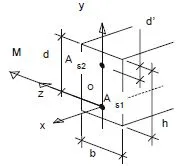
In this section, the design of a reinforced concrete section at the ultimate limit state (ULS) is considered by using a rectangular simplified law for the compression concrete block, and a bilinear law for the steel that accounts for the hardening behavior. This design is compatible with Eurocode 2 material parameters. The rectangular cross-section is shown in Figure 1.1. The steel reinforcement area has to be designed for this given concrete section.
Figure 1.1. Rectangular cross-section at ultimate limit state
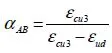
Pivot AB is characterized for the rectangular cross-section by the neutral axis position:
[1.1]
For instance, for a C30-37 type concrete and for a B500B steel, the numerical values are
(if the hardening effect is taken into account), leading to αAB = 0.072165.
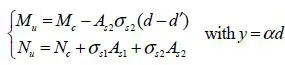
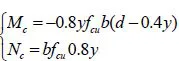
For a general reinforced concrete section, the bending moment and normal force equilibrium equations are written with respect to the center of gravity of the tensile steel reinforcement as:
[1.2]
where Nc and Mc are the normal force and moment in the compression concrete block calculated from the simplified rectangular constitutive law.
[1.3]
For a reinforced concrete section with only steel reinforcement, the bending moment equilibrium equation is written in a dimensionless format:
[1.4]
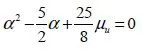
We recognize a second-order equation with respect to the position of the neutral axis α:
[1.5]
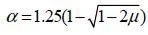
whose solution of interest is given by:
[1.6]
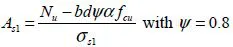
Note that this equation is independent of the pivot considered (pivot A or pivot B). Once the position of the neutral axis is calculated, the tensile steel area is obtained from the normal force equilibrium equation:
[1.7]
ψ = 0.8 for the rectangular simplified constitutive law for concrete.
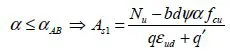
In the case of pivot A, for α ≤ α AB, the strain capacity of the tensile steel reinforcement εs1 is equal to εud, and the steel stress σs1 is equal to
(see [equation 3.91] of [CAS 12]), leading to:
[1.8]
In the case of pivot B, for α ≤ α AB the strain of the tensile steel reinforcement εs1 depends on the position of the neutral axis. If the tensile steel reinforcement behaves in elasticity, the tensile steel area is calculated from:
[1.9]
In pivot B, the tensile steel reinforcement behaves in the elastic range for:
[1.10]
In pivot B, the behavior of the reinforced cross-section, when the tensile steel reinforcement reaches the elastic strain limit εs1= εsu is called the balance failure behavior α = αbal. This behavior is observed in the presence of compression normal forces. However, in simple bending (without normal forces), the design of the reinforced cross-section when the steel reinforcements behave linearly elastically may not be efficient for economic reasons, as the tensile steel reinforcements in the elasticity range are not optimized. In this case, it is recommended to add some compression steel reinforcement to increase the stress level in the compression steel reinforcement.
If the tensile steel reinforcement behaves in plasticity, the tensile steel area has to be calculated from:
[l.11]
Consider, for instance, the case of the reinforced concrete section in simple bending (Nu = 0). The tensile steel reinforcement is assumed to be perfectly plastic without hardening (k = 1 and then q = 0 and q′ = fsu). For the perfect plasticity case considered in these numerical applications, pivot A does not exist as there is no strain limit capacity imposed by the Eurocode 2 rules (or the steel ductility is so high that it has no limited effect in the design). The steel content is obtained with the simplified rectangular diagra...
Table of contents
Cover
Contents
Title page
Copyright page
Preface
Chapter 1: Advanced Design at Ultimate Limit State (ULS)
Chapter 2: Slender Compression Members – Mechanics and Design
Chapter 3: Approximate Analysis Methods
Appendix 1: Cardano’s Method
Appendix 2: Steel Reinforcement Table
Bibliography
Index
Trusted by 375,005 students
Access to over 1.5 million titles for a fair monthly price.
Study more efficiently using our study tools.
Frequently asked questions
Yes, you can cancel anytime from the Subscription tab in your account settings on the Perlego website. Your subscription will stay active until the end of your current billing period. Learn how to cancel your subscription
No, books cannot be downloaded as external files, such as PDFs, for use outside of Perlego. However, you can download books within the Perlego app for offline reading on mobile or tablet. Learn how to download books offline
Perlego offers two plans: Essential and Complete
Essential is ideal for learners and professionals who enjoy exploring a wide range of subjects. Access the Essential Library with 800,000+ trusted titles and best-sellers across business, personal growth, and the humanities. Includes unlimited reading time and Standard Read Aloud voice.
Complete: Perfect for advanced learners and researchers needing full, unrestricted access. Unlock 1.5M+ books across hundreds of subjects, including academic and specialized titles. The Complete Plan also includes advanced features like Premium Read Aloud and Research Assistant.
Both plans are available with monthly, semester, or annual billing cycles.
We are an online textbook subscription service, where you can get access to an entire online library for less than the price of a single book per month. With over 1.5 million books across 990+ topics, we’ve got you covered! Learn about our mission
Look out for the read-aloud symbol on your next book to see if you can listen to it. The read-aloud tool reads text aloud for you, highlighting the text as it is being read. You can pause it, speed it up and slow it down. Learn more about Read Aloud
Yes! You can use the Perlego app on both iOS and Android devices to read anytime, anywhere — even offline. Perfect for commutes or when you’re on the go. Please note we cannot support devices running on iOS 13 and Android 7 or earlier. Learn more about using the app
Yes, you can access Reinforced Concrete Beams, Columns and Frames by Jostein Hellesland,Noël Challamel,Charles Casandjian,Christophe Lanos in PDF and/or ePUB format, as well as other popular books in Physical Sciences & Mechanics. We have over 1.5 million books available in our catalogue for you to explore.