This book introduces the finite element method applied to the resolution of industrial heat transfer problems. Starting from steady conduction, the method is gradually extended to transient regimes, to traditional non-linearities, and to convective phenomena. Coupled problems involving heat transfer are then presented. Three types of couplings are discussed: coupling through boundary conditions (such as radiative heat transfer in cavities), addition of state variables (such as metallurgical phase change), and coupling through partial differential equations (such as electrical phenomena). A review of the various thermal phenomena is drawn up, which an engineer can simulate. The methods presented will enable the reader to achieve optimal use from finite element software and also to develop new applications.
In this part we introduce the finite element method in the simplest field of thermal science: steady state conduction. We therefore consider a solid Ω undergoing thermal loads and try to determine the temperature field
in this solid, when it is in equilibrium with the external environment. In this part, it is assumed that no quantity involved depends on time. Thermal loads are therefore constant and the solid is motionless. The equilibrium state sought corresponds to a steady state. Besides, we will restrict our study to the linear case in which the mathematical field is clearly identified. The finite element method is introduced according to the following three steps.
Firstly, the physical problem to solve is analyzed from a mathematical point of view. This leads to a series of three problems (equations [1.8], [1.10] and [1.13]). Problem [1.8] is a partial differential equation resulting directly from physical modeling with its boundary conditions. Problem [1.10] turns this partial differential equation into a variational equation by means of the weighted residual method. Finally, problem [1.13], often called weak form, is the basis of the finite element method.
It is possible to find an approximate solution to each of the three problems [1.8], [1.10] and [1.13]. For this purpose, several methods are used. Each of them will be illustrated by a work example: an induction-heated plate. We will use a physical model to describe this example, then seek approximate solutions (the temperature field) of problems [1.8], [1.10] and [1.13] related to this physical model.
Chapter 2 deals with the finite element method. This method is based upon the weak form described in Chapter 1. The approximation used is called finite element approximation. It consists of discretizing the geometry (the mesh) and approximating the temperatures sought (nodal approximation). This step makes it possible to write the problem to solve in a discretized form, which is very appropriate for a computer numerical solution. In this chapter, the various steps of the finite element method will be illustrated by a new work example: thermal conduction in a plate with holes.
In Chapter 3, we introduce isoparametric finite elements starting from the notion of the reference element. This makes it possible to develop simple and rapid methods for the calculation of the element quantities involved in the discrete problem formulation. The major types of isoparametric elements are also described in detail in this chapter.
Chapter 1
Problem Formulation
1.1. Physical modeling
In this chapter we describe the different steps of physical modeling leading in the next section to a boundary value problem. These steps are:
1) writing the equation expressing the solid thermal equilibrium,
2) introducing the Fourier law connecting the heat flux to the temperature gradient,
3) formulating boundary conditions.
1.1.1. Thermal equilibrium equation
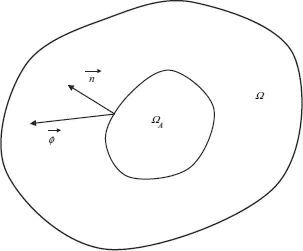
Figure 1.1 illustrates a homogenous solid Ω. In order to write that this solid is in thermal equilibrium, consider any portion ΩA related to this solid and write that the heat produced on that portion is equal to the heat flux coming out of it, i.e.:
[1.1]
In this equation,
is a vector characterizing the heat flux surface density (in W/m2) coming out of ΩA through its boundary ∂ΩA,
is the outward unit normal to this surface, and Q is a scalar representing an internal heat volumetric source (in W/m3) in ΩA. Among the physical phenomena represented by this volumetric term, we can include Joule effect heating (conduction or induction), heat dissipation by plastic deformation, etc.
Figure 1.1.Solid thermal equilibrium
If the divergence theorem is now applied (integration by ...
Table of contents
Cover
Title Page
Copyright
Introduction
PART 1: Steady State Conduction
PART 2: Transient State, Non-linearities, Transport Phenomena
PART 3: Coupled Phenomena
Bibliography
Index
Trusted by 375,005 students
Access to over 1.5 million titles for a fair monthly price.
Study more efficiently using our study tools.
Frequently asked questions
Yes, you can cancel anytime from the Subscription tab in your account settings on the Perlego website. Your subscription will stay active until the end of your current billing period. Learn how to cancel your subscription
No, books cannot be downloaded as external files, such as PDFs, for use outside of Perlego. However, you can download books within the Perlego app for offline reading on mobile or tablet. Learn how to download books offline
Perlego offers two plans: Essential and Complete
Essential is ideal for learners and professionals who enjoy exploring a wide range of subjects. Access the Essential Library with 800,000+ trusted titles and best-sellers across business, personal growth, and the humanities. Includes unlimited reading time and Standard Read Aloud voice.
Complete: Perfect for advanced learners and researchers needing full, unrestricted access. Unlock 1.5M+ books across hundreds of subjects, including academic and specialized titles. The Complete Plan also includes advanced features like Premium Read Aloud and Research Assistant.
Both plans are available with monthly, semester, or annual billing cycles.
We are an online textbook subscription service, where you can get access to an entire online library for less than the price of a single book per month. With over 1.5 million books across 990+ topics, we’ve got you covered! Learn about our mission
Look out for the read-aloud symbol on your next book to see if you can listen to it. The read-aloud tool reads text aloud for you, highlighting the text as it is being read. You can pause it, speed it up and slow it down. Learn more about Read Aloud
Yes! You can use the Perlego app on both iOS and Android devices to read anytime, anywhere — even offline. Perfect for commutes or when you’re on the go. Please note we cannot support devices running on iOS 13 and Android 7 or earlier. Learn more about using the app
Yes, you can access Finite Element Simulation of Heat Transfer by Jean-Michel Bergheau,Roland Fortunier in PDF and/or ePUB format, as well as other popular books in Physical Sciences & Thermodynamics. We have over 1.5 million books available in our catalogue for you to explore.