![]()
Chapter 1
Getting to Know Autodesk® 3ds Max® 2013
Welcome to Mastering Autodesk 3ds Max 2013. Autodesk 3ds Max is the premier software package for 3D modeling, texturing, and animation, and it has many features specifically designed to assist artists, architects, engineers, and designers in various disciplines in the realization of their projects. It includes a Software Development Kit (SDK), which is used to develop plug-ins that give the program additional functionality. 3ds Max Design is a different installation and, in addition to having all the features of 3ds Max (except for the SDK), 3ds Max Design offers two exclusive tools. The Lighting Analysis tool is used to help meet the Leadership in Energy and Environmental Design (LEED) 8.1 certification standards. The Civil Visualization Extension is a customized version of the Dynamite VSP plug-in for importing design data from AutoCAD Civil 3D or the Bentley MX design tools. In this book, we simply refer to the program as 3ds Max.
Autodesk 3ds Max 2013 provides users with cutting-edge rendering technology, easy-to-use materials, improved interoperability with other related design and CAD software, enhancements to modeling and animation tools, and better viewport interactivity than ever before.
This chapter introduces some of the special features of 3ds Max 2013, and then it gets you started working with the 3ds Max interface.
In this chapter, you will learn to
- Navigate and configure the viewports
- Dock and float toolbars
- Copy objects and use the transform tools
- Create a named selection set
Introducing the New 3ds Max 2013 Features
3ds Max 2013 is a notable release that extends the comprehensive features and functionality with new, exciting capabilities, and it also updates many existing features. This is an important release with a long list of improvements and additions that will greatly impact your projects, whether you have been using 3ds Max for a number of years or are new to the world of 3D.
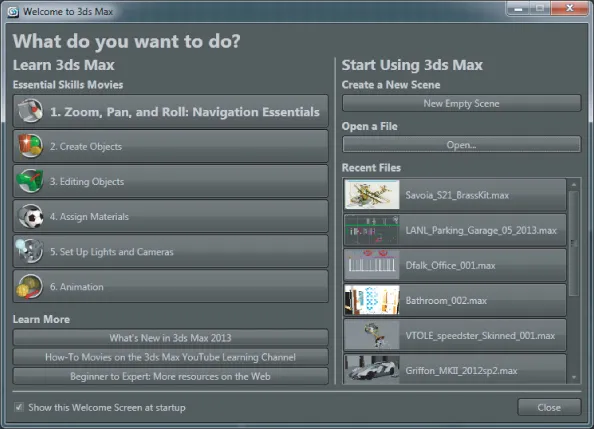
Each new version of 3ds Max incorporates fresh and exciting tools to enhance your capabilities and workflow while also increasing the performance of the program on your computer system. Utilizing these new features is a key to improving your skills and decreasing the time it takes to complete your projects. When you start the program, you are presented with the Welcome To 3ds Max dialog box (see Figure 1.1), which includes links to Essential Skills Movies, which teach many of the basic skills for using 3ds Max. It also includes a link to the “What's New” section of the Help documents, which explain the new features and links to the 3ds Max Learning Channel on YouTube. Autodesk has done a tremendous job of regularly adding new content to that channel. The Welcome To 3ds Max dialog box also provides you quick access to start a new empty scene, the Open File dialog box, and a list of the last 10 files you have opened. Note that if you don't see this dialog box, you can go to the Help menu and click Essential Skills Movies from there.
Here, in no particular order, are some of the high points of 3ds Max 2013:
Modeless Array Dialog Box
The Array dialog box is now modeless, meaning that you can interact with the 3ds Max 2013 viewports while the dialog box is open, so that you can adjust your views and see the preview of the array before you commit to it. This is a great ease-of-use update for 3ds Max.
Egg Spline
A new default shape called Egg has been added to 3ds Max. This allows you to create a closed spline that resembles an egg. The spline shape includes a built-in Outline parameter. This feature is in both 3ds Max 2013 and 3ds Max Design 2013, and it is primarily used for support of the Autodesk Civil View Pipe Network tools that work only with 3ds Max Design 2013.
Hair And Fur
Hair And Fur has seen some updates for 3ds Max 2013.
MassFX
The MassFX dynamics tools from NVIDIA have been updated and now include cloth simulation, an updated Ragdoll (formerly Skeleton) system, and a Multi-Object Editor to modify selections of objects more easily. Dynamics simulations can now take advantage of and interact with standard 3ds Max Force space warps.
gPoly
gPoly is a new mesh format designed and optimized for the internal mesh format of 3ds Max, which eliminates the conversions needed from editable mesh and poly formats. The result is faster animation when playing back high-resolution deforming objects.
Retime Tool
The new Retime Tool works in the Curve Editor to help you adjust the animation of your scenes.
Track View
The Track View menus have been updated to more closely resemble the animation editor found in Autodesk® Maya® software.
Autodesk Animation Store
The Autodesk Animation Store appears at the bottom of the Animation menu, and it opens in the Utilities tab. You can browse a selection of readymade animation clips, purchase the animation clips directly from the site, and apply them to your Biped-based characters.
Skin Modifier
The Skin Modifier has been updated to sort bones automatically in ascending or descending order and provide better content filtering of bone names based on user-entered criteria.
Workspaces
3ds Max 2013 users can now store multiple workspaces directly in a 3ds Max 2013 session. The workspaces are accessed from the Quick Access toolbar at the top of the 3ds Max interface.
State Sets
Found on the Rendering menu, state sets provide you with a way to keep and interact with different states of scenes you are editing. State sets also directly integrate with Adobe After Effects CS4 (32-bit) and CS5.x (64-bit only) so that you can send your 3ds Max 2013 scene to After Effects, make modifications, and then have those updates applied back to 3ds Max.
Viewport Layouts
The Viewport Layouts toolbar appears on the 3ds Max 2013 interface vertically along the left edge, and it allows you to store and quickly access different viewport conf...