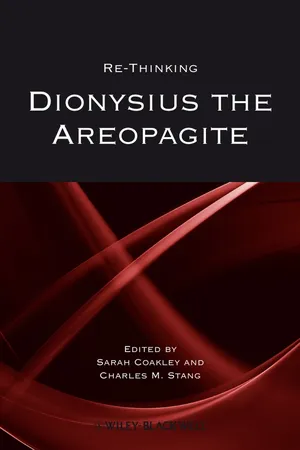
Dionysius the Areopagite, the early sixth-century Christian writer, bridged Christianity and neo-Platonist philosophy. Bringing together a team of international scholars, this volume surveys how Dionysius's thought and work has been interpreted, in both East and West, up to the present day.
One of the first volumes in English to survey the reception history of Dionysian thought, both East and West
Provides a clear account of both modern and post-modern debates about Dionysius's standing as philosopher and Christian theologian
Examines the contrasts between Dionysius's own pre-modern concerns and those of the post-modern philosophical tradition
Highlights the great variety of historic readings of Dionysius, and also considers new theories and interpretations
Analyzes the main points of hermeneutical contrast between East and West
DIONYSIUS, PAUL AND THE SIGNIFICANCE OF THE PSEUDONYM
CHARLES M. STANG
This chapter advances a new approach to the Corpus Dionysiacum: I suggest that we interpret the CD through the lens of the pseudonym, Dionysius the Areopagite, and the corresponding influence of Paul.1 We have known since the late nineteenth century, when Hugo Koch and Josef Stiglmayr published their independent demonstrations, that the author of the CD was substantially indebted to the writings of the fifth century Neoplatonist Proclus and therefore was no first century disciple of Paul but a late fifth- or early sixth-century pseudepigrapher.2 Since this revelation, however, very few scholars have regarded the pseudonym and the corresponding influence of Paul as at all relevant, never mind crucial, to a proper understanding of this author and his perplexing corpus.3 On the whole, scholars have tended to explain away the pseudonym as a convenient means either to win a wider readership for the CD or to safeguard the author from censorship and persecution in an age of anxious orthodoxies. Scholars have also tended to pass over the influence of Paul and have instead situated the CD against the backdrop of late Neoplatonism or late antique Eastern Christianity.
The influence of Paul by no means displaces the influence of late Neoplatonism or of late antique Eastern Christianity—both of which are, to my mind, undeniable. The pseudonym and the influence of Paul constitute the best interpretive lens for understanding the CD not because they push these influences to the margins, but precisely because they help us to organize, appreciate, and bring into better focus these influences. In this chapter, I will limit myself to three general points regarding Paul and the pseudonym. First, I will argue that the entire CD needs to be read against the backdrop of Paul’s speech to the Areopagus, whereupon it becomes clear that the author writes under the name of Dionysius the Areopagite in order to suggest that, following Paul, he will effect a new rapprochement between the wisdom of pagan Athens and the revelation of God in Christ. Second, I will demonstrate how crucial Paul is for Dionysius’ own “apophatic anthropology,”4 in other words, his view of how the human self that would solicit union with the “unknown God” (Acts 17:23) must also become somehow “unknown.” Third, having traced this apophatic anthropology and its attribution to Paul, I will hazard a final hypothesis regarding the significance of the pseudonym: that the practice of pseudonymous writing is itself an ecstatic devotional practice in the service of “unknowing” both God and self. This hypothesis will require a short detour through a modern theory of pseudonymous writing and evidence for that theory from the late antique Christian East.
Paul’s Speech to the Areopagus
Apart from writing under the name of Paul’s famous convert from Acts 17, Dionysius the Areopagite, the author of the CD quotes from and alludes to Paul’s life and letters more than he does all the four gospels combined or the whole of the Johannine material.5 It bears mentioning at the outset, however, that this author, along with most of his late antique peers, believed not only that Paul was the author of all the canonical letters (perhaps including Hebrews), but also that his words and deeds were reliably recorded in Acts and even in certain apocryphal texts. In what follows, then, “Paul” refers to this collective literary portrait, not to the modern historical Paul, author of only some of the canonical letters. The most obvious and relevant episode from the life of Paul is his missionary speech to the court of the Areopagus in Athens, as recorded in Acts 17, which begins:
Athenians, I see how extremely religious you are in every way. For as I went through the city and looked carefully at the objects of your worship, I found among them an altar with the inscription, “To an unknown God.” What therefore you worship as unknown, this I proclaim to you. (17:22–23).
Paul begins his speech with characteristic irony. The barb of his comment is more keenly felt in the Greek: the word
can mean exceedingly “superstitious” or “bigoted” just as easily as “pious” or “religious.”6 Paul holds the attention of his audience with flattery so that he can deftly appropriate their own altar “to an unknown god”: what had been established as a safety measure honoring foreign gods still unknown to the Hellenistic world is now transformed in Paul’s hands into the sign of an incipient faith.7 Throughout his speech, Paul appeals to this incipient faith by drawing on his audience’s own literary, philosophical, and religious lexicon—even citing a famous poet to the effect that “we too are [God’s] offspring” (17:28). Paul concludes with a call to repentance and the promise of a day of judgment “by a man whom [God] has appointed, and of this [judgment] [God] has given assurance to all by raising him from the dead” (17:31). Paul thereby establishes a new order: the new dispensation absorbs and subordinates the incipient faith. The resurrected Christ stands with the unknown god at the zenith of this new order, which baptizes ancient wisdom into a new life.
Acts 17:34 says that “some of [the Athenians] joined [Paul] and became believers, including Dionysius the Areopagite.” One would expect that the author who wrote under the name of this Athenian judge would make much of his conversion, and yet nowhere in the CD does Dionysius seem to mention this event or quote from Paul’s rousing speech. Why does he choose to write under the name of a man converted by precisely this speech?
Paul intends in his speech to enfold pagan wisdom into Christian revelation. But whereas Athens is for Paul both a place “full of idols” and home of the altar “to an unknown god,” it is for our author the seat of Plato’s Academy and its diadochoi or “successors,” especially Proclus.8 Might our author be turning to Paul—especially the Paul who speaks to the Areopagus—in order to provide a template for absorbing and subordinating pagan wisdom? Might our author, steeped in Neoplatonism as he surely is, be taking on the role of a convert of Paul precisely to make the point that the riches of Neoplatonism do not constitute “foreign divinities” (17:18) but rather an incipient faith?
This would certainly square with Paul’s letter to the Romans, where he laments the fact that although all of the nations once knew God’s “eternal power and divine nature” (1:20), all but the Jews fell away from this ancient faith and “became fools” (1:22). The gentiles “exchanged” (1:23, 25) their ancient faith in God for idolatrous images and human foolishness masquerading as wisdom. For our author, this is no less evident in his day than it was in Paul’s. Just as for Paul the pagan literary, philosophical and religious traditions of Athens still bear the traces of their knowledge of God—preeminently the inscription to “an unknown god”—so too for our author the Neoplatonic tradition bears traces of that same ancient knowledge of God that was subsequently corrupted by human folly. This is corroborated by Dionysius’ “Seventh Letter,” in which he calls on Paul to help him rebut a certain sophist, Apollophanes, who has charged him with “patricide” for “making unholy use of things Greek to attack the Greeks.”9 Dionysius is said to be guilty of betraying his paternal tradition, subordinating Greek wisdom to his faith in Christ. Dionysius responds that it is the Greeks who are guilty, for it is they “who make unholy use of godly things to attack God.”10 God has given the Greeks “wisdom” and “divine reverence” which they have squandered. This gift was none other than the “knowledge of beings” or “philosophy.”11 Had they remained faithful to the true philosophy revealed to them by God in ancient times, “true philosophers [would have been] uplifted to him who is the Cause not only of all beings but also of the very knowledge which one can have of these beings.”12
The pseudonym suggests that the entire CD needs to be understood against the backdrop of Paul’s speech to the Areopagus, that is, as an attempt to enfold pagan wisdom into the new order and dispensation in Christ.13 On this reading, the fact that the CD is shot through with Plotinus, Iamblichus, and Proclus should not be taken as evidence of corruption by alien wisdom, but rather as an effort to show that much within this philosophical tradition still bears the seal of God. If this is the case, Dionysius can sample widely and deeply from this tradition, as long as Christian revelation remedies the human folly that prevents this tradition from being truly uplifting.
By way of the pseudonym and the shadow of Paul, therefore, the author actually tells us how to interpret his own substantial debt to Neoplatonism. One result of this interpretatio sui is that many of the features that have struck modern scholars as manifestly Neoplatonic and therefore as obvious evidence of his true allegiance to pagan philosophy are, on this construal, better understood as features of the original philosophy revealed by God and marshaled by Paul to bring the wayward Greeks back into the fold. For example, the simultaneous divine operations of procession, rest and return (,
and
), which form the backbone of Neoplatonic metaphysics, are, according to our author, technical terms derived from Paul, who says of God in his letter to the Romans (11:36) that “from him and through him and to him are all things” (
).14
So too with Dionysius’ widespread appeal to “theurgy” (,
a contraction of
= the “work of God”): modern scholars have either cited his appeal to theurgy as evidence of his true identity as a Neoplatonist or desperately sought to distance him from theurgy so as to safeguard his Christian identity.15 The practice of theurgy or “god-work” became popular in the second century after the widespread circulation of a collection of oracular sayings, The Chaldean Oracles, which were composed—or channeled—by a father and son team, both named Julian.16 According to the oracles, the heavens are teeming with gods and spirits. Between this busy heavenly realm and our own there exists a secret “sympathy,” which, when understood, permits the theurgist, or “god-worker,” to use the earthly to manipulate the heavenly, that is, to use special elements and words in rituals in order to compel the gods to do our bidding. In the late third and early fourth century, the philosopher Iamblichus, a student of Plotinus and rival of Porphyry, offered a philosophical defense of the practice of theurgy. His Onthe Mysteries, however, shifts the understanding of what is at work in theurgy and how.17 For Iamblichus, we do not compel the gods to do our bidding, but rather we step into the stream of divine work and are thereby deified.
Dionysius borrows the language of “theurgy” directly from Iamblichus, and means by it much the same as the pagan philosopher did, namely that we step into the saving work of God and are thereby deified.18 The difference between the two, of course, comes down to what each believes the...
Table of contents
Cover
Title
Copyright
INTRODUCTION—RE-THINKING DIONYSIUS THE AREOPAGITE
1: DIONYSIUS, PAUL AND THE SIGNIFICANCE OF THE PSEUDONYM
2: THE EARLIEST SYRIAC RECEPTION OF DIONYSIUS1
3: THE RECEPTION OF DIONYSIUS UP TO MAXIMUS THE CONFESSOR
4: THE RECEPTION OF DIONYSIUS IN THE BYZANTINE WORLD: MAXIMUS TO PALAMAS
5: THE EARLY LATIN DIONYSIUS: ERIUGENA AND HUGH OF ST. VICTOR
6: THE MEDIEVAL AFFECTIVE DIONYSIAN TRADITION
7: ALBERT, AQUINAS, AND DIONYSIUS
8: DIONYSIUS AND SOME LATE MEDIEVAL MYSTICAL THEOLOGIANS OF NORTHERN EUROPE
9: CUSANUS ON DIONYSIUS: THE TURN TO SPECULATIVE THEOLOGY1
10: LUTHER AND DIONYSIUS: BEYOND MERE NEGATIONS
11: DIONYSIAN THOUGHT IN SIXTEENTH-CENTURY SPANISH MYSTICAL THEOLOGY
12: THE RECEPTION OF DIONYSIUS IN TWENTIETH-CENTURY EASTERN ORTHODOXY
13: DIONYSIUS, DERRIDA, AND THE CRITIQUE OF “ONTOTHEOLOGY”
14: DIONYSIUS IN HANS URS VON BALTHASAR AND JEAN-LUC MARION
Index
Trusted by 375,005 students
Access to over 1.5 million titles for a fair monthly price.
Study more efficiently using our study tools.
Frequently asked questions
Yes, you can cancel anytime from the Subscription tab in your account settings on the Perlego website. Your subscription will stay active until the end of your current billing period. Learn how to cancel your subscription
No, books cannot be downloaded as external files, such as PDFs, for use outside of Perlego. However, you can download books within the Perlego app for offline reading on mobile or tablet. Learn how to download books offline
Perlego offers two plans: Essential and Complete
Essential is ideal for learners and professionals who enjoy exploring a wide range of subjects. Access the Essential Library with 800,000+ trusted titles and best-sellers across business, personal growth, and the humanities. Includes unlimited reading time and Standard Read Aloud voice.
Complete: Perfect for advanced learners and researchers needing full, unrestricted access. Unlock 1.5M+ books across hundreds of subjects, including academic and specialized titles. The Complete Plan also includes advanced features like Premium Read Aloud and Research Assistant.
Both plans are available with monthly, semester, or annual billing cycles.
We are an online textbook subscription service, where you can get access to an entire online library for less than the price of a single book per month. With over 1.5 million books across 990+ topics, we’ve got you covered! Learn about our mission
Look out for the read-aloud symbol on your next book to see if you can listen to it. The read-aloud tool reads text aloud for you, highlighting the text as it is being read. You can pause it, speed it up and slow it down. Learn more about Read Aloud
Yes! You can use the Perlego app on both iOS and Android devices to read anytime, anywhere — even offline. Perfect for commutes or when you’re on the go. Please note we cannot support devices running on iOS 13 and Android 7 or earlier. Learn more about using the app
Yes, you can access Re-thinking Dionysius the Areopagite by Sarah Coakley, Charles M. Stang, Sarah Coakley,Charles M. Stang in PDF and/or ePUB format, as well as other popular books in Theology & Religion & Religion. We have over 1.5 million books available in our catalogue for you to explore.