- Includes chapters on connecting content to the calendar, writing for online publications, trends, issues and controversies, and writing dramatic stories
- New chapters in this edition include 'How To Find A Magazine Job', 'Last Chance: The Final Draft', and 'Writing for Trades, Associations and Organizations'
- New sections in this edition include 'Improving Your Pizzazz and 'Original Research = Original Articles'
- English
- ePUB (mobile friendly)
- Available on iOS & Android
eBook - ePub
About this book
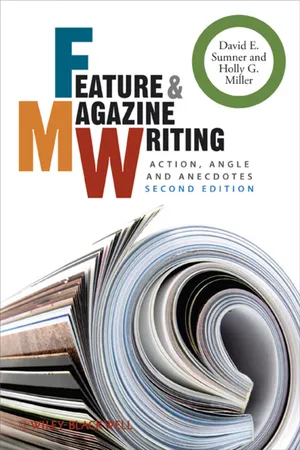
This fully revised and updated edition of Feature and Magazine Writing covers everything from finding original ideas to locating expert sources. With fresh perspectives and advice from professional writers and editors, this colorfully-written introduction is required reading for anyone who wishes to become a strong feature writer.
Information
PART I
PREPARING TO WRITE FEATURE AND MAGAZINE ARTICLES
The process begins with an interesting and fresh idea so tightly focused that the writer can summarize it in a single sentence. The research phase follows and takes two forms: a thorough exploration of existing materials, and thoughtful interviews conducted with knowledgeable and quotable sources.
1
CAPTURING READER ATTENTION
Your takeaway . . .
Characteristics of compelling stories include strong action, specific angles and plenty of anecdotes. This chapter will tell you why these are important ingredients in your writing recipes. You will learn the five most common mistakes of beginning writers and how to avoid those mistakes. You also will learn the differences between newspaper and magazine writing and why you should learn as much as you can about your readers.
“Do you know, Madam, that I would rather write for a magazine for $2 a page than for a newspaper at $10? I would. One takes more pains, . . . looks nicer in print and . . . has a pleasanter audience.”[Mark Twain in a letter to Mary Fairbanks, May 29, 1870]
“China’s Instant Cities” in National Geographic chronicles the booming growth of cities and factories along China’s northern coast where newly constructed factories churn out everything from playing cards and neckties to table-tennis paddles and socks. To illustrate the country’s growth, reporter Peter Hessler told the story of the creation and growth of a family-owned company named “Lishui Yashun Underdress Fittings Industry Co., Ltd.,” which makes wire fittings required in the manufacture of women’s bras.1
“Pat Dollard’s War on Hollywood” in Vanity Fair told the story of Dollard, a wealthy Hollywood agent and filmmaker, who abandoned Hollywood’s “inner circle” to travel to Iraqi war zones, where he was injured and almost killed while producing a documentary that supported America’s war effort. His story was later made into a movie with the same title.2
An article in Atlanta Magazine, “You Have Thousands of Angels Around You,” told a heart-tugging story about Cynthia Siyomvo, a 17-year-old refugee from Burundi who, after arriving in Atlanta without any family, faced the threat of deportation. But soon she discovered a circle of new friends who helped her find a home and began pursuing a biology degree and a career in medicine.3
These three stories won National Magazine Awards, the magazine industry’s most prestigious awards—equal to the Pulitzer Prizes among newspapers. “China’s Instant Cities” won the NMA for Reporting, “Pat Dollard’s War on Hollywood” won the top award for Profile Writing, and “You Have Thousands of Angels Around You” won the NMA’s top honor for Feature Writing.
These stories also provide rich examples of action, angle and anecdotes, which comprise the three primary ingredients of interesting writing. “There is a principle of writing so important, so fundamental that it can be appropriately called the First Law of Journalism and it is simply this: be interesting,” wrote Benton Patterson, a former Guideposts editor and author of Write To Be Read.4 This book’s title includes Action, Angle and Anecdotes because we believe that lively action, a fresh, creative angle and lots of anecdotes characterize interesting writing that keeps readers interested and involved.
Action. These stories tell about Chinese cities and factories that grew out of nowhere, a street-side bomb that injured a Hollywood filmmaker in Iraq, and a Burundi teenage girl who discovered a new circle of friends and support from a southern American city.
Action is one characteristic of interesting stories. “Readers love action, any kind of action, and the story that does not move, that just sits there stalled while people declaim, explain, elaborate and suck their thumbs is justly labeled by some editors as MEGO—My Eyes Glaze Over,” said William Blundell, in The Art and Craft of Feature Writing.5
Angle. These stories don’t vaguely describe “Chinese industrial growth” or the “status of refugees in the United States.” They have a focus—an angle on specific people who have a story to tell that illuminates larger issues, such as the war in Iraq.
An angle makes a story interesting because it provides enough detail about a subject to give the reader some fresh, original information. Broad subjects are vague, fuzzy and boring. Fresh angles give insight into old topics. You have to find a tiny slice that no one has cut before from a broad topic (such as “time management” or “weight loss”) to make a publishable article out of it.
Anecdotes. These three stories contain dozens of anecdotes, which is another way of describing real-life examples and illustrations. They tell specific stories about specific people doing specific things at specific times and in specific places.
Anecdotes make articles interesting by telling true stories about people doing things. Many articles begin with an anecdote for a good reason: anecdotes tell a story—a tiny tale that draws us into the larger one. They illustrate the meaning of the information that follows. Nothing is more involving or revealing than human drama, and anecdotes capture drama with impact.
SIDEBAR 1
Best American Magazines
Over the past 25 years, these 10 magazines have won more National Magazine Awards than any others. The National Magazine Awards—given by the American Society of Magazine Editors—are the magazine industry’s top honors.
The New Yorker
National Geographic
Newsweek
Vanity Fair
Esquire
Sports Illustrated
Rolling Stone
Wired
Time
BusinessWeek
Feature stories are sometimes called “human-interest stories.” Good writers understand people as well as they know the language. They are sensitive, socially connected individuals who have an innate sense for finding and writing stories that interest humans. The more you talk to people, the more you understand what people are interested in hearing and discussing.
When most people pick up a magazine or the feature section of a newspaper, they’re looking for entertainment or information. If a guy snoozes with an unfinished feature article on his lap, then the publication hasn’t done its job. You can’t argue that he’s too lazy to understand the challenging content. Our sympathies are with the reader. If he got bored, it’s because the writers didn’t do their job. Great writing is all about reaching the reader through the use of compelling action, specific angles and colorful anecdotes.
FIVE MISTAKES OF BEGINNING WRITERS
After reading thousands of student-written articles for more than 30 years, we’ve created a list of the most common mistakes we’ve seen. We will start by explaining these five common mistakes and tell you how this book will teach you to avoid them.
Staying safe in your own backyard
Too many new writers rely on home-grown situations for article ideas and personal connections for interviews. They want to write about themselves, their parents, brothers and sisters, aunts and uncles or grandparents. Probably every person has a couple of good stories that originate among relatives. But once you write those stories, your tank is empty. You can’t become a successful writer by staying in your own backyard. You can’t rely on personal experience for more than a few article ideas or limit interviews to those people you know.
The main problem with writing about friends or family members is the writer’s lack of objectivity and detachment. For example, what seems fascinating to you about your father may, in fact, be commonplace and boring to most readers. The Model Code of Ethics published by the Associated Collegiate Press says collegiate journalists “Should not cover . . . or make news judgments about family members or persons with whom they have a financial, adversarial or close sexual or platonic relationship.” Another reason for avoiding these convenient sources is that they fail to challenge you to venture outside your backyard and find the article ideas and sources you will need to discover week after week and year after year if you want to become a successful journalist. You also won’t be challenged to work in your professional mode as you prepare and execute a probing interview.
Meg Grant, former West Coast editor for the Reader’s Digest, says: “You really have to be fearless about approaching people and getting them to give you what you need. I think they will often give it to you if you ask them.” She says that years ago when she worked for People magazine, an editor assigned her to interview the families of three children killed by a drunk driver, who was also a celebrity athlete:
The editor told me, “You have to knock on their door and talk to some of these victims’ families. I know you think they don’t want to talk to you, but the truth is they do. They want to talk to someone and they want to tell you about their kids.” So I had to go bang on those people’s doors and say, “Would you talk to me?” And he was right. They did want to talk.6
Some students don’t read enough outside of class assignments to know the difference between an original and an unoriginal idea. We know a journalism professor who begins each semester with a student survey that asks class members to list the magazines and newspapers that they read on a regular basis. The vast majority report that they don’t read any print publication but depend on the Internet to gi...
Table of contents
- Cover
- Title page
- Copyright
- PREFACE: THE FUTURE OF MAGAZINES IS BRIGHT
- PART I: PREPARING TO WRITE FEATURE AND MAGAZINE ARTICLES
- PART II: SELLING FEATURE AND MAGAZINE ARTICLES
- PART III: WRITING FEATURE AND MAGAZINE ARTICLES
- PART IV: DIFFERENT TYPES OF FEATURE AND MAGAZINE ARTICLES
- PART V: POSTSCRIPT
- Appendix 1: SHOPTALK—A GLOSSARY OF MAGAZINE LINGO
- Appendix 2: SUGGESTED IN-CLASS ACTIVITIES AND ASSIGNMENTS
- INDEX
Trusted by 375,005 students
Access to over 1.5 million titles for a fair monthly price.
Study more efficiently using our study tools.
Frequently asked questions
Yes, you can cancel anytime from the Subscription tab in your account settings on the Perlego website. Your subscription will stay active until the end of your current billing period. Learn how to cancel your subscription
No, books cannot be downloaded as external files, such as PDFs, for use outside of Perlego. However, you can download books within the Perlego app for offline reading on mobile or tablet. Learn how to download books offline
Perlego offers two plans: Essential and Complete
- Essential is ideal for learners and professionals who enjoy exploring a wide range of subjects. Access the Essential Library with 800,000+ trusted titles and best-sellers across business, personal growth, and the humanities. Includes unlimited reading time and Standard Read Aloud voice.
- Complete: Perfect for advanced learners and researchers needing full, unrestricted access. Unlock 1.5M+ books across hundreds of subjects, including academic and specialized titles. The Complete Plan also includes advanced features like Premium Read Aloud and Research Assistant.
We are an online textbook subscription service, where you can get access to an entire online library for less than the price of a single book per month. With over 1.5 million books across 990+ topics, we’ve got you covered! Learn about our mission
Look out for the read-aloud symbol on your next book to see if you can listen to it. The read-aloud tool reads text aloud for you, highlighting the text as it is being read. You can pause it, speed it up and slow it down. Learn more about Read Aloud
Yes! You can use the Perlego app on both iOS and Android devices to read anytime, anywhere — even offline. Perfect for commutes or when you’re on the go.
Please note we cannot support devices running on iOS 13 and Android 7 or earlier. Learn more about using the app
Please note we cannot support devices running on iOS 13 and Android 7 or earlier. Learn more about using the app
Yes, you can access Feature and Magazine Writing by David E. Sumner,Holly G. Miller in PDF and/or ePUB format, as well as other popular books in Languages & Linguistics & Communication Studies. We have over 1.5 million books available in our catalogue for you to explore.