![]()
Chapter 1
Introduction
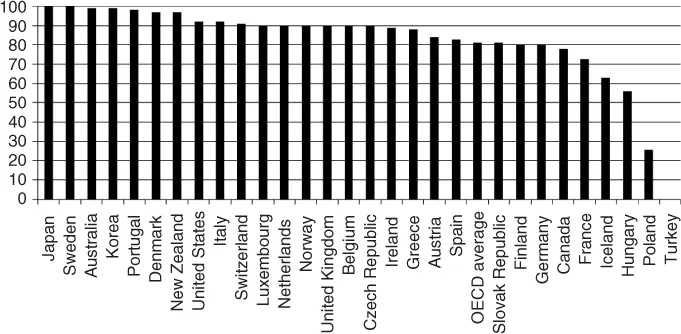
Without doubt, both cellular phones and the Internet have had a great impact on our lives. Since their introduction in the late 1970s and the early 1980s, the demand for cell phones has had a steady growth in terms of usage and popularity. Initially aimed at “mobilizing” telephony service, mobile communications have gone from bettering voice quality, to adding basic exchanges, to the currently witnessed proliferation of delivering fully fledged multimedia services. This latter evolution was motivated, and made feasible, by the exponential popularity that the Internet has undergone since its introduction to the general public in the mid 1990s. Indeed, the Internet has evolved much since then, and has managed to span the introduction of various multimedia services, ranging from emails and file transfers, to live voice and video streams. By the end of the 1990s, extending Internet services to mobile telecommunications was foreseen as a natural evolution. The many efforts made at the time pursuing such extension—both in the industrial and research sectors can already be seen in today's widely deployed Third Generation (3G) networks. The popularity of today's 3G networks was further strengthened by the introduction of truly smart cellular phones, or smart phones, which featured highly usable interfaces and ease of installation of software applications and packages. Figure 1.1 shows the 3G coverage in the some countries, as calculated by the Organization for Economic Cooperation and Development (OECD) [1].
The advent of a capable mobile Internet has made possible many new services and applications, and has impacted nearly all public and private service sectors. With the recent evolutions of 3G technologies, namely HSPA+, users are able to interact live and through both voice and video with their friends and partners. At the same time, sharing services and social networks resulted in multitudes of text, voice and video statuses and snapshots being constantly uploaded. Users are also able to access their work and financial documents on the go, and connect to their working stations that reside either at their offices or in the Internet cloud, greatly enhancing their productivity over the air. Meanwhile, doctors and caregivers are able to monitor the vitals and the state of their patients remotely, immensely reducing costs incurred for commuting and hospital stays costs and improving the patients' overall wellbeing. Third generation networks have also enabled location based services, already being utilized by various targeted advertisements and reward-based credit cards. Such location based services are also enabling the tracking of vehicles, cargo trucks and products nationwide and in real time.
Indeed, much of the above services—and more—can already be witnessed. Despite such possibilities, the increasing demand and popularity of mobile applications and services, in addition to the growing dependence on Internet applications and services in the various sectors (government, commerce, industry, personal, etc.) is calling for a more reliable broadband connectivity that can be made anytime and anywhere. In addition, and as will be noted below, the elemental characteristics of 3G networks hindered their capability of handling this increased demand. Hence, the International Telecommunications Union—Radiocommunications Sector (ITU-R) sought in 2006 to initiate efforts towards realizing more capable networks. The resulting network would mark a substantial improvement over current networks, and facilitate a smooth transition in next generation networks. Such improvements would inevitably include enhancements to both the access network, that is, the Radio Interface Technologies (RITs), and the core network, that is, network management interface.
The intention of this book is to provide an overview of the two Radio Interface Technologies (RITs) that were presented by the Third Generation Partnership Project (3GPP) and the Institute for Electrical and Electronics Engineer (IEEE) in response the ITU-R requirements letter for Fourth Generation (4G), or IMT-Advanced networks. The letter, issued in 2008, identified the target performance criteria in which the candidate technologies must outperform 3G networks. Both candidate technologies, namely 3GPP's Long Term Evolution—Advanced (LTE-Advanced) and IEEE's 802.16m, were approved by the ITU-R Working Party 5D in October 2010 as initially satisfying the basic requirements.
The objective of this chapter is to elaborate on the motivation for IMT-Advanced networks. The following section summarizes the evolution of the wireless generations, indicating the great advances that have thus far been achieved in wireless communications in general. We next elaborate on the exact motivations for IMT-Advanced. Section 1.3 describes the expected features of IMT-Advanced systems, and the elements of performance used to specify their requirements. Section 1.4 then introduces the two RIT that have been recently approved as satisfying the ITU-R requirements. Finally, Section 1.5 details an overview of the book.
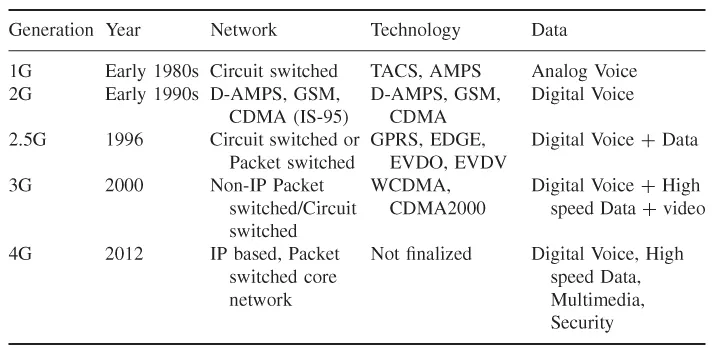
Table 1.1 Generations of cellular technologies [2]
1.1 Evolution of Wireless Networks
Table 1.1. summarizes the history of cellular networks. Through the generations, emphases have been made on different design objectives, ones that best served the requirements of the time.
Interest in the First Generation (1G) cellular, for example, focused on mobilizing landline telephony. The outcome networks, Advanced Mobile Phone Systems (AMPS) and Total Access Communication Systems (TACS), were circuit switched with analog voice transmission over the air. A definite drawback of analog transmission was a generally degraded quality and an extreme sensitivity to basic mobility and medium conditions. Hence, the main design objective in Second Generation (2G) cellular networks was to enhance voice quality. The standards responded by replacing analog voice transmission with digital encoding and transmission, immensely improving voice communication. Improvements to the network core also facilitated the introduction of basic digital messaging services, such as the Short Messaging Service (SMS). The two main standards comprising 2G networks were Global System for Mobile Communications (GSM) and Interim Standard 95 (IS-95), commercially called (cdmaOne). GSM relied mostly on Time Division Multiple Access (TDMA) techniques, while cdmaOne, as the name suggests, utilized Code Division Multiple Access (CDMA). Such division, in addition to variation in the spectrum bands utilized for deployments in different regions, would mark a characteristic interoperability problem that was to be witnessed for a substantial period of time afterwards.
The introduction and the increasing popularity of the 2G technologies coincided with the early years of the Internet. As the Internet experienced an exponential growth in usage, interest in having digital and data services of wireless and mobile devices began to materialize. Evolutions for the two main 2G technologies, GSM into General Packet Radio Services (GPRS) and Enhanced Data Rates for GSM Evolution (EDGE) and cdmaOne into cdmaTwo (IS-95b), enhanced the network cores to be able to handle simple data transfers. For example, GPRS introduced two components, the GPRS Support Node (SGSN) and the Gateway GPRS Support Node (GGSN). The objectives of these components was to augment the existing GSM infrastructure to facilitate data access at the RIT level (SGSN), and to facilitate interconnecting the GPRS network with other data networks, including the Internet (GGSN). Basic email and mobile web access were enabled, but the sophistication of the general mobile Internet experience did not allow popular access, and restricted its usage to the enterprise.
In 1999, the ITU approved five radio interfaces comprising the IMT-2000 technologies. These were the EDGE, cdma2000, Universal Mobile Telecommunication System (UMTS) (Wideband—CDMA (W-CDMA), Time-Division—CDMA (TD-CDMA) and Time Division-Synchronous CDMA (TD-SCDMA)) and Digital Enhanced Cordless Telecommunications (DECT). In 2007, Worldwide Interoperability for Microwave Access (WiMAX) was also recognized as an IMT-2000 technology. These technologies make up the 3G networks. In their design, great emphasis was given to enhance the support for voice services, expand and enhance the support for data services, and enable multimedia to the mobile handset. 3G technologies are sometimes classified based on their nature, with EDGE and CDMA2000 recognized as being evolutionary technologies, that is, enhancing their 2G predecessor technologies, and UMTS and WiMAX as revolutionary, that is, based on completely new radio interfaces. In the case of UMTS, it was WCDMA, while WiMAX relied on Orthogonal Frequency Multiple Access (OFDMA). As will be illustrated in the next chapter, the viability of sub-carrier allocation facilitated by OFDMA has made it the multiple access technique of choice in 4G networks.
3G technologies displayed, and still display, that Internet access through a mobile handset can provide users with a rich experience. The recent widespread of smart phones and pads offered by various vendors indicates the strong demand for such services. However, 3G technologies have faced certain challenges in accommodating the increasing demand. These include deteriorating quality o...