Industrial high pressure processes open the door to many reactions that are not possible under 'normal' conditions. These are to be found
in such different areas as polymerization, catalytic reactions, separations, oil and gas recovery, food processing, biocatalysis and more.
The most famous high pressure process is the so-called Haber-Bosch process used for fertilizers and which was awarded a Nobel prize.
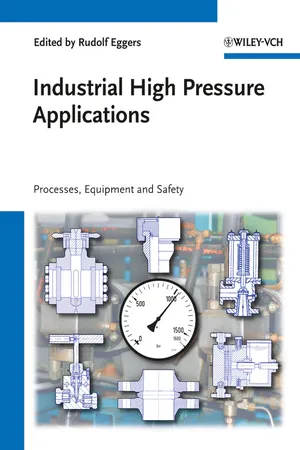
Following an introduction on historical development, the current state, and future trends, this timely and comprehensive publication goes on to describe different industrial processes, including methanol and other catalytic syntheses, polymerization and renewable energy processes, before covering safety and equipment issues.
With its excellent choice of industrial contributions, this handbook offers high quality information not found elsewhere, making it invaluable
reading for a broad and interdisciplinary audience.
- English
- ePUB (mobile friendly)
- Available on iOS & Android
eBook - ePub
About this book
Information
Part I
Introduction
Chapter 1
Historical Retrospect on High-Pressure Processes
The historical development of high-pressure processes since the beginning of the industrial period is based on two concepts: first, the transfer of the inner energy of water vapor at elevated pressures into kinetic energy by the invention of the steam engine; second, the movement of gas-phase reaction equilibrium at high pressures enabling the production of synthetic products like ammonia. Thus, the industrial use of high-pressure processes goes back to both mechanical and chemical engineering. Beginning in the second half of the eighteenth century, the need of safe and gas-tight steam vessels up to few megapascals became essential because that time many accidents happened by bursting of pressure vessels. Chemical industry started high-pressure synthesis processes in the early twentieth century. Compared to moderate working pressures of steam engines, the pressure range now was extremely high between 10 and 70 MPa. As a consequence, a fast growing requirement for high-pressure components like high-pressure pumps, compressors, heat transfer devices, tubes and fittings, reliable sealing systems, and in particular new pressure vessel constructions developed.
Besides, mechanical and chemical engineering material science has promoted the development of new high-pressure processes by creating high ductile steels with suitable strength parameter.
Finally, the safety of high-pressure plants is of outstanding importance. Thus, in the course of development, national safety rules for vessels, pipes, and valves have been introduced by special organizations. For example, in 1884, the American Society of Mechanical Engineering (ASME) launched its first standard for the uniformity of testing methods of boilers. The German society TÜV was founded in 1869 in order to avoid the devastating explosions of steam vessels.
The following list of year dates shows essential milestones of high-pressure processes concerning their development and technical design:
1680: Papins construction of the first autoclave for evaporating water. The design shows the idea of an early safety valve working on an adjustable counterbalance.
1769: James Watt introduced the steam engine transferring thermal energy in motive power.
1826: Jacob Perkins demonstrated the compressibility of water by experiments above 10 Mpa. Caused by the increasing application of steam engines, the boiling curve of different media became of interest. It was observed that boiling temperatures increase with rising pressure. That time one assumes a remaining coexistence of liquid and gas phase up to any high pressure. It was the Irish physicist and chemist Thomas Andrews who in 1860 disproved this assumption. On the basis of experiments with carbon dioxide, he was able to demonstrate a thermodynamic state with no difference between liquid and gas phase characterized by a distinct value of temperature, pressure, and density. This point has been called the “critical point.”
1852: J.P. Joule and W. Thompson discovered the cooling effect caused by the expansion of gases during pressure release.
1873: J.D. van der Waals gives a plausible explanation for the behavior of fluids at supercritical condition.
1900: W. Ostwald claimed a patent on the generation of ammonia by the combination of free nitrogen and hydrogen in the presence of contacting substances.
1913: F. Haber and C. Bosch: First commercial plant synthesizing ammonia from nitrogen and hydrogen at 20 Mpa and 550 °C. The reactors were sized at an inner diameter of 300 mm and a length of 8 m. The productivity of one reactor was 5 ton/day [1]. The pressure vessel was equipped with an in-line tube made from soft iron and degassing holes in order to protect the pressure-resistant walls against hydrogen embrittlement. This process was the forerunner of many others that have been developed into commercial processes [2].
1920: First application of methanol synthesis as a conversion of carbon monoxide and hydrogen at a pressure of 31 MPa and temperatures between 300 and 340 °C.
1924: First industrial plant for direct hydrolysis of fuel from coal at 70 MPa based on the Bergius process, which was claimed at 1913.
1953: Initiation of a polyethylene production at about 250 MPa.
1978: First commercial decaffeination plant using supercritical carbon dioxide as a solvent.
The development of high-pressure vessel design is characterized by the initiation of seamless and forged cylindrical components. The two versions are the forged solid wall construction and a group of different layered wall constructions. Among these, the BASF Schierenbeck vessel plays an important role, because these vessels are manufactured without welding joints. Figure 1.1 presents an overview.
Figure 1.1 Survey on high-pressure vessel design [3]....
Table of contents
- Cover
- Related Titles
- Title Page
- Copyright
- Preface
- List of Contributors
- Part I: Introduction
- Part II: Processes
- Part III: Process Equipment and Safety
- Appendix: International Codes and Standards for High-Pressure Vessels
- Index
Trusted by 375,005 students
Access to over 1.5 million titles for a fair monthly price.
Study more efficiently using our study tools.
Frequently asked questions
Yes, you can cancel anytime from the Subscription tab in your account settings on the Perlego website. Your subscription will stay active until the end of your current billing period. Learn how to cancel your subscription
No, books cannot be downloaded as external files, such as PDFs, for use outside of Perlego. However, you can download books within the Perlego app for offline reading on mobile or tablet. Learn how to download books offline
Perlego offers two plans: Essential and Complete
- Essential is ideal for learners and professionals who enjoy exploring a wide range of subjects. Access the Essential Library with 800,000+ trusted titles and best-sellers across business, personal growth, and the humanities. Includes unlimited reading time and Standard Read Aloud voice.
- Complete: Perfect for advanced learners and researchers needing full, unrestricted access. Unlock 1.5M+ books across hundreds of subjects, including academic and specialized titles. The Complete Plan also includes advanced features like Premium Read Aloud and Research Assistant.
We are an online textbook subscription service, where you can get access to an entire online library for less than the price of a single book per month. With over 1.5 million books across 990+ topics, we’ve got you covered! Learn about our mission
Look out for the read-aloud symbol on your next book to see if you can listen to it. The read-aloud tool reads text aloud for you, highlighting the text as it is being read. You can pause it, speed it up and slow it down. Learn more about Read Aloud
Yes! You can use the Perlego app on both iOS and Android devices to read anytime, anywhere — even offline. Perfect for commutes or when you’re on the go.
Please note we cannot support devices running on iOS 13 and Android 7 or earlier. Learn more about using the app
Please note we cannot support devices running on iOS 13 and Android 7 or earlier. Learn more about using the app
Yes, you can access Industrial High Pressure Applications by Rudolf Eggers in PDF and/or ePUB format, as well as other popular books in Technology & Engineering & Chemical & Biochemical Engineering. We have over 1.5 million books available in our catalogue for you to explore.