![]()
Chapter 1
Introduction
Publish/subscribe (pub/sub) technology encompasses a wide number of solutions that aim at solving a vital problem pertaining to timely information dissemination and event delivery from publishers to subscribers [1, 2]. In this chapter, we give an overview to pub/sub systems, examine their history, and motivate the contents and structure of this book.
1.1 Overview
The pub/sub paradigm is very useful in describing and monitoring the world around us. Any person meets a constant barrage of events in his waking hours. Most of these events are irrelevant and they should not be allowed to consume the decision maker's resources of awareness, watchfulness, processing and deciding upon actions. Some events are useful to notice and then there are others which are important, even critically important and create the need to muster all the tools and resources to hand. The ability to be aware of a rich stream of events with minimal exertion and to immediately detect critical events for further processing is central to any successful person or organization. The task of efficient event awareness is formidable.
There are a couple of mitigating factors, though. Typically we might know something about the probable sources of interesting events, although we are not actually interested in knowing who sends the notification of an event. Also we might know in advance something about the type of interesting events and can use this knowledge to preselect sources and also to recognize which are critical events. Thus we are interested in event streams of certain types and sources. One can say that we want to subscribe only such a subset of events streams that is enriched for our purposes.
For digital communication purposes this can be interpreted like this: we need a useful communication paradigm, a pub/sub, also called event notification, service that enables the communication components to dynamically detect and isolate particular events. Simultaneously the pub/sub service must allow introduction of new kinds of events. The participating components are generally unaware of each other, that is, an event may be sourceless from the viewpoint of the receiver.
The pub/sub information dissemination and event delivery problem can be stated as follows: How to deliver information from its publishers to interested and active subscribers in an efficient and timely manner? Information is delivered in the form of asynchronous events, which are first detected, and then delivered by publishers to active subscribers in the form of notification messages.
The problem is vital, because many applications require timely data dissemination. To give some examples, stock market data updates, online advertising, asynchronous events in a graphical user interface (GUI), purchase and delivery tracking, digital news delivery, online games, Web feeds (RSS), and in signalling in many embedded and industrial systems. Indeed, pub/sub is a general enabler for many different kinds of applications and it is especially useful in connecting distributed components together forming a basis for loosely coupled systems.
This problem is also challenging, because the information delivery and processing environments can be diverse and a single technological solution cannot address all these environments and the scenario specific requirements. Thus many different pub/sub systems have been developed. Research oriented systems have demonstrated algorithms, structures, and optimizations to pub/sub technology being applied in a certain operating environment. Industry standards have defined the conventions, interfaces, and Application Programming Interfaces (APIs) for creating interoperable pub/sub-based products and solution that use the technology. Thus academic research and industry standardization address two different but partially overlapping facets of the information dissemination problem.
Pub/sub and event-based systems are very different from database systems, because they enable data dissemination from publishers to subscribers in the present and future. This contrasts the traditional database model, in which queries are performed on existing data that is available in a database. The notions of database query and subscription are similar, but the query is about the past whereas the subscription is about the future when it is issued. Data tuples stored in a database and the published event, or notification, are also similar, but differ in that the event is forwarded from the publisher to the subscriber and is not stored by the pub/sub system other than for queuing purposes.
Pub/sub is a broad technology domain and consists of many solutions for different environments. Experiences in building pub/sub solutions and implementing them suggest that no single solution is able to meet the demands of the differing application environments and their requirements. This is evident in the number of pub/sub related standards, implementations, protocols, and algorithms. Yet, the goal of connecting diverse communicating entities through a substrate that supports asynchronous one-to-many communication is shared by these solutions.
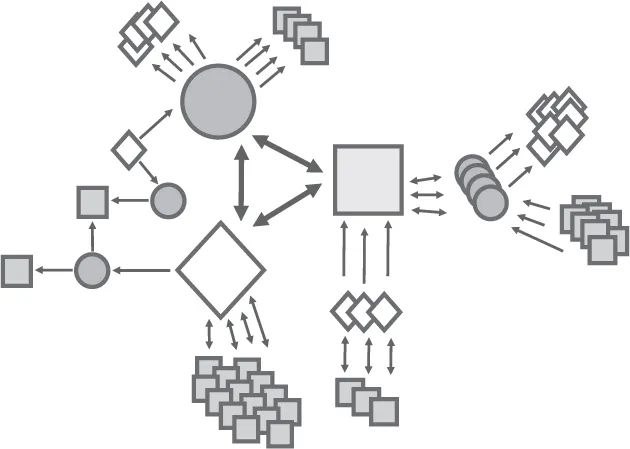
Pub/sub is a potential candidate to become a key enabler for Web and mobile applications. On the Web, pub/sub enables the asynchronous communication of various Web components, such as web pages and web sites. Figure 1.1 presents a vision for content dissemination on the Internet that has inspired Google's Pubsubhubbub system.1 In this vision, anyone can become content publisher and aggregator. Open interfaces and protocols allow the integration of various content sources. Some publishers and sites become large and others remain small and topical.
Popular alert services, such as Google Alerts2 and Microsoft Live Alerts3 allow end users to input keywords and receive relevant dynamic Web content. They are examples of centralized pub/sub solutions for the Web. Their implementation details are not available, but it is believed that alert services are still based on batch processing through search engines. The search engines need to crawl and index live content. Except for a small number of frequently crawled selected sites, the crawling period is typically in the order of a week or tens of days. Thus, they offer a limited form of pub/sub. The next step would be a more decentralized, scalable, and real-time service with support for expressive content matching. Unfortunately, expressive matching semantics and scalability contrast each other making the design, implementation, and deployment of such a global pub/sub service challenging.
Architecture and protocol design should support self-organization and preferential attachment to content sources as well as efficient and timely content dissemination from content publishers through the intermediaries to the content subscribers. The mechanism, techniques, and algorithm are in the key focus of this book. We will address the different facets of the information dissemination problem, and present a collection of frequently employed pub/sub solutions as well as guidelines on how to apply them in practice.
1.2 Components of a Pub/Sub System
Before going deeper into the topic, we first define the central terms and components, and the overall structure of a pub/sub system.
1.2.1 Basic System
The main entities in a pub/sub system are the publishers and subscribers of content. A publisher detects an event and then publishes the event in the form of a notification. A notification encapsulates information pertaining to the observed event. The notification can also be called the event message.
There are many terms for the entities in pub/sub or event systems; for example, the terms subscriber, consumer, and event sink are synonymous. Similarly, publisher, producer, supplier, and event source are synonymous. As mentioned above, the notification or event message denotes that an observed event has happened.
An event represents any discrete state transition that has occurred and is signalled from one entity to a number of other entities. For example, a successful login to a service, the firing of detection or monitoring hardware and the detection of a missile in a tactical system are all events.
Events may be categorized by their attributes, such as which physical property they are related to. For instance spatial events and temporal events note physical activity. Moreover, an event may be a combination of these, for example an event that contains both temporal and spatial information. Events can be categorized into taxonomies on their type and complexity. More complex events, called composite or compound events, can be built out of more specific simple events. Composite events are important in many applications. For example, a composite event may be fired
- in a hospital, when the reading of a sensor attached to a patient exceeds a given threshold and a new drug has been administered in a given time interval;
- in a location tracking service, where a set of users are in the same room or near the same location at the same time; or
- in an office building, where a motion detector fires and there has been a certain interval of time after the last security round.
After the notification has been published, it is the duty of the pub/sub system to deliver the message to interested recipients—the subscribers. A subscriber is an entity that has expressed prior interest to a set of events that meet certain requirements that the subscriber has set. The actual delivery depends on the pub/sub solution being used; for example, it could be based on the following:
- The message is broadcast on the network and devices on the same network will see the message. The pub/sub system running on a device can then process the message and deliver it to the subscriber if it is active on the device.
- The message is delivered via network supported multicast, in which a specific network primitive is used for delivering the message from one publisher to many subscribers.
- The message is sent directly by the publisher to subscribers that have informed the publisher that they are interested in receiving a notification. The publisher then utilizes a one-to-one message delivery protocol on top of the communication primitives offered by the network, typically the TCP/IP protocol stack.
- The message is first sent to a broker server and then delivered by the broker to active subscribers. In this case, the subscribers have expressed their interest in receiving notifications with the broker.
- The message is delivered through a network of brokers. The scalability of a pub/sub system can be increased by deploying a network of pub/sub brokers.
The two first cases are based on communication primitives provided by the underlying network, namely broadcast and multicast. Typically these primitives are not usable with Internet applications, because they are supported only within specific regions of the Internet and thus cannot be used to deliver messages in the global environment. The third ...