- Extensive new preface examines how dramatic recent events have transformed the socio-political landscape of our world
- Applies Castells' hypotheses to contemporary issues such as Al Qaeda and global terrorist networks, American unilateralism and the crisis of political legitimacy throughout the world
- A brilliant account of social, cultural, and political conflict and struggle all over the world
- Analyzes the importance of cultural, religious, and national identity as sources of meaning for people, and its implications for social movement
- Throws new light on the dynamics of global and local change
- English
- ePUB (mobile friendly)
- Available on iOS & Android
eBook - ePub
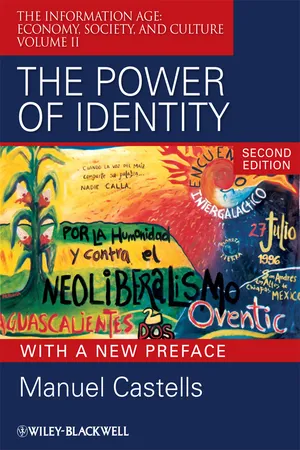
The Power of Identity
About this book
In this second volume of The Information Age trilogy, with an extensive new preface following the recent global economic crisis, Manuel Castells deals with the social, political, and cultural dynamics associated with the technological transformation of our societies and with the globalization of the economy.
Information
1
Communal Heavens: Identity and Meaning in the Network Society
The capital is established near Zhong Mountain;
The palaces and thresholds are brilliant and shining;
The forests and gardens are fragrant and flourishing;
Epidendrums and cassia complement each other in beauty.
The forbidden palace is magnificent;
Buildings and pavilions a hundred stories high.
Halls and gates are beautiful and lustrous;
Bells and chimes sound musically.
The towers reach up to the sky;
Upon altars sacrificial animals are burned.
Cleansed and purified, We fast and bathe.
We are respectful and devout in worship, Dignified and serene in prayer.
Supplicating with fervor, Each seeks happiness and joy.
The uncivilized and border people offer tribute,
And all the barbarians are submissive.
No matter how vast the territory,
All will be eventually under our rule.
Hong Xiuquan
Such were the words of the “Imperially Written Tale of a Thousand Words,” composed by Hong Xiuquan, the guide and prophet of the Taiping Rebellion, after establishing his heavenly kingdom in Nanjing in 1853.1 The insurgency of Taiping Tao (Way of Great Peace) aimed at creating a communal, neo-Christian fundamentalist kingdom in China. The kingdom was organized, for more than a decade, in conformity with the revelation of the Bible that, by his own account, Hong Xiuquan received from his elder brother, Jesus Christ, after being initiated into Christianity by evangelical missionaries. Between 1845 and 1864, Hong’s prayers, teachings, and armies shook up China, and the world, as they interfered with the growing foreign control of the Middle Kingdom. The Taiping Kingdom perished, as it lived, in blood and fire, taking the lives of 20 million Chinese. It longed to establish an earthly paradise by fighting the demons that had taken over China, so that “all people may live together in perpetual joy, until at last they are raised to Heaven to greet their Father.”2 It was a time of crisis for state bureaucracies and moral traditions, of globalization of trade, of profitable drug traffic, of rapid industrialization spreading in the world, of religious missions, of impoverished peasants, of the shaking of families and communities, of local bandits and international armies, of the diffusion of printing and mass illiteracy, a time of uncertainty and hopelessness, of identity crisis. It was another time. Or was it?
The Construction of Identity
Identity is people’s source of meaning and experience. As Calhoun writes:
We know of no people without names, no languages or cultures in which some manner of distinctions between self and other, we and they, are not made… Self-knowledge – always a construction no matter how much it feels like a discovery – is never altogether separable from claims to be known in specific ways by others.3
By identity, as it refers to social actors, I understand the process of construction of meaning on the basis of a cultural attribute, or a related set of cultural attributes, that is given priority over other sources of meaning. For a given individual, or for a collective actor, there may be a plurality of identities. Yet, such a plurality is a source of stress and contradiction in both self-representation and social action. This is because identity must be distinguished from what, traditionally, sociologists have called roles, and role-sets. Roles (for example, to be a worker, a mother, a neighbor, a socialist militant, a union member, a basketball player, a churchgoer, and a smoker, at the same time) are defined by norms structured by the institutions and organizations of society. Their relative weight in influencing people’s behavior depends upon negotiations and arrangements between individuals and these institutions and organizations. Identities are sources of meaning for the actors themselves, and by themselves, constructed through a process of individuation.4
Although, as I will argue below, identities can also be originated from dominant institutions, they become identities only when and if social actors internalize them, and construct their meaning around this internalization. To be sure, some self-definitions can also coincide with social roles, for instance when to be a father is the most important self-definition from the point of view of the actor. Yet, identities are stronger sources of meaning than roles because of the process of self-construction and individuation that they involve. In simple terms, identities organize the meaning, while roles organize the functions. I define meaning as the symbolic identification by a social actor of the purpose of her/his action. I also propose the idea that, in the network society, for reasons that I will develop below, for most social actors, meaning is organized around a primary identity (that is an identity that frames the others), which is self-sustaining across time and space. While this approach is close to Erikson’s formulation of identity, my focus here will be primarily on collective, rather than on individual, identity. However, individualism (different from individual identity) may also be a form of “collective identity,” as analyzed in Lasch’s “culture of narcissism.”5
It is easy to agree on the fact that, from a sociological perspective, all identities are constructed. The real issue is how, from what, by whom, and for what. The construction of identities uses building materials from history, from geography, from biology, from productive and reproductive institutions, from collective memory and from personal fantasies, from power apparatuses and religious revelations. But individuals, social groups, and societies process all these materials, and rearrange their meaning, according to social determinations and cultural projects that are rooted in their social structure, and in their space/time framework. I propose, as a hypothesis, that, in general terms, who constructs collective identity, and for what, largely determines the symbolic content of this identity, and its meaning for those identifying with it or placing themselves outside of it. Since the social construction of identity always takes place in a context marked by power relationships, I propose a distinction between three forms and origins of identity building:
- Legitimizing identity: introduced by the dominant institutions of society to extend and rationalize their domination vis à vis social actors, a theme that is at the heart of Sennett’s theory of authority and domination,6 but also fits with various theories of nationalism.7
- Resistance identity: generated by those actors who are in positions/conditions devalued and/or stigmatized by the logic of domination, thus building trenches of resistance and survival on the basis of principles different from, or opposed to, those permeating the institutions of society, as Calhoun proposes when explaining the emergence of identity politics.8
- Project identity: when social actors, on the basis of whatever cultural materials are available to them, build a new identity that redefines their position in society and, by so doing, seek the transformation of overall social structure. This is the case, for instance, when feminism moves out of the trenches of resistance of women’s identity and women’s rights, to challenge patriarchalism, thus the patriarchal family, and thus the entire structure of production, reproduction, sexuality, and personality on which societies have been historically based.
Naturally, identities that start as resistance may induce projects, and may also, along the course of history, become dominant in the institutions of society, thus becoming legitimizing identities to rationalize their domination. Indeed, the dynamics of identities along this sequence shows that, from the point of view of social theory, no identity can be an essence, and no identity has, per se, progressive or regressive value outside its historical context. A different, and very important matter, is the benefits of each identity for the people who belong.
In my view, each type of identity-building process leads to a different outcome in constituting society. Legitimizing identity generates a civil society; that is, a set of organizations and institutions, as well as a series of structured and organized social actors, which reproduce, albeit sometimes in a conflictive manner, the identity that rationalizes the sources of structural domination. This statement may come as a surprise to some readers, since civil society generally suggests a positive connotation of democratic social change. However, this is in fact the original conception of civil society, as formulated by Gramsci, the intellectual father of this ambiguous concept. Indeed, in Gramsci’s conception, civil society is formed by a series of “apparatuses,” such as the Church(es), unions, parties, cooperatives, civic associations, and so on, which, on the one hand, prolong the dynamics of the state, but, on the other hand, are deeply rooted among people.9 It is precisely this dual character of civil society that makes it a privileged terrain of political change by making it possible to seize the state without launching a direct, violent assault. The conquest of the state by the forces of change (let’s say the forces of socialism, in Gramsci’s ideology) present in civil society is made possible exactly because of the continuity between civil society’s institutions and the power apparatuses of the state, organized around a similar identity (citizenship, democracy, the politicization of social change, the confinement of power to the state and its ramifications, and the like). Where Gramsci and de Tocqueville see democracy and civility, Foucault and Sennett, and before them Horkheimer and Marcuse, see internalized domination and legitimation of an over-imposed, undifferentiated, normalizing identity.
The second type of identity-building, identity for resistance, leads to the formation of communes, or communities, in Etzioni’s formulation.10 This may be the most important type of identity-building in our society. It constructs forms of collective resistance against otherwise unbearable oppression, usually on the basis of identities that were, apparently, clearly defined by history, geography, or biology, making it easier to essentialize the boundaries of resistance. For instance, ethnically based nationalism, as Scheff proposes, often “arises out of a sense of alienation, on the one hand, and resentment against unfair exclusion, whether political, economic or social.”11 Religious fundamentalism, territorial communities, nationalist self-affirmation, or even the pride of self-denigration, inverting the terms of oppressive discourse (as in the “queer culture” of some tendencies in the gay movement), are all expressions of what I name the exclusion of the excluders by the excluded. That is, the building of defensive identity in the terms of dominant institutions/ideologies, reversing the value judgment while reinforcing the boundary. In such a case, the issue arises of the reciprocal communicability between these excluded/exclusionary identities. The answer to this question, which can only be empirical and historical, determines whether societies remain as societies or else fragment into a constellation of tribes, sometimes euphemistically renamed communities.
The third process of constructing identity, that is project identity, produces subjects, as defined by Alain Touraine:
I name subject the desire of being an individual, of creating a personal history, of giving meaning to the whole realm of experiences of individual life… The transformation of individuals into subjects results from the necessary combination of two affirmations: that of individuals against communities, and that of individuals against the market.12
Subjects are not individuals, even if they are made by and in individuals. They are the collective social actor through which individuals reach holistic meaning in their experience.13 In this case, the building of identity is a project of a different life, perhaps on the basis of an oppressed identity, but expanding toward the transformation of society as the prolongation of this project of identity, as in the above-mentioned example of a post-patriarchal society, liberating women, men, and children, through the realization of women’s identity. Or, in a very different perspective, the final reconciliation of all human beings as believers, brothers and sisters, under the guidance of God’s law, be it Allah or Jesus, as a result of the religious conversion of godless, anti-family, materialist societies, otherwise unable to fufill human needs and God’s design.
How, and by whom, different types of identities are constructed, and with what outcomes, cannot be addressed in general, abstract terms: it is a matter of social context. Identity politics, as Zaretsky writes, “must be situated historically.”14 Thus, our discussion must refer to a specific context, the rise of the network society. The dynamics of identity in this context can be better understood by contrasting it with Giddens’s characterization of identity in “late modernity,” a historical period which, I believe, is an era reaching its end – by which I do not mean to suggest that we are in some way reaching the “end of history” as posited in some postmodern vagaries. In a powerful theorization, whose main lines I share, Giddens states that “self-identity is not a distinctive trait possessed by the individual. It is the self as reflexively understood by the person in terms of her/his biography.” Indeed, “to be a human being is to know… both what one is doing and why one is doing it… In the context of post-traditional order, the self becomes a reflexive project.”15
How does “late modernity” impact this reflexive project? In Giddens’s terms,
one of the distinctive features of modernity is an increasing interconnection between the two extremes of extensionality and intentionality: globalising influences on the one hand and personal dispositions on the other… The more tradition loses its hold, and the more daily life is reconstituted in terms of the dialectical interplay of the local and the global, the more individuals are forced to negotiate lifestyle choices among a diversity of options… Reflexively organized life-planning… becomes a central feature of the structuring of self-identity.”16
While agreeing with Giddens’s theoretical characterization of identity-building in the period of “late modernity,” I argue, on the basis of analyses presented in volume I of this trilogy, that the rise of the network society calls into question the processes of the construction of identity during that period, thus inducing new forms of social change. This is because the network society is based on the systemic disjunction between the local and the global for most individuals and social groups. And, I will add, by the separation in different time–space frames between power and experience (volume I, chapters 6 and 7). Therefore, reflexive life-planning becomes impossible, except for the elite inhabiting the timeless space of flows of global networks and their ancillary locales. And the building of intimacy on the basis of trust requires a redefinition of identity fully autonomous vis à vis the networking logic of dominant institutions and organizations.
Under such new conditions, civil societies shrink and disarticulate because there is no longer continuity between the logic of power-making in the global network and the logic of association and representation in specific societies and cultures. The search for meaning takes place then in the reconstruction of defensive identities around communal principles. Most of social action becomes organized in the opposition between unidentified flows and secluded identities. As for the emergence of project identities, it still happens, or may happen, depending on societies. But, I propose the hypothesis that the constitution of subjects, at the heart of the process of social change, takes a different route to the one we knew during modernity, and late modernity: namely, subjects, if and when constructed, are not built any longer on the basis of civil societies, which are in the process of disintegration, but as prolongation of communal resistance. While in modernity (early or late) project identity was constituted from civil society (as in the case of socialism on the basis of the labor movement), in the network society, project identity, if it develops at all, grows from communal resistance. This is the actual meaning of the new primacy of identity politics in the network society. The analysis of processes, conditions, and outcomes of the transformation of communal resistance into transformative subjects is the precise realm for a theory of social change in the information age.
Having reached a tentative formulation of my hypotheses, it would be against the methodological principles of this book to go any further down the path of abstract theorizing that could quickly divert into bibliographical commentary. I shall try to suggest the precise implications of my analysis by focusing on a number of key processes in the construction of collective identity selected by their particular relevance to the process of social change in the network society. I will start with religious fundamentalism, both in its Islamic and Christian versions, although this does not imply that other religions (for example, Hinduism, Buddhism, Judaism) are less important or less prone to fundamentalism. I shall continue with nationalism, considering, after some overview of the issue, two very different, but significant processes: the role of nationalism in the disintegration of the Soviet Union, and in post-Soviet republics; and the formation and re-emergence of Cat...
Table of contents
- Cover
- The Information Age
- Title Page
- Copyright
- Dedication
- List of Figures
- List of Tables
- List of Charts
- Preface to the 2010 Edition of The Power of Identity
- Preface and Acknowledgments 2003
- Acknowledgments 1996
- Our World, our Lives
- 1: Communal Heavens: Identity and Meaning in the Network Society
- 2: The Other Face of the Earth: Social Movements against the New Global Order
- 3: The Greening of the Self: The Environmental Movement
- 4: The End of Patriarchalism: Social Movements, Family, and Sexuality in the Information Age
- 5: Globalization, Identification, and the State: A Powerless State or a Network State?
- 6: Informational Politics and the Crisis of Democracy
- Conclusion: Social Change in the Network Society
- Methodological Appendix
- Summary of Contents of Volumes I and III
- References
- Index
Trusted by 375,005 students
Access to over 1.5 million titles for a fair monthly price.
Study more efficiently using our study tools.
Frequently asked questions
Yes, you can cancel anytime from the Subscription tab in your account settings on the Perlego website. Your subscription will stay active until the end of your current billing period. Learn how to cancel your subscription
No, books cannot be downloaded as external files, such as PDFs, for use outside of Perlego. However, you can download books within the Perlego app for offline reading on mobile or tablet. Learn how to download books offline
Perlego offers two plans: Essential and Complete
- Essential is ideal for learners and professionals who enjoy exploring a wide range of subjects. Access the Essential Library with 800,000+ trusted titles and best-sellers across business, personal growth, and the humanities. Includes unlimited reading time and Standard Read Aloud voice.
- Complete: Perfect for advanced learners and researchers needing full, unrestricted access. Unlock 1.5M+ books across hundreds of subjects, including academic and specialized titles. The Complete Plan also includes advanced features like Premium Read Aloud and Research Assistant.
We are an online textbook subscription service, where you can get access to an entire online library for less than the price of a single book per month. With over 1.5 million books across 990+ topics, we’ve got you covered! Learn about our mission
Look out for the read-aloud symbol on your next book to see if you can listen to it. The read-aloud tool reads text aloud for you, highlighting the text as it is being read. You can pause it, speed it up and slow it down. Learn more about Read Aloud
Yes! You can use the Perlego app on both iOS and Android devices to read anytime, anywhere — even offline. Perfect for commutes or when you’re on the go.
Please note we cannot support devices running on iOS 13 and Android 7 or earlier. Learn more about using the app
Please note we cannot support devices running on iOS 13 and Android 7 or earlier. Learn more about using the app
Yes, you can access The Power of Identity by Manuel Castells in PDF and/or ePUB format, as well as other popular books in Social Sciences & Sociology. We have over 1.5 million books available in our catalogue for you to explore.