![]()
Part One
Explanation of the GIPS Standards
![]()
Chapter 1
Fundamentals of Compliance
The institutional investor searching for a new investment manager will consider many factors before making a choice. The manager's reputation, the breadth of the firm's offerings, and the manager's fee schedule all play a role in this decision. While past performance cannot guarantee future results, this information provides valuable insight about an investment manager. One factor that is almost always considered in a search is the investment manager's historical track record. With only a few exceptions, investment managers have historically had minimal, if any, regulations or guidance that instructs the firm on how to calculate and report investment performance to prospective investors. The Global Investment Performance Standards (GIPS®), administered by CFA Institute, fill that void.
SCOPE OF THE GIPS STANDARDS
The Global Investment Performance Standards are a set of voluntary standards for calculating and reporting investment performance to a prospective investor. Institutional investors, such as pension plans and endowments, will often consider hiring only managers who have calculated and presented their performance in compliance with the GIPS standards. The GIPS standards provide investors with assurance that performance records are comparable and that they are prepared based on the ethical principles of fair representation and full disclosure.
The GIPS standards do not attempt to address every performance measurement issue that a money manager may face. For example, the GIPS standards are not intended to govern performance presented as part of internal reporting within the investment management firm or for client reporting to existing clients. The GIPS standards are primarily concerned with marketing performance history to prospective clients.
There is no global law that requires a firm to comply with the GIPS standards. (But if an investment manager claims compliance, the local regulator can and often does test that claim.) The GIPS standards are a form of industry self-regulation. An investment manager that chooses to comply with the GIPS standards must comply with all of the applicable requirements of the GIPS standards on a firmwide basis. The GIPS standards also include a series of recommendations that are considered industry best practices. A firm that complies with the GIPS standards may select which, if any, of these recommendations the firm will adopt and follow.
HISTORY OF THE GIPS STANDARDS
Several decades ago, the Association for Investment Management and Research (AIMR®, now known as CFA Institute) recognized the need for performance standards. In 1987, the AIMR Performance Presentation Standards (AIMR-PPS®) were issued and over the next decade became widely adopted in the United States, primarily by managers of institutional assets. At the same time, other countries were beginning to take notice of these standards. Recognizing that the AIMR-PPS standards were directed mainly at the U.S. and Canadian markets, several countries used the AIMR-PPS standards as a starting point and tailored them for local use. To facilitate the ability of money managers to do business across borders and address the proliferation of country-specific standards, in 1995 AIMR undertook the process of creating a set of performance standards that could be used by all firms globally. The end result of this effort was the issuance of the first edition of the GIPS standards in February 1999.
Several countries adopted the GIPS standards as their local standard as issued, making no changes. However, other countries that already had their own standards were hesitant to replace their current standards with the GIPS standards, particularly if the local standards had been widely adopted and extensively interpreted, as was the case in the United States and Canada. To take the first step toward unifying the different standards used globally, a concept of Country Versions of GIPS (CVG) was created. Each CVG would have as its core the GIPS standards themselves, but would allow for additional requirements and recommendations over and above those included in the GIPS standards. In 2000, the AIMR-PPS standards became a CVG. The process to become a CVG was quite simple for the AIMR-PPS standards, since the GIPS standards were primarily based on the concepts in the AIMR-PPS standards.
When the GIPS standards were originally created, it was agreed that they would be reviewed and updated every five years. This first five-year review resulted in the issuance of the 2005 edition of the GIPS standards in February of that year. This edition began the process of eliminating all CVGs as a key step toward meeting the stated goal of having one standard for performance calculation and presentation used globally. Firms that complied with a CVG could continue to do so until they reported performance for any period after December 31, 2005. Once a firm reported performance for subsequent periods, the firm was required to transition from CVG-based reporting to reporting in compliance with the GIPS standards.
To facilitate convergence to one global standard, the GIPS standards provided full reciprocity for historical periods. For example, a firm that previously complied with the AIMR-PPS standards and transitioned to the GIPS standards in 2006 could state that the firm complied with the GIPS standards for all periods and make no reference to prior compliance with the AIMR-PPS standards. Reciprocity allowed firms throughout the world to remove references to local standards from their presentations and to speak only about the GIPS standards.
The next five-year update was completed in January 2010 when the 2010 edition of the GIPS standards was issued. The 2010 edition has an effective date of January 1, 2011. Compliant presentations that include any performance results for periods beginning on or after January 1, 2011 must comply with the presentation and disclosure requirements of the 2010 edition. All input and calculation data requirements must be followed beginning on that date. (Unless explicitly stated otherwise, this book references and provides guidance for the 2010 edition of the GIPS standards.)
To facilitate global acceptance and adoption of the GIPS standards, local sponsoring organizations serve as “Country Sponsors” of the GIPS standards. Country Sponsors, such as The Securities Analysts Association of Japan, promote the GIPS standards in their local market, and provide feedback and input on country-specific concerns. As of December 2010, over 30 Country Sponsors have adopted the GIPS standards as their local standard. A current list of Country Sponsors is available on the GIPS standards web site (www.gipsstandards.org). In accordance with standard CFA Institute practice, for governance purposes Country Sponsors are pooled into three geographic areas: Americas; EMEA (Europe, Middle East, and Africa); and Asia Pacific.
GOVERNANCE OF THE GIPS STANDARDS
CFA Institute is an investments industry association that is best known as the administrator of the CFA and CIPM exams. The Chartered Financial Analyst® (CFA®) designation is a key credential for anyone in the investment management industry. The Certificate in Investment Performance Measurement (CIPM) program has a narrower focus on the investment performance field. CFA Institute has ultimate responsibility for the GIPS standards and funds a permanent staff to promote and enhance the GIPS standards. CFA Institute recruits volunteers from a variety of constituents to guide and enhance the GIPS standards.
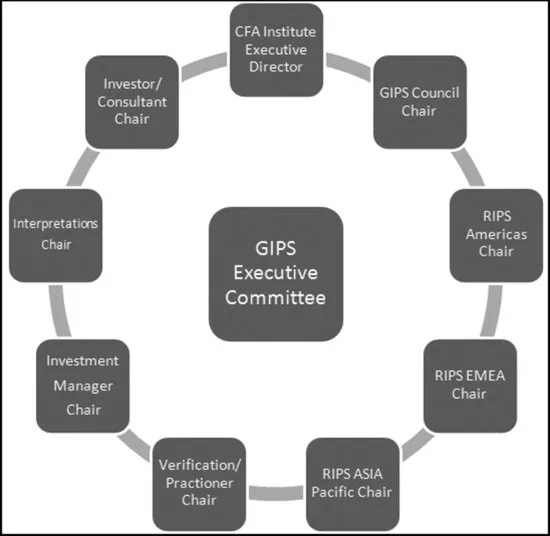
The Executive Committee (EC) serves as the decision-making authority for the GIPS standards. The EC, which functions as the equivalent to a company's Board of Directors, includes nine “seats” and is organized according to the structure illustrated in Figure 1.1.
Four of the nine seats (Investor/Consultant, Interpretations, Investment Manager, and Verification/Practitioner) are appointed by CFA Institute. Four seats represent Country Sponsors through the global Regional Investment Performance Subcommittees (RIPS) and the GIPS Council, and are elected by Country Sponsors. (The GIPS Council includes a representative from each Country Sponsor.) The ninth seat is held by the CFA Institute Executive Director of the GIPS standards.
With the exception of the CFA Institute Executive Director seat, which is a permanent position, all seats have term limits. The GIPS Council Chair seat rotates every two years, and rotates between the three geographical segments. All other seats are elected or appointed for four-year terms.
Each EC member chairs a subcommittee, and each subcommittee is supported by a CFA staff liaison. The subcommittees and CFA staff members do much of the detailed work required to maintain and improve the GIPS standards. Subcommittees and working groups are created as needed. For example, a working group of private equity specialists was created to oversee the update of the private equity guidance for the 2010 edition. The continued success of the GIPS standards globally is directly related to the active participation by committed and engaged volunteers and Country Sponsor organizations.
ORGANIZATION OF THE GIPS STANDARDS
Firms must comply with all requirements of the GIPS standards, as well as any interpretive guidance. This body of knowledge includes the GIPS standards, a series of Questions & Answers addressing narrow issues, and Guidance Statements, which are topical papers addressing issues more broadly. A firm must comply with the GIPS standards themselves as well as Q&As, Guidance Statements, and any other guidance issued by CFA Institute and the GIPS Executive Committee.
All guidance is available at the GIPS standards web site. Guidance is updated periodically, and CFA Institute notifies practitioners and other interested parties of changes via e-mail alerts.
The GIPS standards themselves are collected in a booklet that is organized into five chapters and three appendixes (see Table 1.1). Each provision, which represents either a requirement or a recommendation, has a number that references a section in Chapter I. (For example, Provision 0.A.4 states that the GIPS standards must be applied on a firmwide basis, and is included in Section 0.) The glossary in Chapter V defines the specific meaning of key words used in the GIPS standards. These terms are printed in the GIPS standards in SMALL CAPITAL LETTERS.
Table 1.1 Organization of the GIPS Standards
| Chapter I, Section 0 | Fundamentals of Compliance |
| Chapter I, Section 1 | Input Data |
| Chapter I, Section 2 | Calculation Methodology |
| Chapter I, Section 3 | Composite Construction |
| Chapter I, Section 4 | Disclosure |
| Chapter I, Section 5 | Presentation and Reporting |
| Chapter I, Section 6 | Real Estate |
| Chapter I, Section 7 | Private Equity |
| Chapter I, Section 8 | Wrap Fee/Separately Managed Account (SMA) Portfolios |
| Chapter II | GIPS Valuation Principles |
| Chapter III | GIPS Advertising Guidelines |
| Chapter IV | Verification |
| Chapter V | Glossary |
| Appendix A | Sample Compliant Presentations |
| Appendix B | Sample Advertisements |
| Appendix C | Sample List of Composite Descriptions |
Each section of Chapter I contains both requirements and recommendations. All firms must comply with all of the applicable requirements within Sections 0 to 5 of Chapter I. A firm may choose, however, which recommendations it will follow. In the past, recommendations were viewed as provisions that were likely to become requirements in future editions of the GIPS standards. This may have been true when the GIPS standards and their predecessor standards were new. However, given the maturity of the GIPS standards, this is no longer the case and we should view the recommendations as simply best practices.
FUNDAMENTALS OF COMPLIANCE
The Fundamentals of Compliance section (Section 0) was first included in the 2005 edition of the GIPS standards. Several of the provisions within this section were added to explicitly state what had been implicit and to remove any doubt about the responsibilities of a compliant firm. Other provisions within Section 0 speak to overarching principles of the GIPS standards. The following text explains the key provisions of Section 0.
Firmwide Compliance
An organization that chooses to comply with the GIPS standards must comply on a firmwide basis. Firm is used throughout this book to refer to an organization that has chosen to comply with the GIPS standards. Defining the firm is the first step in the GIPS compliance process. Chapter 2 of this book provides guidance on defining the firm.
Complete Compliance
An organization that does not claim compliance with the GIPS standards can make no reference to the GIPS standards. Investment managers cannot state that they are in “partial compliance” with the GIPS standards or are “in compliance with the GIPS standards except for… .” There is no ability to partially comply with the GIPS standards. An organization either fully complies with the GIPS standards or does not comply at all.
Use of Composites
The GIPS standards are predicated on the use of composites. A composite is an entity representing a collection of all portfolios managed according to a particular style or strategy. We use composites to recognize that most investment firms manage multiple portfolios on behalf of multiple clients. However, portfolios managed according to the same strategy could still achieve a different return. One of the key notions underpinning the GIPS standards is that the requirement to use composites prevents a firm from “cherry picking” the best-performing portfolio for a strategy and using that portfolio's performance to represent the strategy's track record. A prospective client should be able to review the fairest possible representation of a firm's track record. This would take into account not just selected portfolios but all portfolios managed according to a specific strategy.
Composites must include only “actual” portfolios. The performance of model or hypothetical portfolios may be presented as supplemental information but may not be combined with the performance of actual po...