![]()
Chapter 1
The Business Plan
1.1 Introduction
Wireless broadband networks are very different from the traditional voice networks, hence should not be deployed as an extension of those. A greenfield operator should start the conception of a new network by building a business case. An existing network benefits also from a proper business case, even if it is done during its operational life.
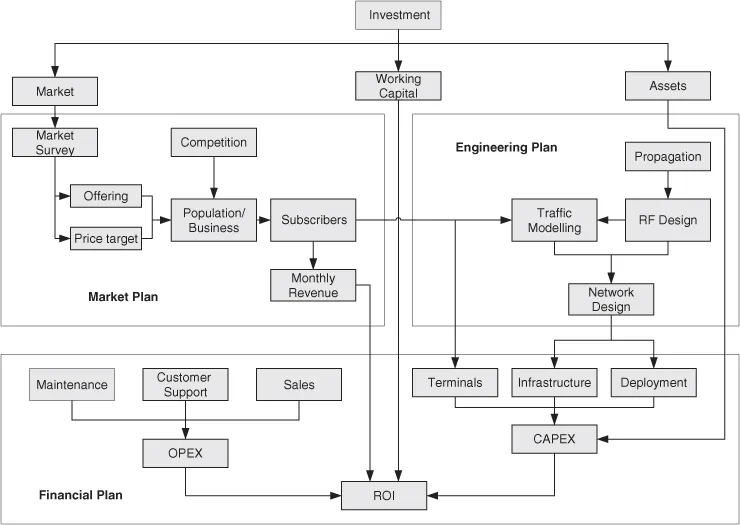
A properly designed business plan requires a small investment upfront, but substantiates the investment and can be used to leverage capital. Thus investors are not surprised by unexpected cash flow requirements or by unforeseen technical or operational issues. Figure 1.1 illustrates the main components of a business plan.
A business plan has three main components, described in detail in the next sections:
- the market plan;
- the engineering plan;
- the financial plan.
1.2 Market Plan
Understanding the market is essential to define the product offering and its acceptance by the market. This should be done through market research, which could be exploratory or confirmatory.
- In the exploratory case, options are left wide open and the results from the research will define the outcome.
- In the confirmatory case, a set of assumptions is made and are confirmed or not by the research.
A market research is divided into three areas:
- market information: where information is collected;
- market segmentation: where demographic, psychographic, ethnographic and lifestyle information is gathered;
- market trends: where market evolution over time is predicted.
Market research can be done in four phases:
- Market scan: collection and analysis of available data that can contribute to the subject. Optionally customer visits can be done at the location where they use the service (businesses or residences), to ask broad questions about their satisfaction with existing services and their willingness to accept alternative offerings.
- Options generation: unconstrained options should be formulated to define all possible offerings.
- Option selection: each option should be evaluated based on the previously collected data and the best ones selected. The proper technique for this selection is choice modeling, which categorizes the data for each choice.
- Selected options evaluation: a customer survey should be done, with questions specific to each option.
Market research should be done by a specialized professional or company, as many of the network assumptions are based on it. It should be done periodically for existing deployments as well, so the service can be adapted to customer expectations and expansions can be properly planned.
The outcome of market research is the market plan, which should aid network designers by specifying the following items:
- Service target area (STA): area in which service should be provided. It can constitute a single continuous area or several separate areas. These areas should be then divided in sub-areas classified by characteristics such as type of service expected and demand.
- Product: product to be offered, its features and restrictions. This includes service plans and its SLA (service level agreement).
- Service coverage: coverage area.
- Client demographics for the STA.
- Client evolution over the years.
1.3 The Engineering Plan
The engineering plan defines the design that fulfills market plan requirements. A complete design should be done, even if the equipment vendor is not yet defined.
Many vendors want to do an initial estimate of the number of cells required for a deployment, for budgetary reasons. The most common question asked to the network designer is: What cell size should be considered for the budgetary quote?
There are many factors that affect cell size:
- RF signal propagation, which depends on the environment and is mistakenly used as the sole criterion.
- Location where service will be provided (rooftop, outdoor, indoor).
- Spectrum availability and, consequently, expected interference.
- Equipment to be used.
- Amount of traffic to be carried in each location and its distribution.
These items interact with each other and cannot be treated separately. As an example, if the traffic to be carried is high, we need to resort to higher modulation schemes that require stronger signals and are more prone to interference. We generally give a range that can be applied. A common mistake is to consider a uniform traffic distribution, which leads to significant under-estimation of the infrastructure required.
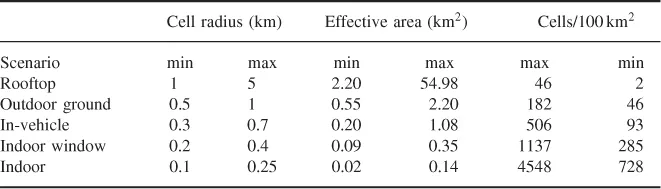
Table 1.1 gives an idea of the variability of number of sites required in different scenarios. We strongly suggest that an initial design be done, so more precise numbers are used.
Table 1.1 Number of sites for an initial design
Ideally, a drive test should be conducted to collect measurements and calibrate RF propagation models for the area. Default...