![]()
Chapter 1
Introduction
Esa Metsälä, Juha Salmelin and Erik Salo
1.1 Why Read This Book
Several textbooks exist either on mobile networks or on (packet) networking, but separately, and they usually consider their subjects in isolation from each other. However, no mobile network exists without a related transport network connecting the elements; and also, mobile networks are becoming more and more important ‘customers’ for many kinds of packet networks.
Therefore this book is about considering these two domains together, and about looking at mobile network and backhaul network interactions, and how these two domains should take each other into account, particularly in the new era of (fully) packet-based transport solutions.
Mobile backhaul, as shown in Figure 1.1, is at the intersection of a mobile network and a transport network. Some aspects are more closely related to the radio network. Another area originates from the transport and networking side.
Usually mobile networks, radio interfaces, and other radio related topics are discussed within a circle of radio communication experts, without considering so much the other parts of the whole network. As an example, the 3GPP view of the transport connection between any two mobile network elements is a single, straight line. This very high level of abstraction serves focusing on the mobile network specific issues. However, when transport connections in real life are more complex, and in the era of packet networks very much more complex, different types of issues start to appear; functionalities and especially performance of the mobile network are impacted. The influence can in some cases be significant.
Correspondingly, it is not that easy for a networking expert to delve into the details of mobile network – even the fundamental concepts may be hidden into a number of mobile network standards. Also, 3GPP mobile networks, and their radio interfaces are not at all like a wireless LAN: their protocols are not based on Ethernet (which one could feel familiar with), and there is more of protocol layering and a division of functionality between mobile elements; simply put, they are more complex.
Therefore, if your background is in radio communication and mobile network, you will benefit from having an understanding of how the backhaul is built and how it influences the actual behavior and performance of the mobile network. For example, end-user bit rates are not limited only by the radio interface, but also by backhaul links, and thus it is becoming more important to understand and take into account the backhaul solutions applied.
On the other hand, if you are an IP and networking expert, you can use your competence more effectively when you understand more of the internal workings of the radio network side, and the basic requirements of radio networks relating to connections. Even if mobile backhaul is not the main driver for the networking industry, innovative solutions are needed to provide economic connections for advanced mobile networks and their services and data volumes, for example to cope with the high peak rates of HSPA+ and LTE networks.
1.2 What is ‘Mobile Backhaul’
Figure 1.1 already provides the first answer: mobile backhaul unites a mobile network with transport/packet networks. Some elements and functions of the mobile network are within the scope, and the rest of functionality and characteristics are coming from the transport and packet networking side. Ultimately it is the mobile network that serves the end-users, however, the deployment and design of the mobile backhaul impacts not only the mobile element interfaces, but also contributes to mobile network's overall operation and performance.
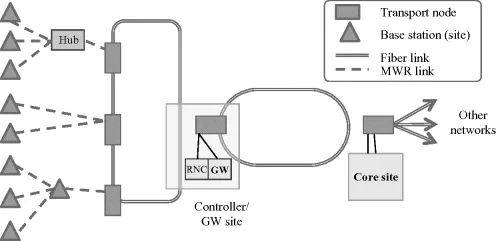
Mobile networks themselves are already well established in very many parts of the world, and mobile networks continue to expand, covering wider and wider areas of the globe. They also develop at a rapid rate and offer more and more services, including many kinds of wideband services, and enable higher and higher bit rates between the terminals and the network. This means that especially the data traffic is growing very fast in many mobile networks. Therefore well-working inter-element connections are necessary for the mobile networks to operate properly, and the role of supporting transport and packet networks is increasing. These transport and packet networks serving mobile networks are called ‘mobile backhaul networks’, or often just ‘mobile backhaul’ (MBH), as they connect a large number of base station sites to a limited number of centralized sites (see Figure 1.2).
The MBH networks are presently experiencing a big change, as the growth of mobile data traffic and development of packet transport technologies and equipment has created a strong push to use packet-based MBH solutions, both to increase feasible data throughputs and to improve the cost-efficiency of MBH networks.
Backhaul networks have always been an important part of the overall mobile network business case; connections to the base station sites are important, as their number is very high. These ‘last mile links’ (or ‘first mile links’, depending on your point of view) influence significantly the overall network costs. Now when network capacities increase and cell sizes decrease, transport share of the overall network costs tends to increase. Packet-based transport solutions help here, in keeping transport cost increase at a reasonable level.
1.3 Targets and Scope of the Book
This book is intended to give an overview of different aspects of mobile backhaul networks, and also provide a more detailed discussion on protocols, functionalities and technologies on both the radio network side and on the backhaul and networking technologies.
By nature, some terminology will be more 3GPP and radio-oriented, while a part comes from the networking world.
The book covers the mobile backhaul networks from the base station sites up to the core sites; however, it puts more emphasis on network segments closer to the base station sites (access tier, see Figure 2.2), as these parts have more mobile specific characteristics and are also economically the most important part of the backhaul.
Upper MBH network tiers often serve a combination of mobile and fixed traffic, are more built based on fixed traffic requirements and have a smaller influence on the mobile network economy; however, it is important to take into account also their impact on mobile network performance. Backhauls for indoor solutions are often a mix of fixed and mobile traffic and are beyond the scope of this book.
Technically, the book covers networking (or transport and transmission) related functionalities. Radio network protocols and key functionalities are reviewed as the radio network is the client layer for the mobile backhaul. While reading the backhaul oriented chapters it is useful to keep the basic mobile network architecture and operation in mind as this helps to identify interactions that are of a more subtle nature.
1.4 Organization of the Book
The body of the book is organized in two parts.
Part I considers networks as entities, from needs and change drivers to network transitions and from mobile systems to packet networking and implementation aspects. Part II studies key functionalities in MBH: Synchronization, Resilience, Quality of Service, and Security, with the aim of going deeper into each of these topics.
The first chapter in Part I, Chapter 02, provides an introduction to the backhaul networks, to the needs and economic aspects of transport in mobile networks, and discusses the drivers for the packet-based MBH solutions as well as some transition issues. Part I continues with Chapter 03 describing mobile systems standardized by 3GPP. The emphasis is on logical interfaces and the related protocol stacks for the transport and for the end user service delivery. Radio network key functionality is introduced as well.
Chapter 04 in turn provides an overview of packet networks and networking technologies and protocols especially for readers who are already more familiar with the radio network technologies. Chapter 4 also discusses how the packet technologies are used in implementing a backhaul service for the radio network layer.
The last chapter of Part I, Chapter 05, discusses transport technologies and systems used in MBH networks, their main characteristics and briefly the services available for outsourcing MBH functionality; the focus in Chapter 05 is on the systems needed and used in the MBH access tier.
Part II starts with Chapter 06 discussing an important and very mobile network specific transport topic, namely provision of synchronization for mobile base stations over the transport network – a topic of increasing importance when we move towards packet-based MBH networks.
Chapter 07 addresses resilience. When moving to the packet network, carrier grade resilience is needed. Failure types in the packet network differ from those experienced in TDM networks, which easily causes a concern unless the topic is addressed. Recovery after a failure in the packet network as well typically relies on different methods than TDM does.
Chapter 08 is about quality of service (QoS) in the backhaul, focusing on QoS needs of all traffic types existing in the backhaul. Also, the role of transport in the overall end-to-end quality is discussed. QoS is one of the topics which directly and concretely links the radio network layer with the backhaul layers. It is often the first topic mentioned when discussing common areas between the radio network and backhaul experts.
And then Chapter 09 discusses security in the MBH networks and various networking solutions. With packet-based mobile backhaul, new types of threats emerge, and these need to be addressed. Cryptographic protection with IPsec is one of the tools for protecting the backhaul.
Chapter 10 provides an overview on how a packet-based MBH solution for a particular mobile network case is found and put together, including some examples of possible MBH solutions (solution types) for specific mobile network development cases.
Chapter 11 then contains a brief summary of the book.
![]()
Part I
Mobile and Packet Networks
![]()
Chapter 2
Mobile Backhaul and the New Packet Era
Erik Salo and Juha Salmelin
2.1 Backhaul Network, Tiers and Costs
Mobile backhaul (MBH) networks serve mobile networks by providing connections between mobile network elements located in different geographical sites; no mobile network exists without a related MBH network. The main task of a MBH network is to connect a very large number of mobile network base station sites to a relatively small number of central sites where the mobile network core elements are located.
Basically a MBH network transfers transparently mobile system internal traffic and signaling between the mobile system elements. Even if mobile traffic is not interpreted by the MBH network, its properties affect mobile traffic in several ways, and thus the MBH network has a significant influence on the mobile network end-to-end quality. It is important to take these dependencies and influence fully into account when designing mobile networks which are optimized in respect of total cost and end-to-end performance.
To give some idea of the MBH network overall structure, one can note that a mobile network typically contains thousands, sometimes even...