A readable little book assisting the student in understanding, in a nonmathematical way, the essentials of the different bonds occurring in chemistry. Starting with a short, self-contained,introduction, Chapter 1 presents the essential elements of the variation approach to either total or second-order molecular energies, the system of atomic units (au) necessary to simplify all mathematical expressions, and an introductory description of the electron distribution in molecules. Using mostly 2x2 Hückel secular equations, Chapter 2, by far the largest part of the book because of the many implications of the chemical bond, introduces a model of bonding in homonuclear and heteronuclear diatomics, multiple and delocalized bonds in hydrocarbons, and the stereochemistry of chemical bonds in polyatomic molecules, in a word, a model of the strong first-order interactions originating the chemical bond. In Chapter 3 the Hückel model of the linear polyene chain is used to explain the origin of band structure in the 1-dimensional crystal. Chapter 4 deals with a simple two-state model of weak interactions, introducing the reader to understand second-order electric properties of molecules and VdW bonding between closed shells. Lastly, Chapter 5 studies the structure of H-bonded dimers and the nature of the hydrogen bond, which has a strength intermediate between a VdW bond and a weak chemical bond. Besides a qualitative MO approach based on HOMO-LUMO charge transfer from an electron donor to an electron acceptor molecule, a quantitative electrostatic approach is presented yielding an electrostatic model working even at its simplest pictorial level. A list of alphabetically ordered references, author and subject indices complete the book.
1.6 Exchange-overlap Densities and the Chemical Bond
In physics and chemistry it is not possible to develop any useful model of matter without a basic knowledge of some elementary mathematics. This involves use of some elements of linear algebra, such as the solution of algebraic equations (at least quadratic), the solution of systems of linear equations, and a few elements on matrices and determinants.
1.1 MATRICES AND SYSTEMS OF LINEAR EQUATIONS
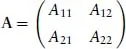
We start from matrices, limiting ourselves to the case of a square matrix of order two, namely a matrix involving two rows and two columns. Let us denote this matrix by the boldface capital letter A:
(1.1)
where Aij is a number called the ijth element of matrix A. The elements Aii (j = i) are called diagonal elements. We are interested mostly in symmetric matrices, for which A21 = A12· If A21 = A12 = 0, the matrix is diagonal. Properties of a square matrix A are its trace(tr A = A11 + A22), the sum of its diagonal elements, and its determinant,denoted by |A| = det A, a number that can be evaluated from its elements by the rule:
(1.2)
Two 2 × 2 matrices can be multiplied rows by columns by the rule:
(1.3)
(1.4)
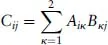
the elements of the product matrix C being:
(1.5)
So, we are led to the matrix multiplication rule:
(1.6)
If matrix B is a simple number a, Equation (1.6) shows that all elements of matrix A must be multiplied by this number. Instead, for a|A|, we have from Equation (1.2):
(1.7)
so that, multiplying a determinant by a number is equivalent to multiplying just one row (or one column) by that number.
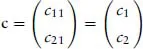
We can have also rectangular matrices, where the number of rows is different from the number of columns. Particularly important is the 2 ×1 column vector c:
(1.8)
or the 1 × 2 row vector C:
(1.9)
where the tilde ~ means interchanging columns by rows or vice versa (the transposed matrix).
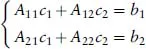
The linear inhomogeneous system:
(1.10)
can be easily rewritten in matrix form using matrix multiplication rule (1.3) as:
(1.11)
where c and b are 2 × 1 column vectors.
Equation (1.10) is a system of two algebraic equations linear in the unknowns c1 and c2, the elements of matrix A being the coefficients of the linear combination. Particular importance has the case where b is proportional to c through a number λ:
(1.12)
which is known as the eigenvalue equation for matrix A. λ is called an eigenvalue and c an eigenvector of the square matrix A. Equation (1.12) is equally well written as the homogeneous system:
(1.13)
where 1 is the 2 × 2 diagonal matrix having 1 along the diagonal, called the identity matrix, and 0 is the zero vector matrix, a 2 × 1 column of zeros. Written explicitly, the homogen...
Table of contents
Cover
Title page
Copyright
Dedication
Preface
1: Mathematical Foundations
Part 1: Short-range Interactions
Part 2: Long-Range Interactions
References
Author Index
Subject Index
Trusted by 375,005 students
Access to over 1.5 million titles for a fair monthly price.
Study more efficiently using our study tools.
Frequently asked questions
Yes, you can cancel anytime from the Subscription tab in your account settings on the Perlego website. Your subscription will stay active until the end of your current billing period. Learn how to cancel your subscription
No, books cannot be downloaded as external files, such as PDFs, for use outside of Perlego. However, you can download books within the Perlego app for offline reading on mobile or tablet. Learn how to download books offline
Perlego offers two plans: Essential and Complete
Essential is ideal for learners and professionals who enjoy exploring a wide range of subjects. Access the Essential Library with 800,000+ trusted titles and best-sellers across business, personal growth, and the humanities. Includes unlimited reading time and Standard Read Aloud voice.
Complete: Perfect for advanced learners and researchers needing full, unrestricted access. Unlock 1.5M+ books across hundreds of subjects, including academic and specialized titles. The Complete Plan also includes advanced features like Premium Read Aloud and Research Assistant.
Both plans are available with monthly, semester, or annual billing cycles.
We are an online textbook subscription service, where you can get access to an entire online library for less than the price of a single book per month. With over 1.5 million books across 990+ topics, we’ve got you covered! Learn about our mission
Look out for the read-aloud symbol on your next book to see if you can listen to it. The read-aloud tool reads text aloud for you, highlighting the text as it is being read. You can pause it, speed it up and slow it down. Learn more about Read Aloud
Yes! You can use the Perlego app on both iOS and Android devices to read anytime, anywhere — even offline. Perfect for commutes or when you’re on the go. Please note we cannot support devices running on iOS 13 and Android 7 or earlier. Learn more about using the app
Yes, you can access Models for Bonding in Chemistry by Valerio Magnasco,Valerio Magnasco in PDF and/or ePUB format, as well as other popular books in Physical Sciences & Physical & Theoretical Chemistry. We have over 1.5 million books available in our catalogue for you to explore.