Winner of the John Gilmary Shea Prize
A groundbreaking history of how Africans in the French Empire embraced both African independence and their Catholic faith during the upheaval of decolonization, leading to a fundamental reorientation of the Catholic Church.
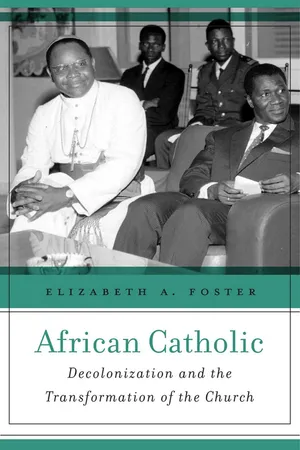
African Catholic examines how French imperialists and the Africans they ruled imagined the religious future of French sub-Saharan Africa in the years just before and after decolonization. The story encompasses the political transition to independence, Catholic contributions to black intellectual currents, and efforts to alter the church hierarchy to create an authentically "African" church.
Elizabeth Foster recreates a Franco-African world forged by conquest, colonization, missions, and conversions—one that still exists today. We meet missionaries in Africa and their superiors in France, African Catholic students abroad destined to become leaders in their home countries, African Catholic intellectuals and young clergymen, along with French and African lay activists. All of these men and women were preoccupied with the future of France's colonies, the place of Catholicism in a postcolonial Africa, and the struggle over their personal loyalties to the Vatican, France, and the new African states.
Having served as the nuncio to France and the Vatican's liaison to UNESCO in the 1950s, Pope John XXIII understood as few others did the central questions that arose in the postwar Franco-African Catholic world. Was the church truly universal? Was Catholicism a conservative pillar of order or a force to liberate subjugated and exploited peoples? Could the church change with the times? He was thinking of Africa on the eve of Vatican II, declaring in a radio address shortly before the council opened, "Vis-à-vis the underdeveloped countries, the church presents itself as it is and as it wants to be: the church of all."
- 369 pages
- English
- ePUB (mobile friendly)
- Available on iOS & Android
eBook - ePub
About this book
Information
1
POSTWAR WINDS OF CHANGE
Church and State in French Africa
IN JANUARY 1947, Léopold Senghor, who was then representing Senegal as a deputy in the French National Assembly, penned a letter of complaint to Monsignor Louis Le Hunsec, the superior general of the Spiritans, the French missionary congregation that controlled the Catholic hierarchy in Senegal and provided most of the colony’s priests.1 Senghor, a Catholic who had excelled in Spiritan mission schools as a boy and had considered joining the priesthood, was very respectful toward Le Hunsec, who had served in Dakar as the apostolic vicar of Senegambia from 1920 to 1926.2 Yet the deputy nonetheless forwarded an angry petition from “a group of his young Catholic constituents” concerning a French Spiritan, Father Charles Catlin. They had implored Senghor to see Le Hunsec and make sure that Catlin, then on leave in France, was not sent back to Dakar, where he served as chaplain general of French West African forces.3 “This priest is a first-class negrophobe,” they complained, “and we do not want him anymore. In his conversation, in his entire attitude, in many instances, he displays his complete contempt for those with black skin.” They closed their missive with a threat: “If he comes back, he may regret it. We cannot answer for what might happen to him. It would be better not to give us the opportunity to act.”4
Senghor agreed wholeheartedly with Dakar’s bellicose Catholic youth. As a student, he had clashed with Father Albert Lalouse, the director of the Spiritans’ seminary in Senegal, who Senghor felt discriminated against his African pupils. Senghor later described Lalouse as a “pious man, but a harsh one, whom we accused of colonialism. He constantly emphasized our flaws as blacks and denounced our lack of civilization.”5 In a follow-up letter to Le Hunsec in March of 1947, Senghor drew the superior general’s attention to the “seriousness of the religious situation” in postwar Senegal. “Unfortunately,” the deputy observed, “missionaries, who were the most liberal Europeans [in Africa] before the war, fail to comprehend the Revolution the war has wrought in minds and in fact.”6 Senghor meant that the experience of the war, in which hundreds of thousands of France’s colonial soldiers had fought to defend the metropole, had raised African expectations for more say in their own affairs, both in the realm of politics and, in the case of African Catholics, within the church.
As a result, Senghor urged French clergy in Africa to advocate for change within the new French Union established by the 1946 constitution, which had made France’s African subjects into citizens of their respective territories.7 “Missionaries should not simply approve, but rather advocate for a radical shift in relations between Europeans and Africans, and especially in political institutions,” he advised. “They must refrain, above all, from anti-Socialism or anti-Communism. I permit myself to speak frankly about this as I am neither a Freemason nor a Communist, and I call myself a Catholic in public,” he wrote. In addition, he felt it was imperative to fill the post of apostolic vicar of Senegambia, left vacant after the 1946 resignation of the Pétainist Spiritan Augustin Grimault, with someone who “accepts the revolution brought about by the new constitution.”8
The words of Senghor and of Dakar’s militant young believers reveal significant currents of rebellion among African Catholics in the wake of World War II. These Catholics worshipped, married, and baptized their children in a missionary church still overwhelmingly staffed by white French clergy. Moreover, many of them felt that French missionaries reinforced the colonial order by equating Catholicism with “superior” French civilization. The fact that Grimault and other prominent French Catholic figures in Africa had publicly supported Marshal Pétain’s collaborationist Vichy regime while African soldiers, including Senghor himself, languished in German prisoner-of-war camps or died fighting for Free France, only fueled African ire toward the missions.9 Their growing frustration with the church reflected their broader irritation with French administrative and military authorities, who seemed to want to return to the colonial status quo without recognizing or rewarding African sacrifices in the war. Such tensions ran particularly high in Dakar, the sprawling administrative capital of French West Africa. The brutal French repression of a 1944 protest at nearby Camp Thiaroye, which killed dozens of African soldiers demanding their rightful pay after fighting to liberate metropolitan France, was still fresh in many minds there.10
Yet while some French clergymen such as Monsignor Grimault or Father Catlin apparently did not comprehend the mounting African desire for postwar change, there were in fact new forces at work both within and upon the Catholic missions in French Africa in the mid to late 1940s. Together with the activism of a militant African Catholic elite, these new currents would ultimately bring about important transformations in the missions in the two decades that followed. They included novel collaborative efforts between rival missionary congregations to pool resources across territorial borders, a strong Vatican push for the training of more African clergy, and French secular authorities’ adoption of what they termed a “positive religious policy,” which reversed a forty-year-old administrative stance by fully embracing Catholic missions as valuable allies. Indeed, beginning in 1946, state funding flowed freely to Catholic schools and healthcare initiatives all across French Africa, enabling a vast expansion of Catholic infrastructure and social services.
Of course, these new developments did not all point in the same direction. Vatican initiatives, though halting at the outset, aimed to extricate Catholicism from the prevailing colonial order and create a church manned by African clergy. And while some missionary executives tried to act in the spirit of the Vatican’s directives, French priests often had a hard time divorcing themselves from the political, social, and racial structures that shaped their daily lives in French Africa. Moreover, the bracing new state support for missionary activity effectively tied Catholic institutions more closely to the French regime. A French government report from 1945 or 1946 contained the telling observation that there was an important difference between Catholic and Protestant missionaries in French Equatorial Africa: “The Catholics consider themselves French and want to be French; while the Protestants, due to their universalist and international tendencies, confuse the spiritual and the temporal,” the author observed.11 This administrative conflation of French and Catholic aims perfectly corroborates Léopold Senghor’s 1947 critique of the church in French Africa. He felt it was not truly catholic in the universal sense, but French, and therefore “colonialist,” often racist, and paternalistic toward its African believers.
This chapter examines the immediate postwar maneuvers of the missions, the Vatican, and the French administration vis-à-vis the future of the Catholic Church in French Africa. In doing so, it explores the genesis of a critical tension that underpins the rest of the book. Just at the moment when the French government began funding missions to act as subcontractors in the service of its development goals in Africa, the Vatican launched a sustained push toward a future African church freed from compromising colonial ties. These divergent aims mingled on the ground in daily mission practice and within the consciences of individual missionaries. They sowed confusion and controversy within French and African Catholic communities, whose members seized on and touted visions of the church that aligned with their respective worldviews. Educated, politically engaged African Catholics like Léopold Senghor looked to the church to use its message and its influence to dismantle the racial hierarchies of colonial French Africa as soon as possible, yet conservative missionaries reveled in their conclusion that state authorities had finally recognized the value of their French Catholic “civilizing mission” in Africa. As we will see, the nature of Catholicism’s relationship to European colonialism in Africa only became more fraught as critics within and outside of Africa increasingly challenged the legitimacy of the French colonial order.
MISSIONS AFTER THE WAR
Some French missionary bishops did see a need to adapt to new postwar circumstances in Africa, though their thinking did not necessarily align with Senghor’s recommendations. Their chief concern was evangelization, which had suffered during the war. The military mobilization of missionaries and of Africans, the interruption of contact with Europe, and attendant material hardships had all taken a toll on the missions’ ability to proselytize. Wartime political divisions had not helped matters: while French Equatorial Africa had rallied to de Gaulle in 1940, Pétain’s Vichy regime had prevailed in French West Africa until 1943 and had provoked strong disagreements among both French and African Catholics. In addition, missions feared that the newly ascendant French Communist Party was a dangerous rival for African hearts and minds. As a result, at the instigation of White Father and apostolic vicar of Ouagadougou Joanny Thévenoud, the prelates of French West Africa (with some glaring abstentions) met in Bobo-Dioulasso between November 26 and December 1, 1945 to engage in an unprecedented discussion of common challenges that crossed political and ecclesiastical jurisdictions. In response to those challenges, they formulated an ambitious program to combine their forces that resulted in significant new Catholic initiatives and institutions in French Africa.
The disruption of the war had exposed the limitations of the existing model of missionary evangelism, in which the dominant congregation in each jurisdiction treated its territory much like a fief, jealously guarding its control and eyeing its neighboring counterparts with suspicion. Thévenoud and others felt it was high time to try to create federal Catholic institutions across all of French West Africa, though not everyone agreed. The prominent Spiritan bishops Raymond Lerouge in Guinea and Grimault in Senegal refused to go to the meeting, exemplifying rivalries between congregations that would persist for years to come. Apostolic prefect of the Casamance Joseph Faye, the only other Spiritan and the only African prelate in French Africa, also did not attend, but sent a European Spiritan to represent him.12 Faye, a quiet would-be monk who despaired in his role as superior to missionaries who openly displayed their racist contempt for him, likely did not want to sit around the table with his French counterparts.13
The assembled bishops treated a wide variety of subjects, but the most important outcome of their meeting was their creation of joint efforts designed to bolster Catholic influence in three key domains in French West Africa: education, the press, and social activism or, as they termed it, Catholic Action. They expressed their desire to create a training school in Côte d’Ivoire for African teachers and monitors for all the West African missions, as well as to invite the Society of the Sacred Heart of the Child Jesus to found a cross-federation secondary school for promising Catholic students, perhaps also to be located in Côte d’Ivoire.14 To make their efforts truly collaborative, they proposed sharing the executive positions for federal organizations among their various congregations. Thus, Father Jacques Bertho of the Society of African Missions continued as federal director of Catholic instruction, a post originally created in 1942, and the White Fathers headed up the new federation-wide Catholic newspaper Afrique nouvelle, which was headquartered in Dakar as of 1947. Thévenoud hoped to find a Spiritan to be a director of Catholic works, to coordinate Catholic Action initiatives throughout the federation.15
The bishops also highlighted the training of African clergy, which, they pronounced, “should be among the first of our preoccupations.” In their official report of the meeting, they painted an overly rosy picture of the status of the African clergy in their missions, congratulating themselves that “indigenous priests effectively fulfill the same functions in the ministry as their European counterparts,” and noting that in Dahomey and Togo some of them were directors of schools or in sole charge of entire districts. Moreover, they claimed that “everywhere [African clergy] live the communal life of the missionary congregations that trained them.”16 A Vatican representative would see things quite differently when he toured French Africa a few months later, but it is clear that the bishops knew even before his arrival that Rome had high expectations on this front. They formally asked the pope for permission to admit seminary students born of illegitimate marriages and of non-Catholic parents, and to dispense such students from any “irregular” status as a result. “The reason for this,” they wrote, “is that thes...
Table of contents
- Cover
- Title Page
- Copyright
- Dedication
- Contents
- Maps
- Introduction: Catholic Conversations at the End of Empire
- 1. Postwar Winds of Change: Church and State in French Africa
- 2. A Truly Universal Church: Alioune Diop and Catholic Negritude
- 3. Theologies of Colonization: Debating the Legitimacy of Empire
- 4. Entirely Christian and Entirely African: African Catholic Students in Postwar France
- 5. Men of Transition: African Clergy in Postwar French Africa
- 6. Foe or Friend? Catholics and Islam on the Eve of Independence in French Africa
- 7. Slavery and Charity: Connecting French Catholics to Africa
- Conclusion: Decolonization and Vatican II
- Abbreviations
- Notes
- Archives and Key Periodicals
- Acknowledgments
- Index
Trusted by 375,005 students
Access to over 1.5 million titles for a fair monthly price.
Study more efficiently using our study tools.
Frequently asked questions
Yes, you can cancel anytime from the Subscription tab in your account settings on the Perlego website. Your subscription will stay active until the end of your current billing period. Learn how to cancel your subscription
No, books cannot be downloaded as external files, such as PDFs, for use outside of Perlego. However, you can download books within the Perlego app for offline reading on mobile or tablet. Learn how to download books offline
Perlego offers two plans: Essential and Complete
- Essential is ideal for learners and professionals who enjoy exploring a wide range of subjects. Access the Essential Library with 800,000+ trusted titles and best-sellers across business, personal growth, and the humanities. Includes unlimited reading time and Standard Read Aloud voice.
- Complete: Perfect for advanced learners and researchers needing full, unrestricted access. Unlock 1.5M+ books across hundreds of subjects, including academic and specialized titles. The Complete Plan also includes advanced features like Premium Read Aloud and Research Assistant.
We are an online textbook subscription service, where you can get access to an entire online library for less than the price of a single book per month. With over 1.5 million books across 990+ topics, we’ve got you covered! Learn about our mission
Look out for the read-aloud symbol on your next book to see if you can listen to it. The read-aloud tool reads text aloud for you, highlighting the text as it is being read. You can pause it, speed it up and slow it down. Learn more about Read Aloud
Yes! You can use the Perlego app on both iOS and Android devices to read anytime, anywhere — even offline. Perfect for commutes or when you’re on the go.
Please note we cannot support devices running on iOS 13 and Android 7 or earlier. Learn more about using the app
Please note we cannot support devices running on iOS 13 and Android 7 or earlier. Learn more about using the app
Yes, you can access African Catholic by Elizabeth A. Foster in PDF and/or ePUB format, as well as other popular books in History & 20th Century History. We have over 1.5 million books available in our catalogue for you to explore.