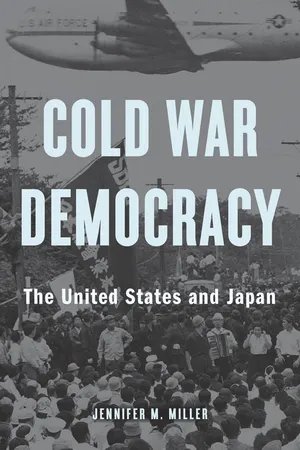
A fresh reappraisal of Japan's relationship with the United States, which reveals how the Cold War shaped Japan and transformed America's understanding of what it takes to establish a postwar democracy.
Is American foreign policy a reflection of a desire to promote democracy, or is it motivated by America's economic interests and imperial dreams? Jennifer Miller argues that democratic ideals were indeed crucial in the early days of the U.S.–Japanese relationship, but not in the way most defenders claim. American leaders believed that building a peaceful, stable, and democratic Japan after a devastating war required much more than elections or a new constitution. Instead, they saw democracy as a psychological and even spiritual "state of mind," a vigilant society perpetually mobilized against the false promises of fascist and communist anti-democratic forces. These ideas inspired an unprecedented crusade to help the Japanese achieve the individualistic and rational qualities deemed necessary for democracy.
These American ambitions confronted vigorous Japanese resistance. Activists mobilized against U.S. policy, surrounding U.S. military bases and staging protests to argue that a true democracy must be accountable to the Japanese people. In the face of these protests, leaders from both the United States and Japan maintained their commitment to building a psychologically "healthy" democracy. During the occupation, American policymakers identified elections and education as the wellsprings of a new consciousness, but as the extent of Japan's remarkable economic recovery became clear, they increasingly placed prosperity at the core of a revised vision for their new ally's future. Cold War Democracy reveals how these ideas and conflicts informed American policies, including the decision to rebuild the Japanese military and distribute U.S. economic assistance and development throughout Asia.
- 358 pages
- English
- ePUB (mobile friendly)
- Available on iOS & Android
eBook - ePub
About this book
Information
• 1 •
Democracy as a State of Mind
ON SEPTEMBER 1, 1945, as the Japanese government prepared to formally surrender aboard the USS Missouri, U.S. secretary of state James Byrnes released a statement that charted the momentous postwar task ahead. The goal of the coming occupation, he claimed, was not simply to transform Japan’s government or military. It was to change the dreams and desires of the Japanese people. “So now we come to the second phase of our war against Japan—what might be called the spiritual disarmament of the people of that Nation—to make them want peace instead of wanting war. This is in some respects a more difficult task than that of effecting physical disarmament. Attitudes of mind cannot be changed at the points of bayonets or merely by the issuance of edicts.” Despite the enormity of this undertaking, Byrnes claimed that the Japanese already possessed the core of spiritual freedom. Rather than imposing foreign ideas and values, he claimed, the United States would facilitate Japan’s “spiritual liberation” by “remov[ing]” all the obstacles that had “closed the door to truth and have stifled the free development of democracy in Japan” and “made the people accept the militaristic philosophy of their warlords.” Byrnes implied that the United States’ superior history and understanding of democracy—the highest form of government—would allow it to transform a foreign people. It would enable a “spiritual liberation,” an unleashing of the soul and its allegedly natural desire for peace and democracy.1
It is easy to dismiss Byrnes’ conception of democratization as mental, psychological, and spiritual transformation as empty rhetoric. Yet this was the powerful paradigm shared by countless American wartime leaders, planners, and the postwar occupation authorities, who repeatedly proclaimed that democracy was fundamentally dependent on specific attitudes, psychologies, and mentalities. To reform Japan after fifteen years of war, they argued, democratic institutions were not enough. To replace the militarist past with a democratic and peaceful future, the Japanese people would also have to develop a democratic conscience premised on rationality, individualism, and a strong sense of civic responsibility. For Byrnes and others, this mindset would encourage the Japanese to mobilize against antidemocratic threats—both people and ideas—while leading them “to want peace.” This belief that democracy depended on the mental state of the people fundamentally undergirded American wartime planning for the occupation. It also deeply informed the implementation of American occupation policies after the war. As George Atcheson, political adviser to the U.S. occupation, put it in a 1947 letter to President Harry Truman, democracy was a “state of mind” and would have to “take firm hold of the minds of the Japanese people” for the occupation to succeed.2
Byrnes’ talk of “spiritual liberation” also exemplified a foundational tension that dominated American thinking about wartime and postwar Japan, which vacillated between fearing the dangerous Japanese mind and believing it could reach a healthy and “mature” democratic psychology. On the one hand, during World War II, policymakers, intellectuals, and commentators repeatedly asserted that Japanese psychology explained Japan’s violent expansion overseas. Perhaps most famous (or infamous) was Geoffrey Gorer’s claim that Japanese aggression stemmed from an obsession with cleanliness developed through “drastic toilet training,” which fostered weak morals and hid a deeply seated “strong desire to be aggressive.” To secure a peaceful future, Americans would have to remake the Japanese psyche, restructuring everything from family relations to social norms. Only then could it be freed from the iron grip of militarist ideologies and deceptive wartime propaganda. On the other hand, despite these orientalist and racialized assumptions about Japanese culture and politics, wartime planners and occupation policymakers presumed that the Japanese people were potentially capable of becoming a “normal” nation. If guided correctly by Americans, the Japanese could build new mentalities that would bolster “healthy” and “rational” thought patterns, which in turn would support democratic politics. Wartime planners and U.S. occupation officials oscillated between lamenting Japan’s problematic spirit and celebrating its ability to overcome a history of militarism and move toward a universal democratic future. The wide-ranging policies they implemented in Japan, from purging military personnel to constitutional revision and economic reform, were fundamentally shaped by this ideological paradox.3
This conception of democracy and democratization as a psychological process is crucial not only to understanding wartime planning and early U.S. occupation policies but also to explaining the bewildering transformations of the early Cold War. Historians have often divided the occupation of Japan into two phases: a limited period when the occupation authorities were genuinely, if imperially, interested in Japan’s democratization, and the 1947 shift known as the “reverse course,” when occupation authorities turned their attention to economic stability and anticommunist mobilization to lay the foundations for a future alliance between the United States and Japan. In this later period, U.S. officials cooperated with the conservative Japanese government to pursue anticommunist purges within public and private institutions, quash labor activism, and emphasize economic retrenchment and stability rather than redistribution. For many Japanese—especially leftists, students, and laborers—these shifts were dramatic and led to profound disappointment over the squandered promise of Japan’s democratic transformation. Yet in the minds of the occupation authorities, these policy shifts were not simply a compromise of democracy for the sake of geostrategic calculations; rather, they were part of an ongoing effort to stabilize and secure what they perceived as the democratic mind and “spirit” against a deviant and aggressive communist enemy. Alongside a desire to economically stabilize Japan, key intellectual, ideological, and legal continuities facilitated the “reverse course.” Many of its policies, such as anticommunist purges, relied heavily on ideas, regulations, and policies developed during the war and the early years of the occupation. This continuity also stemmed from an ongoing conception of democracy as a process of mental vigilance against misleading propaganda and ideas advanced by deceptive antidemocrats. Essentially, the rigid way that the occupation authorities defined democracy in wartime and early postwar contexts provided a useful set of legal practices, rhetorical strategies, and intellectual frameworks to identify and mobilize against communism as the new threat to the Japanese mind. This blend of psychology and politics was the connective tissue that bound together seemingly very different policies.
What is more, the belief that both democracy and anticommunism were a “state of mind” was not limited to American conceptualizations of Japan. It evolved in an international context, drawing on and shaping Americans’ understanding of their own political culture. During World War II and the early Cold War, the widespread belief emerged among Americans that both democracy and its challengers—especially totalitarianism and, more specifically, communism—rose and fell on mindsets and mentalities. Studies of national character and morale during World War II, for example, proclaimed that a country’s future was fundamentally shaped by mental and psychological strength. As Harvard psychologist Gordon Allport declared, “Morale is a condition of physical and emotional wellbeing residing in the individual citizen … National problems … are nothing but personal problems shared by all citizens.” After the war, the continued belief in a profound connection between individual psyches and the fate of nations connected seemingly isolated Cold War policies and ideas across the Pacific. As the United States conducted hearings in the House Un-American Activities Committee (HUAC), drastically increased the size of the Federal Bureau of Investigation (FBI) to pursue communists, and investigated federal employees for loyalty, the occupation authorities and the Japanese government cooperated to endow the postwar Japanese state with startlingly similar anticommunist mechanisms. These included a proposed HUAC in Japan’s parliament, an FBI-like bureau in the Japanese attorney general’s office, the purge of communists from government positions and private industry, and new legislation designed to control so-called subversive activities. Japan, then, was not a peculiar exception, but shaped by broader American assumptions about politics and psychology that altered political life in both states. In the process, endowing the Japanese people with anticommunist “spirit” became an important site of U.S.–Japanese cooperation that would shape this alliance for years to come.4
This chapter therefore argues that a specific conceptualization of democracy, one that defined democratization as a process of mental and psychological transformation, served as a crucial link connecting wartime planning with the two phases of the U.S. occupation of Japan. To do so, it proceeds in three sections. The first examines wartime planning to trace how American officials, academics, and commentators argued that Japan had turned to militarism because the militarist leadership strangled and misled the public mind; democratizing Japan thus necessitated unleashing the mind through new practices, rights, and values, particularly freedom of thought. The second part examines a select group of policies in the early years of the occupation—elections and constitutional reform, political purges, educational reform, and economic reform—to analyze how each of these policies prioritized the creation of a democratic conscience free from misleading and infectious militarist ideologies. The final section examines the occupation’s turn against communism, tracing how anticommunist policies stemmed, in part, from a belief that communism now posed the greatest threat to a democratic Japanese mind. In doing so, it juxtaposes anticommunist policies in Japan with those developed in the United States to argue that policymakers spanning the Pacific believed that the strength of democratic societies across the globe rested on the mental and emotional vigilance of everyday citizens. The occupation of Japan therefore demonstrates how the experiences of World War II and the rise of the Cold War transformed understandings of democracy itself.
Wartime Thinking about Democracy and Militarism in Japan
Though the United States took the lead in fighting the transpacific war against Japan, President Franklin D. Roosevelt made few statements about Japan’s postwar fate during the conflict itself. He only charted the broad contours of his thinking, maintaining that Japan’s aggressive pursuit of war and empire went well beyond military adventurism or a quest for imperial power. It also stemmed from ideologies and psychologies that sought conquest and total dominance. As he stated to the press following the Casablanca conference in January 1943, victory “does not mean the destruction of the population of Germany, Italy or Japan, but it does mean the destruction of the philosophies of those countries which are based on conquest and subjugation of other people.” Roosevelt was therefore clear that Japan’s defeat would involve more than disarmament. Reconstruction would entail a fundamental remaking of the nation’s cultural, political, and social patterns—the “philosophies”—that had facilitated war. People who were truly “free,” liberated from the grip of destructive ideologies, would then naturally chose peace and representative politics; as Roosevelt later stated, “the Japanese war-lord form of government” was “abridgement of freedom” which “no nation in all the world that is free to make a choice is going to set itself up under.” Roosevelt was unsure how psychological change of such magnitude could take place, and did not provide a clear blueprint for its attainment. Yet he clearly believed that remaking Japanese mentalities and patterns of thought was key to the future.5
Roosevelt’s scant commentary meant that detailed thinking and planning about the postwar occupation and Japan’s transformation was left to others. During the war, scholars, journalists, and commentators produced volumes of literature seeking to explain the ideologies and mechanisms of the wartime state and Japan’s prospects for the future. Meanwhile, the formal task of postwar planning began in the State Department, which formed several planning committees in 1942. Perhaps the most prolific was the Inter-Divisional Area Committee on the Far East (IDAFE), which met 234 times between fall 1942 and fall 1945. IDAFE was a mix of diplomats and scholars; its collective membership represented the small community of expertise about Japan. Members included Joseph Ballantine, a former consul to Mukden, China, who led the meetings; Hugh Borton, a professor of Japanese history from Columbia University and a pioneer of Japanese studies in the United States; Eugene Dooman, former counselor to the U.S. Embassy in Tokyo; and George Blakeslee, a professor of history and international relations at Clark University. Alongside contemporary publications and wartime research, IDAFE members relied on their own experiences with East Asia diplomacy and personal ties to the region. Dooman and Ballantine had grown up in Osaka as the children of missionaries; Borton conducted research at Tokyo Imperial University in the 1930s. Throughout the war, these planning committees served as the crucial space for American thinking and debates about Japan, articulating and shaping official understanding of the country’s path to war. Geared as they were toward Japan’s reconstruction, discussions held by IDAFE and its successor committees also reflected American policymakers’ dominant beliefs about the values and structures necessary for establishing a peaceful and democratic future in Japan.6
If there was one assumption shared by the majority of wartime planners, it was the belief that the military stood at the root of Japanese domestic and foreign ills. In fact, even before the attack on Pearl Harbor, consensus was emerging among American observers that the military had become a cancerous institution that overtook the Japanese state and instilled militarist ideology in the people. In 1937, University of Chicago sociologist Harold Lasswell published his famous examination of the “garrison state,” a new political regime where “the specialist on violence is at the helm, and organized economic and social life is systematically subordinated to the fighting forces.” Japan, claimed Lasswell, was the ultimate “ideal type” of this kind of regime, exemplified by its militarist spirit at home and its aggressive expansion of the war in China. Throughout the Pacific War, a variety of observers repeated variants of this claim that the Japanese state had been fundamentally taken over by the military. Writing in 1942, former New York Times Tokyo chief Hugh Byas asserted, “Japan has become a ‘national defense state’ in which all the energies of the nation are harnessed to war, and everything above bare subsistence is devoted to aggression.” In 1943’s Japan’s Military Masters, Hillis Lory, a former member of the faculty at Hokkaido Imperial University in Sapporo, lamented what he believed to be the military’s total dominance. The military, he warned, “holds unrivalled power within the government, ruthlessly cutting the pattern of Japan’s foreign and domestic policies to meet its own specifications … For Japan as for no other country, to know her Army is to know her nation.” Emulating such sentiments, wartime planners believed that dismantling Japan’s military elite was key to its future. As Hugh Borton stated in 1943, Japan’s political structure must be altered so that “military oligarchs cannot again gain the ascendency.”7
Dislodging this militarist ideology, however, required understanding why the military had risen to power in the first place. How had the military become the core of the Japanese state? Many observers traced this development to Japan’s “incomplete” modernization, a process that had begun with the 1868 Meiji Restoration, which replaced the Tokugawa Shogunate with a constitutional monarchy and limited parliamentary democracy. As Byas asserted: “The most important political fact about Japan today is that it has not finished the revolution that began in 1868.” Some observers, such as Borton, highlighted constitutional, structural, and institutional problems, especially the Japanese cabinet and military’s constitutional independence from parliamentary oversight (both were directly loyal to the emperor). This arrangement, explained Borton, allowed the military to exert increasing dominance in the 1930s, paving the way for “the totalitarian type of government.” Nor did the people act as a check on the actions of the government. Despite the presence of a parliament (the Diet) and the passage of a 1925 general election law that extended voting rights to all males over the age of 25, the growing centralization of the Japanese government had made “extremely difficult the emergence of a political consciousness or a realization by the people of the true function and purpose of both national and local government.”8
Others took a broader socioeconomic view, explaining that an outwardly modern Japan maintained premodern and feudal hierarchies. During the nineteenth century, we...
Table of contents
- Cover
- Title Page
- Copyright
- Contents
- Acronyms
- Introduction
- 1. Democracy as a State of Mind
- 2. Militarizing Democracy
- 3. The San Francisco Peace Treaty
- 4. Bloody Sunagawa
- 5. A Breaking Point
- 6. Producing Democracy
- Conclusion
- Abbreviations
- Notes
- Acknowledgments
- Index
Trusted by 375,005 students
Access to over 1.5 million titles for a fair monthly price.
Study more efficiently using our study tools.
Frequently asked questions
Yes, you can cancel anytime from the Subscription tab in your account settings on the Perlego website. Your subscription will stay active until the end of your current billing period. Learn how to cancel your subscription
No, books cannot be downloaded as external files, such as PDFs, for use outside of Perlego. However, you can download books within the Perlego app for offline reading on mobile or tablet. Learn how to download books offline
Perlego offers two plans: Essential and Complete
- Essential is ideal for learners and professionals who enjoy exploring a wide range of subjects. Access the Essential Library with 800,000+ trusted titles and best-sellers across business, personal growth, and the humanities. Includes unlimited reading time and Standard Read Aloud voice.
- Complete: Perfect for advanced learners and researchers needing full, unrestricted access. Unlock 1.5M+ books across hundreds of subjects, including academic and specialized titles. The Complete Plan also includes advanced features like Premium Read Aloud and Research Assistant.
We are an online textbook subscription service, where you can get access to an entire online library for less than the price of a single book per month. With over 1.5 million books across 990+ topics, we’ve got you covered! Learn about our mission
Look out for the read-aloud symbol on your next book to see if you can listen to it. The read-aloud tool reads text aloud for you, highlighting the text as it is being read. You can pause it, speed it up and slow it down. Learn more about Read Aloud
Yes! You can use the Perlego app on both iOS and Android devices to read anytime, anywhere — even offline. Perfect for commutes or when you’re on the go.
Please note we cannot support devices running on iOS 13 and Android 7 or earlier. Learn more about using the app
Please note we cannot support devices running on iOS 13 and Android 7 or earlier. Learn more about using the app
Yes, you can access Cold War Democracy by Jennifer M. Miller in PDF and/or ePUB format, as well as other popular books in History & Japanese History. We have over 1.5 million books available in our catalogue for you to explore.