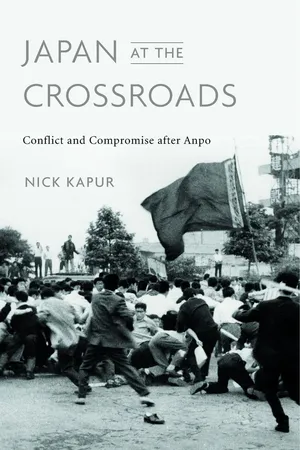
In spring of 1960, Japan's government passed Anpo, a revision of the postwar treaty that allows the United States to maintain a military presence in Japan. This move triggered the largest popular backlash in the nation's modern history. These protests, Nick Kapur argues in Japan at the Crossroads, changed the evolution of Japan's politics and culture, along with its global role.
The yearlong protests of 1960 reached a climax in June, when thousands of activists stormed Japan's National Legislature, precipitating a battle with police and yakuza thugs. Hundreds were injured and a young woman was killed. With the nation's cohesion at stake, the Japanese government acted quickly to quell tensions and limit the recurrence of violent demonstrations. A visit by President Eisenhower was canceled and the Japanese prime minister resigned. But the rupture had long-lasting consequences that went far beyond politics and diplomacy. Kapur traces the currents of reaction and revolution that propelled Japanese democracy, labor relations, social movements, the arts, and literature in complex, often contradictory directions. His analysis helps resolve Japan's essential paradox as a nation that is both innovative and regressive, flexible and resistant, wildly imaginative yet simultaneously wedded to tradition.
As Kapur makes clear, the rest of the world cannot understand contemporary Japan and the distinct impression it has made on global politics, economics, and culture without appreciating the critical role of the "revolutionless" revolution of 1960—turbulent events that released long-buried liberal tensions while bolstering Japan's conservative status quo.
- 337 pages
- English
- PDF
- Available on iOS & Android
eBook - PDF
About this book
Information
Table of contents
- Contents
- Introduction
- 1. Reformulating the US-Japan Alliance
- 2. Stabilizing Conservative Rule
- 3. The Waning of the Opposition Parties
- 4. The Collapse of the 1960 Coalition
- 5. New Directions in Literature and the Arts
- 6. Reshaping the Landscape of Expression
- Conclusion
- Abbreviations
- Notes
- Acknowledgments
- Index
Trusted by 375,005 students
Access to over 1.5 million titles for a fair monthly price.
Study more efficiently using our study tools.
Frequently asked questions
Yes, you can cancel anytime from the Subscription tab in your account settings on the Perlego website. Your subscription will stay active until the end of your current billing period. Learn how to cancel your subscription
No, books cannot be downloaded as external files, such as PDFs, for use outside of Perlego. However, you can download books within the Perlego app for offline reading on mobile or tablet. Learn how to download books offline
Perlego offers two plans: Essential and Complete
- Essential is ideal for learners and professionals who enjoy exploring a wide range of subjects. Access the Essential Library with 800,000+ trusted titles and best-sellers across business, personal growth, and the humanities. Includes unlimited reading time and Standard Read Aloud voice.
- Complete: Perfect for advanced learners and researchers needing full, unrestricted access. Unlock 1.5M+ books across hundreds of subjects, including academic and specialized titles. The Complete Plan also includes advanced features like Premium Read Aloud and Research Assistant.
We are an online textbook subscription service, where you can get access to an entire online library for less than the price of a single book per month. With over 1.5 million books across 990+ topics, we’ve got you covered! Learn about our mission
Look out for the read-aloud symbol on your next book to see if you can listen to it. The read-aloud tool reads text aloud for you, highlighting the text as it is being read. You can pause it, speed it up and slow it down. Learn more about Read Aloud
Yes! You can use the Perlego app on both iOS and Android devices to read anytime, anywhere — even offline. Perfect for commutes or when you’re on the go.
Please note we cannot support devices running on iOS 13 and Android 7 or earlier. Learn more about using the app
Please note we cannot support devices running on iOS 13 and Android 7 or earlier. Learn more about using the app
Yes, you can access Japan at the Crossroads by Nick Kapur in PDF and/or ePUB format, as well as other popular books in History & Art General. We have over 1.5 million books available in our catalogue for you to explore.