As a vehicle to convey both the history of modern China and the complex forces still driving the nation's economic success, rail has no equal. Railroads and the Transformation of China is the first comprehensive history, in any language, of railroad operation from the last decades of the Qing Empire to the present.
China's first fractured lines were built under semicolonial conditions by competing foreign investors. The national system that began taking shape in the 1910s suffered all the ills of the country at large: warlordism and Japanese invasion, Chinese partisan sabotage, the Great Leap Forward when lines suffered in the "battle for steel," and the Cultural Revolution, during which Red Guards were granted free passage to "make revolution" across the country, nearly collapsing the system. Elisabeth Köll's expansive study shows how railroads survived the rupture of the 1949 Communist revolution and became an enduring model of Chinese infrastructure expansion.
The railroads persisted because they were exemplary bureaucratic institutions. Through detailed archival research and interviews, Köll builds case studies illuminating the strength of rail administration. Pragmatic management, combining central authority and local autonomy, sustained rail organizations amid shifting political and economic priorities. As Köll shows, rail provided a blueprint for the past forty years of ambitious, semipublic business development and remains an essential component of the PRC's politically charged, technocratic economic model for China's future.
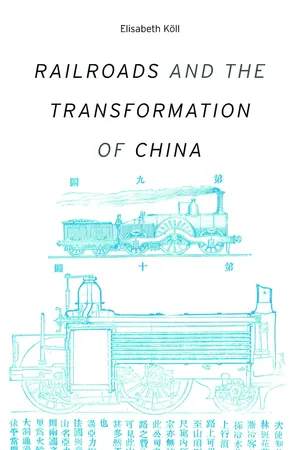
- 417 pages
- English
- PDF
- Available on iOS & Android
eBook - PDF
Railroads and the Transformation of China
About this book
Information
Table of contents
- Cover
- Title Page
- Copyright
- Dedication
- Contents
- List of Figures and Maps
- A Note on Measures, Romanization, and Translations
- Introduction
- I. Competing Interests and Railroad Construction
- II. Railroads in the Market and Social Space
- III. The Making and the Unmaking of the State
- IV. On Track to Socialism
- Conclusion: The Legacies of China’s Railroad System
- Appendix A: Jin-Pu Railroad organization chart, ca. 1929
- Appendix B: Revenue of major Chinese government railroad lines (thousand yuan per mile of line), 1915–1935
- Appendix C: Freight transported by major Chinese government railroad lines (yuan per ton), 1915–1935
- Appendix D: Number of passengers by ticket class, major Chinese government railroad lines, 1918–1935
- Appendix E: Average miles per passenger journey by ticket class, major Chinese government railroad lines, 1918–1935
- Appendix F: Freight designated for export (tons), shipped from Hankou to Guangzhou and onward to Hong Kong by train, October 18–December 31, 1937
- Abbreviations
- Glossary
- Notes
- Acknowledgments
- Index
Trusted by 375,005 students
Access to over 1.5 million titles for a fair monthly price.
Study more efficiently using our study tools.
Frequently asked questions
Yes, you can cancel anytime from the Subscription tab in your account settings on the Perlego website. Your subscription will stay active until the end of your current billing period. Learn how to cancel your subscription
No, books cannot be downloaded as external files, such as PDFs, for use outside of Perlego. However, you can download books within the Perlego app for offline reading on mobile or tablet. Learn how to download books offline
Perlego offers two plans: Essential and Complete
- Essential is ideal for learners and professionals who enjoy exploring a wide range of subjects. Access the Essential Library with 800,000+ trusted titles and best-sellers across business, personal growth, and the humanities. Includes unlimited reading time and Standard Read Aloud voice.
- Complete: Perfect for advanced learners and researchers needing full, unrestricted access. Unlock 1.5M+ books across hundreds of subjects, including academic and specialized titles. The Complete Plan also includes advanced features like Premium Read Aloud and Research Assistant.
We are an online textbook subscription service, where you can get access to an entire online library for less than the price of a single book per month. With over 1.5 million books across 990+ topics, we’ve got you covered! Learn about our mission
Look out for the read-aloud symbol on your next book to see if you can listen to it. The read-aloud tool reads text aloud for you, highlighting the text as it is being read. You can pause it, speed it up and slow it down. Learn more about Read Aloud
Yes! You can use the Perlego app on both iOS and Android devices to read anytime, anywhere — even offline. Perfect for commutes or when you’re on the go.
Please note we cannot support devices running on iOS 13 and Android 7 or earlier. Learn more about using the app
Please note we cannot support devices running on iOS 13 and Android 7 or earlier. Learn more about using the app
Yes, you can access Railroads and the Transformation of China by Elisabeth Köll in PDF and/or ePUB format, as well as other popular books in History & Economic History. We have over 1.5 million books available in our catalogue for you to explore.