In The Colonial Politics of Global Health, Jessica Lynne Pearson explores the collision between imperial and international visions of health and development in French Africa as decolonization movements gained strength.
After World War II, French officials viewed health improvements as a way to forge a more equitable union between France and its overseas territories. Through new hospitals, better medicines, and improved public health, French subjects could reimagine themselves as French citizens. The politics of health also proved vital to the United Nations, however, and conflicts arose when French officials perceived international development programs sponsored by the UN as a threat to their colonial authority. French diplomats also feared that anticolonial delegations to the United Nations would use shortcomings in health, education, and social development to expose the broader structures of colonial inequality. In the face of mounting criticism, they did what they could to keep UN agencies and international health personnel out of Africa, limiting the access Africans had to global health programs. French personnel marginalized their African colleagues as they mapped out the continent's sanitary future and negotiated the new rights and responsibilities of French citizenship. The health disparities that resulted offered compelling evidence that the imperial system of governance should come to an end.
Pearson's work links health and medicine to postwar debates over sovereignty, empire, and human rights in the developing world. The consequences of putting politics above public health continue to play out in constraints placed on international health organizations half a century later.
eBook - ePub
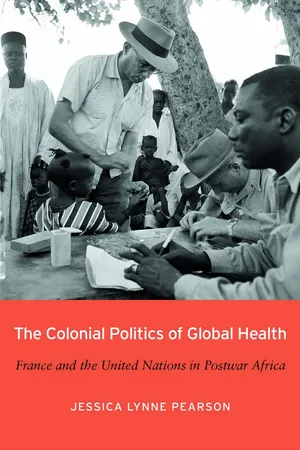
The Colonial Politics of Global Health
France and the United Nations in Postwar Africa
- 260 pages
- English
- ePUB (mobile friendly)
- Available on iOS & Android
eBook - ePub
The Colonial Politics of Global Health
France and the United Nations in Postwar Africa
About this book
Information
Topic
MedicineSubtopic
African HistoryCHAPTER ONE
War, Citizenship, and the Limits of French Civilization
In 1939, the situation wasn’t brilliant. At the beginning of 1946, it was catastrophic. This scenario urgently calls for a complete overhaul of the [colonial] health system based on a freer, more flexible, and more efficient foundation. The native population is wasting away, disappearing. Our doctors are ready. Give them arms.
—Médecin-Colonel Lotte, director of health services, Guinea, 1946
THE FRAGILITY OF LIFE in wartime France has become a well-known story. The word occupation conjures up now-familiar images of the mass exodus from Paris in 1940, of French families trudging slowly along the roadside with all of their worldly possessions, and of French citizens weeping as they observed German armies taking control of their cities.1 In this context of defeat and occupation, physical well-being became more precarious—not only on the battlefield but also at home, where hunger was ubiquitous and food shortages compounded other health problems. By December 1943, the average daily calorie intake for adults had dropped to 1,200. As a result, health services in France saw a rapid increase in rickets, digestive problems, and even tuberculosis, as weakened bodies found themselves increasingly unable to fight off infections. In addition to food scarcity, doctors and patients faced a shortage of medical supplies and hospital beds, which in many cases were requisitioned by German occupiers for their own use. Resistance leaders quickly connected these problems to the larger issue of national survival. In its reports, the Comité français de libération nationale (French Committee of National Liberation; CFLN) highlighted the precarious nature of life on the home front, comparing death by starvation to execution by the Nazi army or the Vichy government.2
Less familiar is the story of how half a decade of war shaped the daily lives of families—especially children—in France’s overseas empire.3 In 1946, a medical report from the director of health services in French Guinea evoked an ongoing battle to fight the effects of epidemic disease and malnourishment, which had been aggravated by wartime conditions. The “arms” that Médecin-Colonel Lotte referred to, however, were not rifles or grenades but rather rat poison to fight the spread of plague and microscope slides to perform blood analyses in malaria-endemic zones. Beyond the colonial government’s inability to fight disease, Lotte’s report also pointed to the French administration’s failure to ensure the basic welfare of African families. While noting that social services were “a primordial component of medical action,” he stated that without “method, continuity, and understanding,” such programs were a “mere façade” in the empire.4 Colonial health services had expanded rapidly during the interwar years, with the construction of hospitals and maternity clinics, the institution of mobile vaccination teams, and the establishment of protocol to combat endemic diseases, such as sleeping sickness and yellow fever. The onset of the Second World War, however, brought the expansion of public health services to a standstill. The occupation drained French budgets and cut off the normal supply of personnel and materials to the colonies, hindering the ability of medical services to reach the people who needed them most.
If ordinary people in the empire suffered alongside their counterparts in metropolitan France during the war, the colonies also served as a lifeline, supplying soldiers, workers, and raw materials and providing a home for resistance movements. In the war’s aftermath, the demands made by imperial subjects for equal political rights thus became all the more compelling. So, as French officials struggled to address the more immediate tasks of postwar reconstruction, they were also embarking on a deeper process of reenvisioning the relationship between France and its empire. The process began in 1944, when delegates from metropolitan France and the colonies gathered in Brazzaville, the capital of AEF, to address questions of political participation and social welfare in the empire.5 The discussions undertaken at Brazzaville culminated in 1946 when the Assemblée nationale constituante (National Constituent Assembly) approved the creation of the French Union, a reimagined French empire that would allow for the political participation of all overseas territories on a footing equal to that of the inhabitants of metropolitan France. According to the provisions of the Lamine Guèye law, all Africans in the French empire would, for the first time, enjoy the same rights of citizenship as their metropolitan counterparts.6 Health was an important component of these reforms, and French officials explicitly linked the improvement of preventative health services to their broad political, social, and economic goals for the empire.
Delegates to the Brazzaville Conference and the Assemblée nationale constituante had high hopes about the power of progressive colonial policy to cement the relationship between France and its empire in the postwar period. The implementation of these policies, however, often fell short in practice.7 Ongoing failures to realize an effective and efficient public health system revealed the limits of colonial reform—and of France’s mission civilisatrice more broadly—in two important ways. First, despite far-reaching plans for health care reform, years of fighting resulted in significant shortages of personnel and supplies that drastically limited the government’s ability to maintain even the most basic of health services for its colonial populations. Second, as African subjects were reimagined—and reimagined themselves—as citizens of the French Union, health took on new—and sometimes unintended—political meanings. While French doctors and colonial officials envisioned public health programs as a way to shape a new kind of “sanitary citizen” of the French Union, Africans themselves sometimes used their new citizenship status to reject public health provisions that they saw as coercive. This growing divide between best-laid plans and the realities of postwar colonial rule would ultimately expose the French government to passionate critiques at the UN and would create an opportunity for new global health organizations to compete with existing structures of colonial public health.
Reenvisioning Colonial Health in Wartime Africa
By the beginning of the twentieth century, European empires stretched across the globe from the Caribbean to Africa, Asia, the Middle East, and the Pacific. Colonial ventures faced a range of obstacles—environmental and human—in the territories they conquered. Public health programs allowed colonial administrations to address both the practical and ideological constraints on their imperial ambitions. Hospitals and clinics, for example, played an important role in helping European colonizers survive biologically “hostile” physical environments in their newly established empires.8 More importantly, though, health services for colonial subjects provided an ideological justification for colonial rule, as an essential component of the “civilization” that colonizers claimed to be bringing to their overseas territories.9 Medical services also ensured a healthy and fertile population that could serve as a source of labor for the extraction of raw materials, as well as a market for colonial products.10 From a scientific standpoint, the colonies and their populations helped experts generate specialized knowledge in the emerging field of tropical medicine, and colonial subjects provided a pool of test subjects for medical experiments that could have raised ethical questions in the metropole.11
The first health services and medical research facilities in French Africa—aimed primarily at Europeans—were constructed in urban areas in the late nineteenth century. These included hospitals in Dakar, Senegal; Kayes, Mali; and Antananarivo, Madagascar, as well as a bacteriological institute, the Institut Marchoux, in Saint-Louis, Senegal. Health services for Africans expanded after the appointment of Ernest Roume to the position of governor-general of AOF in 1902. As Alice Conklin has argued, Roume’s governorship marked a watershed in colonial policy—moving from a short-term strategy of conquest to an approach that focused on improving quality of life and colonial productivity over the longer term. This policy of mise en valeur was geared toward the optimization of resource use—including human resources—in order to promote the long-term prosperity and viability of France’s overseas empire. It also implied an important role for the colonial state in directing the use of these resources. This shift mirrored the growing role that the French state and new sociomedical “experts” would play in the rational management of social problems in the metropole.12
To achieve his goal of improving health for Africans, Roume created the Assistance médicale indigène (Indigenous Medical Assistance Program; AMI), which provided health services free of charge.13 Conklin argues that by setting up the AMI, Roume aimed to dramatically change the way Africans lived. Although he was not the first colonial governor to embrace the idea of the civilizing mission, she argues that Roume was the first with the financial and bureaucratic capacity to truly embark on such a mission.14 One of the primary goals of the AMI was “the numerical growth and physiological amelioration of the indigenous races,” a goal that reflected similar concerns about the quantity and quality of the population in metropolitan France.15 France had faced a declining birthrate since the mid-nineteenth century and, as a result, government officials, demographers, and doctors were haunted for decades by fears of depopulation and biological degeneration. The demographic catastrophe of the First World War exacerbated these fears and provoked a wave of pronatalist measures, including improved infant and maternal health care facilities, special loans and credits for young married couples, and prizes and honors for mothers of large families. These aimed to increase the birthrate and to improve the overall health of children in order to generate a sizeable population of robust workers and soldiers. In the interwar years, colonial administrators and doctors transplanted this project to France’s overseas colonies, where they hoped to increase the population by tackling high rates of infant mortality due to umbilical tetanus, pneumonia, malnutrition, malaria, and poor hygiene.16
Despite the concerted efforts of French doctors and colonial administrators, early medical programs in sub-Saharan Africa were slow to produce visible results. Given the limited resources available, health services for Europeans and Africans living in big cities were often prioritized over services for rural Africans, which were expensive to run. The few doctors that were stationed in the colonies were often forced to work out of poorly provisioned clinics.17 In 1910, anthropologist Abel Lahille wrote, “Is the division of objects necessary for the functioning of the [health] service done in a methodical manner? Not at all. One product that is lacking from one dispensary can be found in another in an excessive and unusable quantity.” He continued with two examples: “Timbuktu once received, in 1907, six kilograms of ipecac! At Kayes, the clinic was stocked with more than 100 kilograms of potassium iodide! By contrast, at the beginning of the winter of 1908, not even a gram of quinine remained.”18 Beyond the practical problems of funding, supplies, and personnel, the AMI also faced several cultural obstacles that arose from colonial racism and the limited understanding of African culture on the part of Europeans. One doctor, for example, claimed, “The indigenous people of Bobo-Dioulasso are of a distressing stupidity … deciding only with reluctance to submit themselves to [the care of] European doctors.”19 Colonial doctors and cultural observers thus portrayed Africans as superstitious and intellectually incapable of accessing modern scientific and medical knowledge.
Despite these obstacles, colonial administrators pushed forward with health care reform in AOF, and Roume’s successors worked to expand the system he put in place. In particular, Governor-General Jules Carde—despite working in a time of global economic hardship during the 1930s—remained ideologically committed to the idea that human resources could and should be rationally managed. Carde’s plan especially emphasized nutrition and the reduction of infant mortality through proper infant and maternal health care provisions.20 Carde claimed that in spite of its shortcomings, the creation of an effective and efficient system of colonial public health was not outside the scope of French medicine or France’s colonial administration. He wrote, “I persuaded myself that I had neither dreamed too grandly, nor that French doctors were incapable of adapting to this milieu a social sanitary organization aimed at protecting the well-being of our indigenous populations.” Improvements should have been especially easy, Carde argued, at a time “when the applications … of Pasteur’s teaching have rendered the fight against contagious diseases all the more simple.”21 If there was ever a time when reform should succeed in AOF, Carde believed, it was this moment, when scientific, social, political, and financial circumstances favored the development of services to protect France’s colonial populations.
The next important moment for public health reform in France’s African colonies came during the Second World War, as colonial officials worked to lay out chang...
Table of contents
- Cover
- Title Page
- Copyright
- Dedication
- Contents
- Abbreviations
- Introduction
- 1. War, Citizenship, and the Limits of French Civilization
- 2. The United Nations and the Politics of Health
- 3. Between Colonial Knowledge and International Expertise
- 4. The World Health Organization Comes to Brazzaville
- 5. Family Health, France, and the Future of Africa
- 6. Fighting Illness, Battling Decolonization
- Epilogue
- Notes
- Bibliography
- Acknowledgments
- Index
Trusted by 375,005 students
Access to over 1.5 million titles for a fair monthly price.
Study more efficiently using our study tools.
Frequently asked questions
Yes, you can cancel anytime from the Subscription tab in your account settings on the Perlego website. Your subscription will stay active until the end of your current billing period. Learn how to cancel your subscription
No, books cannot be downloaded as external files, such as PDFs, for use outside of Perlego. However, you can download books within the Perlego app for offline reading on mobile or tablet. Learn how to download books offline
Perlego offers two plans: Essential and Complete
- Essential is ideal for learners and professionals who enjoy exploring a wide range of subjects. Access the Essential Library with 800,000+ trusted titles and best-sellers across business, personal growth, and the humanities. Includes unlimited reading time and Standard Read Aloud voice.
- Complete: Perfect for advanced learners and researchers needing full, unrestricted access. Unlock 1.5M+ books across hundreds of subjects, including academic and specialized titles. The Complete Plan also includes advanced features like Premium Read Aloud and Research Assistant.
We are an online textbook subscription service, where you can get access to an entire online library for less than the price of a single book per month. With over 1.5 million books across 990+ topics, we’ve got you covered! Learn about our mission
Look out for the read-aloud symbol on your next book to see if you can listen to it. The read-aloud tool reads text aloud for you, highlighting the text as it is being read. You can pause it, speed it up and slow it down. Learn more about Read Aloud
Yes! You can use the Perlego app on both iOS and Android devices to read anytime, anywhere — even offline. Perfect for commutes or when you’re on the go.
Please note we cannot support devices running on iOS 13 and Android 7 or earlier. Learn more about using the app
Please note we cannot support devices running on iOS 13 and Android 7 or earlier. Learn more about using the app
Yes, you can access The Colonial Politics of Global Health by Jessica Lynne Pearson in PDF and/or ePUB format, as well as other popular books in Medicine & African History. We have over 1.5 million books available in our catalogue for you to explore.