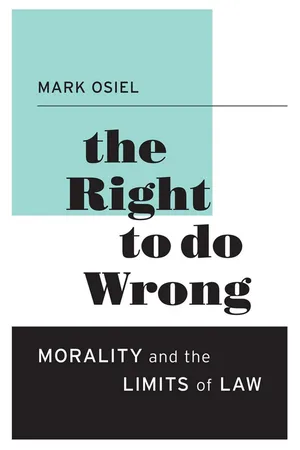
Common morality—in the form of shame, outrage, and stigma—has always been society's first line of defense against ethical transgressions. Social mores crucially complement the law, Mark Osiel shows, sparing us from oppressive formal regulation.
Much of what we could do, we shouldn't—and we don't. We have a free-speech right to be offensive, but we know we will face outrage in response. We may declare bankruptcy, but not without stigma. Moral norms constantly demand more of us than the law requires, sustaining promises we can legally break and preventing disrespectful behavior the law allows.
Mark Osiel takes up this curious interplay between lenient law and restrictive morality, showing that law permits much wrongdoing because we assume that rights are paired with informal but enforceable duties. People will exercise their rights responsibly or else face social shaming. For the most part, this system has worked. Social order persists despite ample opportunity for reprehensible conduct, testifying to the decisive constraints common morality imposes on the way we exercise our legal prerogatives. The Right to Do Wrong collects vivid case studies and social scientific research to explore how resistance to the exercise of rights picks up where law leaves off and shapes the legal system in turn. Building on recent evidence that declining social trust leads to increasing reliance on law, Osiel contends that as social changes produce stronger assertions of individual rights, it becomes more difficult to depend on informal tempering of our unfettered freedoms.
Social norms can be indefensible, Osiel recognizes. But the alternative—more repressive law—is often far worse. This empirically informed study leaves little doubt that robust forms of common morality persist and are essential to the vitality of liberal societies.
- 502 pages
- English
- ePUB (mobile friendly)
- Available on iOS & Android
eBook - ePub
About this book
Information
Topic
DroitSubtopic
Jurisprudence1
Common Morality, Social Mores, and the Law
We must have some level of comfort with the notion of common morality, in its own right, before we can begin to examine its relation to the law. And if common morality, like the law, contributes to elementary social coordination—as to more ambitious forms of solidarity—how might it do so, exactly?
Certain observers militantly affirm that a shared sense of moral fundamentals is necessary in enabling people to cooperate with and rely upon one another in basic ways—necessary even to say that a society exists at all. This common morality is essential, they believe, to any social order in which one would wish to live, at least. For social order of this baseline sort is a threshold condition for thereafter attaining loftier ideals of justice, freedom, and human flourishing. Many also see common morality as essential to uniting a society against its enemies, present or anticipated, distant or residing just next door.
Others passionately deny not only the existence of a common morality (in any nontrivial sense) but its very possibility—indeed, its conceptual intelligibility. On both sides of this sometimes-heated dispute, large numbers apparently believe that acknowledging or repudiating the sheer fact that moral standards are shared within a given national territory has clear and decisive implications for its governance, though these are rarely articulated or explained with any care. Those implications they find either simpático or profoundly unpalatable. To offer a few concrete illustrations: Some people today consider it appalling that persons of modest wealth perceive injustice in a new tax upon the rich that is adverse to those (like Mark Zuckerberg) who earned their billions through technological innovations that much enhance the well-being of most people in the world. Other people, generally of opposing ideological inclinations, find it equally outrageous that so many African Americans do not share the view that, apart from a few “bad apples,” most police officers adhere to acceptable ethical standards, treating criminal suspects with sufficient respect, refraining from excessive force.1
It is by no means obvious what truly follows from according or rejecting a prominent place to common morality in our understanding of national societies and their workings. The question nevertheless appears politically momentous, and there is no doubt that it is ominously large. We might best work up to it gradually, indirectly, by first inquiring what evidence there is for the existence of a common morality, treating this simply as an empirical puzzle. Here is a question that might be resolved on a factual basis, one might hope, even if the answer is unlikely to be a simple yes or no. Before we could examine the issue in such terms, though, we would need to resolve a few thorny conceptual issues, some of which this chapter assays. I therefore sidle up to the bigger questions only somewhat laterally, rather than seeking directly to resolve them. Still, it is possible to begin by naively asking of the available data: How strongly does a national population hold common views of right and wrong? How broadly do members share sentiments on questions of justice, whether in general terms or in reference to more specific issues (conceived in this fashion)?
We would have to adopt a pluralistic stance on pertinent methods for approaching these questions, seeking answers not only in expressions of opinion to survey researchers and in experimental philosophy, but also in many other places, including the everyday mores of various milieus, as ethnographers describe these. Where differences among people initially seem more evident, we would need to consider the possibility that principled commitments, though fundamentally shared, may assume distinct forms in specific subcommunities. The virtue of “personal respectability,” in particular, appears no less weighty in the minds of many who find themselves trapped in poor ethnic enclaves, according to several urban ethnographers,2 as those living in Park Avenue penthouses. Conversely, acceptable mores that initially seem quite similar in different places might in fact signify deeper value commitments wholly at odds.
Though the two greatly overlap, we should not entirely equate the concept of common morality, as here employed, with the verbal expression “common morality,” its use within ordinary language. Philosophers of language are correct to insist on some separation between the social realities with which we are consistently concerned—and which scholars may help us conceptualize—and the particular patterns of wording we routinely employ, at a given place or period, to navigate within these realities. It is nonetheless of some interest that an Ngram Viewer search finds that, since 1800, the term “common morality” has alternately waxed and waned, today enjoying a frequency of usage attained only twice before, in 1811 and 1883.3 We cannot, however, assume that the term retained the same meaning throughout this long period. We can be more confident in interpreting sharp changes over short periods. So it warrants mention that the largest upsurge in American usage of the term for over a century occurred during the 1980s and 1990s, which saw the advent of America’s “culture wars.” Usage of the expression has not much declined since then.
Common morality is an elusive notion, both conceptually and empirically. “We live during a time when the very concept of a single unifying moral order is hard to fathom,”4 write two leading scholars—in evident exasperation. The idea of common morality has long been quite “thin,” in Bernard Williams’s sense.5 Such thin concepts as good, fair, ought, permissible, blameworthy, and praiseworthy are strewn across the language of public discussion in modern liberal societies. These words are rather amorphous, however, too remote from any recognizable social context or moral content—hence, too abstract—to assist much in practical tasks of understanding and evaluation.
We can distinguish these terms, readily and intuitively, from equally positive expressions like honest, rude, brave, heroic, courageous, generous, and wise, and from words with negative valence like cruel, boorish, selfish, barbaric, obscene, and gaudy. These concepts are thick, in that they effectively merge descriptions of fact with judgments of value. They are thick also in the sense that, to use them properly, one must know a great deal about the specific contours and commitments of one’s society, and often about someone’s place within it.
Thick concepts are essentially absent from liberal moral and political philosophy, as they are from the elite political discourse of the societies that spawned it. Yet they still suffuse the language of evaluation in non-elite political discussion and in the private life of nearly everyone within these same countries, if perhaps less so than in the distant past. In certain parts of the world that are more culturally homogeneous than the contemporary West, areas lacking the experience of mass immigration, people continue to employ thick concepts even in their public discourse, it would seem.6 This is because the stronger commitments we make when employing thick concepts often stem from the contemporary expression of a long-standing culture or civilization. Despite continuing differences over the proper interpretation of its legacy, this common heritage can instill some confidence among interlocutors that even their sharper judgments, positive and negative, will be shared—or at least not dismissed as incomprehensible, incoherent, wholly barbaric. By contrast, prevailing understandings of liberal modernity demand that, when engaged in public justification of our political views, we seek to extricate ourselves from precisely such culture-specific commitments. Admittedly, this proves not merely difficult in practice, in the heat of the moment, but impossible fully to imagine, when of cooler head, even in theoretical terms, some insist.
For common morality to become a thick concept, its idea of “wrong” would have to take on much richer coloration, denoting “wrong in this particular way, for these reasons, in those circumstances, when dealing with that kind of person, given an appreciative understanding of our group’s shared criteria of judgment.” Today, within modern liberal societies, the freestanding notion of wrongdoing tells us almost nothing, and so in these respects common morality seems to ascend or, as it were, recede into thin air. Even so, within a given country or professional community, concepts once quite thin can thicken over time. Within the law over recent decades, this is clearly the case with “due process” in U.S. constitutional law and “good faith” within the contract law (and attendant commercial mores) of Western Europe.7 Thick concepts sometimes have to begin their legal life rather ethereally. And concepts once densely specific in reference, evaluative and descriptive, can conversely wizen over time. This is as true within professional communities—of lawyers, physicians, and military officers—as it is of entire national societies. A certain measure of thinning is nearly certain to occur, in fact, whenever any such social entity becomes more internally variegated and seeks to accommodate, rather than suppress, this increasing ideational differentiation, whatever its sources.
This is one way of fairly characterizing the fate of common morality, as personally experienced and articulated among North Americans and Western Europeans in recent years. It should be clear that this way of characterizing our moral history is evaluatively neutral—necessarily so, because, thick ones are by nature no more ethically defensible than thin, not from an avowedly universalistic or cosmopolitan standpoint, at least. Nor are thick, normative concepts particularly helpful in avoiding tension within conversation, for thinner ones enable an adroit speaker to remain somewhat vague, where greater clarity about what she truly thinks could readily invite conflict. The word “inappropriate” is even thinner than “wrong,” still less committed to anything much in particular. This is one major reason the former has so substantially displaced the latter, certainly in interpersonal communication among non-intimates.
The term “common morality,” slippery enough at the conceptual level, turns still more vexing when we confront the political ramifications of its real-life usage. For many people, the very term—along with “moral order”—has become quite controversial, carrying a distinct whiff of Victorian stodginess. An inevitable objection to my purposes, in fact, is that in a given time and place there may exist virtually no common morality at all, in any coherent, robust, or otherwise acceptable sense of the term. After all, subgroups of a national society often feel keen indignation toward very different practices, institutions, and people. Even where moral judgments are widely shared, there is certainly no reason to assume they are defensible.
Yet the questions implicated by the term “common morality” are by no means antiquarian. It is these questions, more than any possible (and certainly contentious) answer to them, that are the focus of this chapter. Their incendiary character should be clear from the observable fact that, when they are not simply deemed too sensitive to broach openly, ensuing disagreements threaten to set us nearly at fisticuffs, even in scholarly settings.8 This is true not only of empirical questions about whether any common morality truly exists and, if so, what its ‘contents’ or implications might be in the here and now. It is true even of the meta-questions, concerned with the vagaries of what precisely it might even mean to speak of a common morality.
Though we today find it hard to believe, in late-nineteenth-century America opposition to the sale and consumption of alcohol was for many people no less intense than indignation against human slavery a generation earlier.9 It is especially difficult to determine the empirical contours and even the existence of common morality when ethical sensibilities and opinions are clearly in flux.10 At such times, new understandings of moral acceptability coexist with those much older, whose adherents vigorously defend these in face of vociferous challenge.11 Where there exists no genuine agreement on what morality demands—beneath the level of ponderous platitude, perhaps—one cannot intelligibly compare these demands with the law’s. (The reverse is also true: when there exists no settled or clearly emergent law on a given question, we cannot intelligibly compare law’s demands on us to those of prevailing morals.)
An essential question here concerns the empirical scope of common morality within a given social order. The methodological obstacles to answering that query are daunting. We can confront them only by employing the widest variety of available instruments, taking up each wherever it best suits the immediate circumstance, from survey research and archival inquiry to participant observation and interviews with insider informants. Even their combination will sometimes leave us well short of the confidence to which we aspire. Yet if the substantive questions impelling such an inquiry are clearly important, we cannot simply discard them upon acknowledging the limitations of our present methodological tools. We must do the best we can with what we have. In the social sciences, there often seems to exist an inverse correlation, alas, between the measure of confidence we can have in our answers and the relative importance of the questions to which they respond.
Let us start with the most ambitious arguments for moral commonality. It may be possible, some plausibly contend, to identify a meaningful form of morality shared universally, everywhere on earth, if we confine its content to a few basic, broad beliefs: do not kill persons; do...
Table of contents
- Cover
- Title Page
- Copyright
- Dedication
- Contents
- Epigraphs
- Introduction: Defining the Puzzle
- 1. Common Morality, Social Mores, and the Law
- 2. A Sampling of Rights to Do Wrong
- 3. Three Rights to Do Wrong
- 4. How to “Abuse” a Right
- 5. Law and Morality in Ordinary Language and Social Science
- 6. Divergences of Law and Morals: Sites and Sources
- 7. Convergences of Law and Morals: Sites and Sources
- 8. Questions of Method and Meaning: The Law at Odds with Common Morality
- 9. Why This Book Is Not What You Had in Mind
- 10. The Changing Stance of Lawyers toward Common Morality
- 11. Commercial Morality, Bourgeois Virtue, and the Law
- 12. How We Attach Responsibilities to Rights
- 13. Common Morality Confronts Modernity
- Conclusion
- Notes
- References
- Acknowledgments
- Index
Trusted by 375,005 students
Access to over 1.5 million titles for a fair monthly price.
Study more efficiently using our study tools.
Frequently asked questions
Yes, you can cancel anytime from the Subscription tab in your account settings on the Perlego website. Your subscription will stay active until the end of your current billing period. Learn how to cancel your subscription
No, books cannot be downloaded as external files, such as PDFs, for use outside of Perlego. However, you can download books within the Perlego app for offline reading on mobile or tablet. Learn how to download books offline
Perlego offers two plans: Essential and Complete
- Essential is ideal for learners and professionals who enjoy exploring a wide range of subjects. Access the Essential Library with 800,000+ trusted titles and best-sellers across business, personal growth, and the humanities. Includes unlimited reading time and Standard Read Aloud voice.
- Complete: Perfect for advanced learners and researchers needing full, unrestricted access. Unlock 1.5M+ books across hundreds of subjects, including academic and specialized titles. The Complete Plan also includes advanced features like Premium Read Aloud and Research Assistant.
We are an online textbook subscription service, where you can get access to an entire online library for less than the price of a single book per month. With over 1.5 million books across 990+ topics, we’ve got you covered! Learn about our mission
Look out for the read-aloud symbol on your next book to see if you can listen to it. The read-aloud tool reads text aloud for you, highlighting the text as it is being read. You can pause it, speed it up and slow it down. Learn more about Read Aloud
Yes! You can use the Perlego app on both iOS and Android devices to read anytime, anywhere — even offline. Perfect for commutes or when you’re on the go.
Please note we cannot support devices running on iOS 13 and Android 7 or earlier. Learn more about using the app
Please note we cannot support devices running on iOS 13 and Android 7 or earlier. Learn more about using the app
Yes, you can access The Right to Do Wrong by Mark Osiel in PDF and/or ePUB format, as well as other popular books in Droit & Jurisprudence. We have over 1.5 million books available in our catalogue for you to explore.