WINNER: CMI Management Book of the Year Awards 2016 - Commuter's Read Category
In an age when customers have access to vast amounts of data about a company, its product and its competitors, customer experience becomes increasingly important as a sustainable source of competitive advantage. But success doesn't just rely on digital engagement and excellence, but also on combining a digital-first attitude with a human touch. In When Digital Becomes Human, Steven Van Belleghem explores and explains the new digital relationships.
Packed with global examples from organizations that have successfully transformed their customer relationships, such as Amazon, Toyota, ING, Coolblue, Nike and Starbucks, When Digital Becomes Human presents a clear model that companies can easily implement to integrate an emotional layer into their digital strategy. This guide to combining two of a business's most important assets - its people and its digital strengths - covers the latest issues in digital marketing and customer experience management, including omnichannel and multichannel experiences, big data and predictive analytics, privacy concerns, customer collaboration (ie crowdsourcing) and more.
eBook - ePub
When Digital Becomes Human
The Transformation of Customer Relationships
- English
- ePUB (mobile friendly)
- Available on iOS & Android
eBook - ePub
About this book
Information
PART ONE
Introduction
Introduction
Humans became digital, now it’s time for digital to become human
Everyone loves E.T. I recently watched this amazing film with my two young sons. And just like everyone else, we had lumps in our throats and tears in our eyes when the moment came for E.T. to say goodbye to his human friend, Elliott. Before E.T., aliens were always ‘bad’. There was nothing human about them. Their very ‘inhumanness’, their lack of human qualities, made them something to be feared. E.T. changed all that. E.T. was an extra-terrestrial with a warm, human side. This was something new. Since then, all ‘good’ aliens in films have had this same human aspect. Everyone likes E.T. Everyone feels sympathy for E.T. Once you have seen it, it is one of those films that you will never forget. Emotional relationships are strong. The same is true for the successful customer relationships of the future: they will make the difference by virtue of their emotional content. But the emotional part of a relationship can only work if its rational, practical side also runs smoothly. The successful customer relationships of the future will therefore be built on both the rational (digital perfection) and the emotional (the human touch).
Nowadays, technology is the sixth sense for the vast majority of people. Hardly an hour (or sometimes scarcely a minute) goes by without us using some piece of technology. Technology assists us in our professional lives, helps us to enjoy our leisure time and allows us to follow the news as it unfolds. Technology is involved in every step of our daily lives. And over the next 5 to 10 years the scale and pace of digitalization will increase significantly. Today, an average family has three pieces of technology linked to the internet. By 2020, this number will likely increase to a minimum of 10. In addition to our telephones, our cars, coffee machines, shoes, fridges and much more will all be inextricably linked to the web.
This rapid digitalization will also have an impact on the relationships between consumers and companies. The customer relationship will be digitally driven from start to finish. The difference between online and offline will quickly disappear. Consumers now live in a world of self-service, automation, smart data use and proactive customer service. This process of digitalization is already moving quickly and the battle to keep ahead in the customer relationship game is a hard one. Companies with an online origin are currently in the lead and are anchoring themselves ever more firmly into the digital world. Most companies with an analogue background are lagging behind in the digitalization of their customer relations. Their future will be uncertain unless they can make up this lost ground – and quickly.
In the relatively near future the digital customer relationship will become a commodity. Whoever fails to make the transition to digital will simply not be able to survive. But even the companies that do make this transition successfully will discover that it is not enough by itself to win the hearts and minds of the customer. The digital transformation will also force companies to transform their human relations as well. What role will the human element play in customer relations in five years’ time? Will self-service, automation and robots come to dominate the customer relations of the future? People can (for the time being, at least) still do something that machines cannot: they can inject emotion into the customer relationship. This means that if people continue to play a role in this relationship, it is important that the focus is set fairly and squarely on emotion. A computer cannot (yet) be creative, empathic or passionate. But people can.
This book is not a story about disruptive innovation. Instead, it seeks to offer you a vision for the customer relationship of the future. It will show you how to achieve the digitalization of your company in the best possible manner. It will help you to make the choices about your future that will need to be made after your successful digitalization. The future is both digital and human.
The structure of When Digital Becomes Human
This book is based on a combination of research and vision. In recent years, I have had the good fortune and the pleasure of discussing the future of customer relations with a number of different experts and companies. The results of these interesting conversations form the core of the book.
In addition, I have also carried out three research projects to test out the hypotheses on which the book is based:
- The Self-Service Economy.1 A global research study carried out in 2013 among 2,750 respondents. The study describes the attitude of consumers towards self-service in all the different phases of the purchase process.
- The Future of Customer Relations.2 A global research study carried out in 2014 among 3,507 respondents. This study describes the attitude of consumers towards the role of people in the customer relationship.
- Qualitative research and tours in Silicon Valley. During the past two years, I have made a number of inspiration tours to Silicon Valley with Peter Hinssen. These tours have given us a glimpse of the future. Because the future already exists – you must simply be prepared to look for it and embrace it. The ideas in this book are partly based on research but also on the most important impulses emanating from the most innovative and trendsetting companies. Some elements of our vision are not yet supported by conclusive research findings, but are based on a firm belief that this is how the future will emerge. In short, these tours have nurtured and nourished my ideas about the modern customer relationship. The tours also gave me the opportunity to conduct a number of interviews with leaders in their field, including CEOs at Disney, Coolblue and Cartamundi.
As always, I am open to all questions, feedback or new insights. You can find me via [email protected] or via Twitter @StevenVBe
Thank you for reading my book.
Notes
1 Van Belleghem, Steven (2013) The Self-Service Economy, own research
2 Van Belleghem, Steven (2014) The Future of Customer Relationships, own research
01
The customer relationship of the future
Different waves strengthen each other
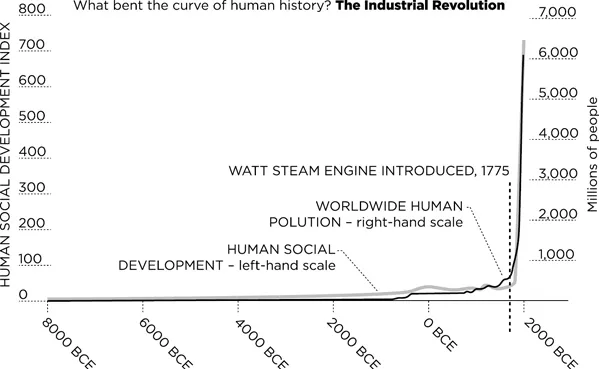
The world is continually evolving. And the level of innovation has increased dramatically since the start of the 20th century. Niall Ferguson, who according to Time magazine is one of the 100 most influential people in the world,1 is convinced that the speed of innovation is linked to the total number of people living on the planet. If you place the curves mapping the evolution of innovation and the evolution of the world’s population alongside each other, you will see that they display clear similarities. The more people there are, the more innovation we generate. In recent decades we have already experienced the sheer speed of the innovation revolution. The introduction of the internet, smartphones and tablets have all dramatically changed our world. In the future this process is certain to intensify to a degree we have never experienced before. The next five years will undoubtedly be the most spectacular in the long history of technological evolution. For the first time, we will see different essential waves of technological innovation occurring concurrently. These technological developments have the potential to completely transform the relationship between consumers and companies.
FIGURE 1.1 Economic growth and population growth
Wave 1: The mobile evolution
The evolution of mobile technology has already come a long way, but is by no means finished; 2015 will be the first year in which more tablets than personal computers are bought.2 Nearly everyone has at least one item of mobile technology, but the possibilities for the use of different kinds of mobile technologies will increase exponentially in the years ahead. This will mean, among other things, faster processing speeds, smarter apps and wearable devices (such as the smart watch). This will help to create a real-time consumer, with a focus on product purchase, health and shared experiences.
Wave 2: The internet of everything
Another related evolution is the so-called ‘internet of everything’. By 2020, the world will be full of ‘connected’ technology. Many everyday products will be linked directly to the internet via sensors. This, for example, is how the smart toothbrush by Philips already works. After you have cleaned your teeth, the brush immediately gives you a score to show how effectively (or not) you have done it. And before you know it your toothbrush will also be capable of making you an appointment with your dentist.
Wave 3: Robots
This is another area where the pace of technological evolution will increase dramatically in the years ahead. In the past, the use of robots was largely confined to production processes in large factories. But it is already possible to see the introduction of similar technologies in many average homes. The number of robomows – self-operating lawn mowers – is increasing each week. In the future robot applications will also be used in the fields of health care, home deliveries and domestic security.
Wave 4: 3D printers
The use of 3D printers is also on the increase. By 2020 a high-quality 3D printer will be available at a price affordable by most average families. The technology still needs to be further improved (particularly in terms of printing time) but progress is being made at lightning speed. 3D printing will allow every consumer to set up their own mini-factory. This evolution will break down the threshold for almost every industry. According to McKinsey, the 3D printing market will be worth $550 billion by 2020.3
Wave 5: Artificial Intelligence
This is the final but by no means the least of the rapid technological developments we can expect in the next decade. The chess computers that were capable of beating grandmasters were among the first examples of this ‘artificial intelligence’ (AI). It is now as long ago as 1997 that the Deep Blue computer got the better of world champion Garry Kasparov. AI relates to computers that are as clever as or even cleverer than the human brain. If this evolution continues, we will soon be talking to computer-directed call centre operatives, while we are convinced that we are still talking to a real human being.
The shorter adoptive curve
When researchers investigated interest among the general population for mobile telephones shortly after the year 2000, the response of the public was very clear. More than 80 per cent of respondents said they did not want a mobile phone, regarding them as a useless and expensive gadget. Ten years later more than 90 per cent of the population already had a mobile phone. In the middle of 2014, 50 per cent of internet users already know Google Glass exists,4 54 per cent have heard of the smart watch and 33 per cent are familiar with the Nike FuelBand. And it is not only the awareness of technological gadgets that is so high – interest in these gadgets is at record levels as well. An estimated 50 per cent of people surveyed would like to have a smart thermostat, 51 per cent think that a connected car is an interesting idea and 41 per cent would love to own a smart fridge. Fifteen years ago technology was for nerds. Today technology is cool.
If you want to study the adoption of new technologies, there is only one place you can start: the book Diffusion of Innovations (2003) by Everett M Rogers.5 The central model in his book is the classic adoption curve. This model identifies five different target groups for innovation adoption. Innovations are first picked up by the innovators, followed shortly thereafter by the early adopters. If this innovation is successful with these groups, it will then be taken up by the early majority, followed in turn by the late majority. Finally, there is the group of people you will never convince: the laggards.
A lack of awareness and a low level of trust in new technologies were initially identified as two of the main factors hindering the fast adoption of an innovation by the early majority. Today, this ‘awareness’ problem no longer exists. New technologies are being increasingly embraced by the media, so that levels of public awareness increase much more rapidly than in the past. And the same time, the ease and user friendliness of innovations such as the iP...
Table of contents
- Cover page
- Title page
- Imprint
- Table of contents
- List of Figures
- Acknowledgements
- Foreword
- Part one: Introduction
- Part two: Digital Transformation
- Part three: The human transformation
- Index
- Full imprint
Trusted by 375,005 students
Access to over 1.5 million titles for a fair monthly price.
Study more efficiently using our study tools.
Frequently asked questions
Yes, you can cancel anytime from the Subscription tab in your account settings on the Perlego website. Your subscription will stay active until the end of your current billing period. Learn how to cancel your subscription
No, books cannot be downloaded as external files, such as PDFs, for use outside of Perlego. However, you can download books within the Perlego app for offline reading on mobile or tablet. Learn how to download books offline
Perlego offers two plans: Essential and Complete
- Essential is ideal for learners and professionals who enjoy exploring a wide range of subjects. Access the Essential Library with 800,000+ trusted titles and best-sellers across business, personal growth, and the humanities. Includes unlimited reading time and Standard Read Aloud voice.
- Complete: Perfect for advanced learners and researchers needing full, unrestricted access. Unlock 1.5M+ books across hundreds of subjects, including academic and specialized titles. The Complete Plan also includes advanced features like Premium Read Aloud and Research Assistant.
We are an online textbook subscription service, where you can get access to an entire online library for less than the price of a single book per month. With over 1.5 million books across 990+ topics, we’ve got you covered! Learn about our mission
Look out for the read-aloud symbol on your next book to see if you can listen to it. The read-aloud tool reads text aloud for you, highlighting the text as it is being read. You can pause it, speed it up and slow it down. Learn more about Read Aloud
Yes! You can use the Perlego app on both iOS and Android devices to read anytime, anywhere — even offline. Perfect for commutes or when you’re on the go.
Please note we cannot support devices running on iOS 13 and Android 7 or earlier. Learn more about using the app
Please note we cannot support devices running on iOS 13 and Android 7 or earlier. Learn more about using the app
Yes, you can access When Digital Becomes Human by Steven Van Belleghem in PDF and/or ePUB format, as well as other popular books in Business & Business General. We have over 1.5 million books available in our catalogue for you to explore.