NLP (Neuro-Linguistic Programming) is believed by many to be a powerful set of tools for facilitating change and enhancing performance. Yet, despite the success stories and proliferation of courses, there is still much skepticism about the validity and effectiveness of NLP.
In NLP Coaching Susie Linder-Pelz brings, for the first time, an evidence-based perspective to this coaching methodology. She explains how and where NLP coaching is used, examines its links to established principles and practices, and questions aspects of NLP where the empirical evidence is missing. She reviews recent developments in NLP-based coaching practice and proposes a specific research agenda that will move NLP coaching towards an evidence-based approach.
NLP Coaching provides numerous case studies and real-life examples which show how NLP assists personal, professional, team, leadership and organizational development. The book includes contributions from leaders in the field: Andrew Bryant, Michelle Duval, Joseph O'Connor, Paul Tosey and Lisa Wake.
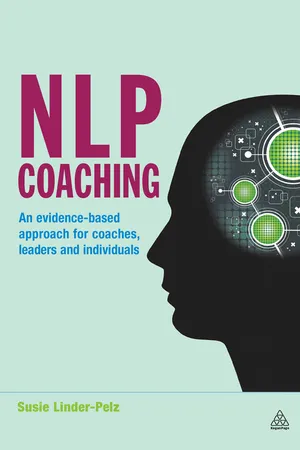
eBook - ePub
NLP Coaching
An Evidence-Based Approach for Coaches, Leaders and Individuals
- 256 pages
- English
- ePUB (mobile friendly)
- Available on iOS & Android
eBook - ePub
About this book
Information
Part I
NLP and coaching
1
What is NLP coaching?
Your ultimate success at helping people achieve their desired outcomes – including managing change – will depend on your ability to observe, identify and utilise the multitude of patterns that will constantly be offered to you in your sensory experience by clients… not in the ability to measure and average types of behavior.1
Consider, if you will, the issues people bring to coaching: they might be feeling fear, frustration or lack of confidence about their work; they may be searching for more fulfilment or need to understand their own or their colleagues’ motivations and goals. They may want to be more innovative and influential, resolve conflicts, manage time better or shape their own and others’ performance. Maybe they are in a bind with regard to their relationship, need to set priorities and get more balance in their lives, or align business goals with people goals.
A 38-year-old manager who came for coaching said, ‘I do the managerial thing perfectly well, but it doesn’t feel right. I want to know what will make me happy. Should I stay in this job or look for another one? I feel I should be able to sort this out by myself, but I seem to be going round in circles. Often I’m full of fear about how I perform. I feel overburdened with the workload and the responsibility. And I’m not enjoying the work. It’s so frustrating.’
People like this seek coaches who listen carefully and help them understand what they need to think and do in order to make the desired changes. But as well as knowing what they need to do, clients need to know how. It is the focus on how people make changes that is the essence of NLP.
A bit of background
Whether you know little or lots about NLP, you have probably heard that NLP is based on Richard Bandler and John Grinder’s understanding that people internally code their experience of the world and of their life, first neurologically and then through language. The most detailed and technical account of the process of discovering, exploring and developing NLP is in Whispering in the Wind, which Grinder wrote with Carmen Bostic St Clair. They explained that the way we know what we know has to do with how we experience the world outside ourselves:
The events presented to us in First Access… are the product of a series of neurological transforms beginning at the point where our receptors and the external world collide… This ‘first access’ is already a set of transformed representations, though it is prior to consciousness, pre-verbal and beyond our ability to influence. The second set of transforms is those of natural language and its derivative forms – formal systems such as logic – which result in our linguistically mediated mental maps.2
When Bandler and Grinder first started to study people’s subjective experience – by observing, listening, asking, eliciting and experimenting – they found that the meaning a person made related to the specific sequence (as well as intensity) of representational systems the person used to process information coming in through their visual, auditory, kinaesthetic, olfactory and gustatory senses. Representational system sequences were called strategies.3 That is what is meant by the structure or patterning of experience. By observing, listening, asking, eliciting and experimenting – modelling – Bandler and Grinder also discovered that people can change their feeling responses by changing the sequence and intensity of the sensory information. Then they explored how: they asked how changing the qualities of the representations (called ‘submodality shifts’) can be utilized to make permanent change, and by observing, listening, asking, eliciting and experimenting Bandler and Grinder came up with a number of change patterns.
Grinder and Bandler understood that the structure of language and experience could be modelled in terms of sequences of sensory experience. By accurately mapping these sequences a change agent has the keys to modifying unwanted or unuseful behaviours.
NLP modelling is based on the distinction – and correspondence – between the deep structure of experience (unconscious) and the surface (transformed, mapped by language) structure and is regarded as ‘one of the crowning achievements of NLP’.4 Dilts talks of the distinction between pure NLP modelling and analytic modelling which is used for information gathering and pattern finding:
The primary approach of NLP has been to model effective behaviours and the cognitive processes behind them. The NLP modelling process involves finding out how the brain is operating by analysing language patterns and non-verbal communication. The results of this analysis are then put into step-by-step strategies or programs that may be used to transfer the skill to other people and areas of application.5
So it is important to bear in mind that while NLP is often perceived as tools, techniques or a technology, originally it was developed as a means of ‘understanding how people process information, construct meaning schemas, and perform skills to achieve results’.6
The term NLP refers to the whole mind–body–emotion system, with systemic patterned connections between neurological processes, language and learned behavioural strategies.7
The rest of this chapter covers:
- The goal of NLP coaching.
- Modelling as the key to effective change work.
In the following chapter I describe the key skills of an NLP coach at work.
The goal of NLP coaching
The goal of NLP coaching is essentially to maximize the client’s ability to respond to their situation resourcefully; to increase the choice they have.
The coach’s job is to assist the client to discover [or map] their own present approach to their situation, to establish what works for them currently and what they want to improve or change. The coach then engages the client in learning more effective means to reach their goals. The outcome of coaching is to assist the client to increase the reliability and value of their own thinking and performance to themselves and their chosen associates in and for the future.8
By going through this mapping process the client moves towards greater self-awareness, behavioural flexibility, choice and effectiveness. The goal of coaching is to clarify the client’s present or ‘problem’ state, their desired outcomes, and to use various NLP skills to enable the client to access their inner resources and resourcefulness to get the changes they want. See Figure 1.1.

Figure 1.1 The goal of NLP coaching
Present state is the internal (and external) picture, sounds, feelings, self-talk and behaviours the client is using to create their current, unwanted responses; desired state describes how the client wants to look, feel, sound and act when their outcomes are achieved, and resources refers to the neurological and linguistic potential the client has to alter their internal representations and external behaviours in order to achieve their outcome. In the next chapter we look at the skills or patterns an NLP coach uses to harnesses the client’s resources.
Summarizing so far: NLP addresses the relationships between how we think, speak (to ourselves and others), feel and act. By analysing and learning from these relationships people can effectively transform the way they traditionally think and act, thus adopting new and more useful ways of thinking, feeling, speaking, acting. The analytic part of this activity is called modelling and is a key feature that distinguishes NLP from other coaching models. In this book we will be talking a lot about the meaning and uses of NLP modelling.
Modelling is the key
It is through modelling that ‘NLP studies the way people take in information from the world, how they describe it to themselves (code it neurologically) with their senses of seeing, hearing, feeling, tasting, smelling… filter it with their beliefs and values, and then act on the result.’10 Those internal and external senses are known in NLP as representation systems.
Another way of saying this is that modelling makes explicit the specific thinking and language patterns, beliefs, as...
Table of contents
- Cover
- Title Page
- Contents
- Acknowledgements
- Introduction
- Part 1 NLP and coaching
- Part 2 An evidence-based approach to NLP coaching
- Part 3 Towards best practice
- Conclusion
- Endnotes
- Bibliography
- Index
- Copyright
Trusted by 375,005 students
Access to over 1.5 million titles for a fair monthly price.
Study more efficiently using our study tools.
Frequently asked questions
Yes, you can cancel anytime from the Subscription tab in your account settings on the Perlego website. Your subscription will stay active until the end of your current billing period. Learn how to cancel your subscription
No, books cannot be downloaded as external files, such as PDFs, for use outside of Perlego. However, you can download books within the Perlego app for offline reading on mobile or tablet. Learn how to download books offline
Perlego offers two plans: Essential and Complete
- Essential is ideal for learners and professionals who enjoy exploring a wide range of subjects. Access the Essential Library with 800,000+ trusted titles and best-sellers across business, personal growth, and the humanities. Includes unlimited reading time and Standard Read Aloud voice.
- Complete: Perfect for advanced learners and researchers needing full, unrestricted access. Unlock 1.5M+ books across hundreds of subjects, including academic and specialized titles. The Complete Plan also includes advanced features like Premium Read Aloud and Research Assistant.
We are an online textbook subscription service, where you can get access to an entire online library for less than the price of a single book per month. With over 1.5 million books across 990+ topics, we’ve got you covered! Learn about our mission
Look out for the read-aloud symbol on your next book to see if you can listen to it. The read-aloud tool reads text aloud for you, highlighting the text as it is being read. You can pause it, speed it up and slow it down. Learn more about Read Aloud
Yes! You can use the Perlego app on both iOS and Android devices to read anytime, anywhere — even offline. Perfect for commutes or when you’re on the go.
Please note we cannot support devices running on iOS 13 and Android 7 or earlier. Learn more about using the app
Please note we cannot support devices running on iOS 13 and Android 7 or earlier. Learn more about using the app
Yes, you can access NLP Coaching by Susie Linder-Pelz in PDF and/or ePUB format, as well as other popular books in Business & Gestione delle risorse umane. We have over 1.5 million books available in our catalogue for you to explore.