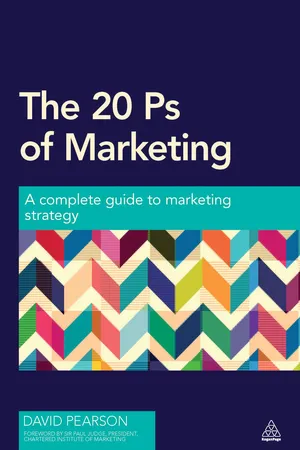
Marketing has changed dramatically since the four classic Ps of the marketing mix (price, product, promotion and place) were proposed. The new marketing landscape is characterized by the demand for constant innovation, rising pressure on budgets, the growth of social media and the impact of issues of sustainability and ethics. As the business landscape has transformed so have the fundamental areas marketers need to master to succeed.
The 20 Ps of Marketing provides a thorough guide to marketers at all levels of the new elements of the marketing mix they need to contend with for business success including: planning; persuasion; publicity; positioning; productivity; partnerships; passion and more. Combining practical advice with case studies it covers brands that have changed the game through mastery of the 20 Ps such as Häagen-Dazs and Sony, and others, such as Kodak, who got left behind.
This essential guide to the current face of marketing strategy provides marketers with a thorough and valuable grounding to the new fundamentals of marketing.
- 240 pages
- English
- ePUB (mobile friendly)
- Available on iOS & Android
eBook - ePub
About this book
Information
Part One
Core
01
Product
There are only three Ps in marketing: Product, Product, Product.
LORD SUGAR TO THE AUTHOR, 1995
Lord Sugar once told me that there were just three Ps of marketing: Product, Product, Product. He was of course echoing the motto of the estate agent – ‘location, location, location’ – or indeed Tony Blair’s soundbite of his three priorities in government: ‘education, education, education’. It’s a nice line and certainly Lord Sugar has had more than his fair share of product successes. He has built from nothing a billion-pound enterprise and is one of Britain’s best-known businessmen, known more now for his television appearances on Britain’s version of Donald Trump’s The Apprentice than for the fact that he did as much as anyone to popularize the personal computer in the UK and later was one of the founders of the satellite television industry.
But for all that, he is wrong on at least one count that I am sure he would acknowledge. What he means is that you have to get the Product right in order to have a chance in the game. But for Lord Sugar getting the Product right is, more than anything, getting the Price right. Price will be addressed in the next chapter, but for now let us assume that the Price point is right. How do we go about developing the Product?
Product development
There are various ways, and you will not be surprised that I will begin with the Procter & Gamble method. P&G bases its Product development firmly on research. It spends huge sums on research and development (R&D) in both the sense of science and also in research into consumer attitudes. It conducts extensive surveys in its chosen field of expertise in order to ensure that it is keeping up to date. For example, as new forms of washing machine are developed it works closely with the manufacturers (an example of the Partnerships that we will consider in Chapter 13), to ensure that it has formulations that will work effectively in the new machines. It also looks at new fields to conquer. Increasingly these are hard to find, which is why, in the recent past, its expansion has come more through acquisition rather than organically.
Many years ago, however, it was a weak player in the shampoo market and decided to become a strong one. P&G’s research into shampoo usage and the washing of hair in general showed it that fully two-thirds of mankind, at least in the developed world, suffer from dandruff some of the time, while one-third suffer from it all the time. Dandruff is both uncomfortable to the sufferer and, unless it is controlled or prevented, is very obvious to everyone as it shows on the shoulders. P&G set out to discover a cure. Over a period of many years it researched some 20,000 different compounds before discovering the one that seemed to give the best results. This was zinc pyrithione. P&G then set about establishing a delivery method and researched further into its usage. I was involved in a small way in the test market of this Product, Head & Shoulders, in the UK. It was already an established success in the United States – I used it there myself as a student in the late 1960s – but P&G did not make the classic mistake of assuming that the same Product marketed in the same way would necessarily succeed in the UK. So the Product was tested in different regions with different types of water, hard and soft. Different formulations and Pack sizes were also tried. And, of course, different Promotions were also tried.
Finally, in 1975, the Product was launched nationally in the UK. It had been in test market for seven years (Boots complained that it should be entered in The Guinness Book of Records). The Product was successful and became brand leader. It still is. That is a Product. Of course, many things have changed; the formulations have been varied with many innovative varieties added. The Packs have changed; the Pricing has changed. But the fundamental Product and its core Positioning (of which more in Chapter 10) have not changed. This research-based method of Product development is no doubt carried out in many other businesses. But it is not the only way.
Sony spends vast sums on research and development, but spends comparatively little on consumer research. Instead its engineers tend to develop their own ideas for Products, based on insights and, of course, a much greater knowledge than the consumer can have in terms of technological capabilities.
Sony is famous for creating markets. Procter & Gamble did not create the shampoo market, it did not even create the dandruff shampoo segment – but it came to dominate it through rigorous commitment to research-based marketing. Sony created the Walkman market, the forerunner of today’s iPod, through a combination of genius and dedicated engineering.
The idea of Producing a tape player without loudspeakers and with no recording capability seemed absurd even to the engineers in Sony. It was not in fact an invention, given that it used existing technologies, although it took painstaking development of those technologies to Produce it. Akio Morita, one of the co-founders of Sony, is credited with the ‘invention’ of the Walkman. But the team of engineers who delivered it was led by Kozo Ohsone, himself a charismatic engineer. He carried around a wooden model of the target Product with the dimensions already decided. To achieve this Shizuo Takashino, his principal assistant engineer, had to Produce a cassette mechanism considerably smaller than those on the market, although the dimensions of the cassette were already fixed. He puzzled over this for months and then one day on his long commute into Shibaura factory he solved it and, displaying a typical example of Sony lateral thinking, bent the angle of the motor to fit the target dimensions.
The Product could now be made but still there were many sceptics, some of whom demanded research into consumer attitudes to the new concept. Akio Morita rejected these calls and argued that no research could predict what would happen. It was Sony’s task to propose to the market and for the market to decide. A worldwide launch then followed, and again scepticism was met in the distribution companies around the world. The Japanese-coined name Walkman was originally rejected, as were other names used in the United States (Soundabout) and the UK (Stowaway). However, with imaginative Promotion, the Product was a huge success and spawned a new lifestyle. Within two years the Americans and the British came round to accept the name Walkman, which is now in the dictionary.
Throughout history inventors have been ahead of their time in predicting market demand for a new kind of Product. Yet although the fundamental need might exist within us for such new Products, conventional research will not identify this need – the reason being that because the consumer does not appreciate that the new Product is a real possibility they will not articulate the demand. But put the Product in front of them and they will say, ‘All my life I wanted one of those!’
Look more closely, however, and you may find evidence of the need. Take manned flight as an example. Throughout most of history, if someone had proposed manned flight he or she would probably have been burnt at the stake as a sorcerer. Yet there is evidence in Greek mythology, in the story of Daedalus who constructs wings for his son Icarus; while in the Arabian Nights there is the story of ‘The Magic Carpet’. Once the first powered aircraft had been demonstrated by the Wright Brothers at Kitty Hawk in 1903, it became a new industry within a few years, and within a couple of generations was an entirely normal activity for millions of travellers.
The enormous success of the telephone industry is another example. Even Alexander Graham Bell saw limited potential for his invention, but it has become ubiquitous. The mobile telephone is leapfrogging in terms of new usage and there is now one mobile telephone for every person on Earth. We have always wanted to communicate, not least across vast distances and to loved ones far away. The mobile phone enables us to do so, yet before the event of the mobile telephone, research would not have provided much insight into its feasibility as a Product.
Quality
Another factor in the success of a Product is quality. Quality is a very difficult concept, for it has both relative and absolute status; quality can be subjective. Football commentators describe a player as ‘quality’ when they mean he is of good quality, not poor quality. A Product must meet a quality standard to be successful and a good manufacturing, or sourcing, company will have quality control procedures to ensure this. These procedures will vary enormously according to the risk of unacceptable quality. A medicinal drug manufacturer, for example, will have an extremely high standard as the risk of failure is too great and unacceptable to society. However, the quality standard has to be built into the Product as it is impossible to test 100 per cent of the Production. In consequence, this Product has a very high Price, which in most developed countries is subsidized by the state and in undeveloped countries is largely unaffordable.
Marginally down from that standard is the food industry, at least with perishable foods that have a risk of salmonella, E. coli or other bacterial risk. Sometimes disproportionately high standards are applied, even though a small degree of salmonella will be present in many foodstuffs and most People are tolerant of that. Nevertheless, the manufacturer cannot take undue risks and so when I was in charge of a food processing factory for Pillsbury, the quality assurance management reported separately from the Production management and had the Power to stop Production and dispatch, pending tests of a suspect batch.
Such standards are not held in the manufacturing of electronics where the Price competition is very high and the customer would not be prepared to pay for the cost of achieving perfection. Nevertheless, standards of quality are considerably higher today than they used to be. Engineers attempt to ‘design out’ the risk of defect.
In the British television industry of the 1950s and 1960s quality was so poor that the majority of customers preferred to rent rather than buy their television and thus paid for a constant service of maintenance. The dealers who effectively sold the same television set many times over became very rich. However, as the Japanese gradually took over the industry in the 1970s and 1980s with their vastly superior products, the rental industry slowly died out as the cost of acquisition came down in relative terms and the risk of acquisition also came down. As Managing Director of Sony UK I used to receive a number of consumer complaints from people who had bought their Sony television 20 years before, had watched it on average for 50 weeks per year, 35 hours per week, had never had to spend a penny on maintenance or service, and now found that it was beginning to give up the ghost. Their complaint was that they thought they had bought a ‘quality’ Product and were disappointed that after 35,000 hours of maintenance-free use the Product needed replacing!
Quality in food does not just mean safety, though that is paramount. It also means enjoyment. Successful food and drink companies will have developed research techniques that identify the degree to which their Products, present and future, satisfy consumers on a hedonic scale, and they will have established benchmarks that new Products must meet before expensive resources are committed to launch. In my time at Mars such hedonic scales were sacred and the company then had an excellent record in developing major new Products with fewer failures than the norm. It is an astonishing fact that most new Product development (NPD) fails, and while the reasons are not always about standards I am prepared to wager that a considerable proportion are.
When I joined Pillsbury to run its very Profitable Green’s of Brighton subsidiary I found that similar hedonic scales had been established but had been overlooked by the previous management who, charged with an imperative to maintain an active NPD programme, had cut corners and launched Products that did not meet their own internal benchmarks.
I reviewed all the recent history of Product introductions and compared them with well-established and Profitable lines. It was clear that for some time we had failed to launch any new Products that lived up to the long-term reputation of the company. I then set in motion a new programme of research and development, supported by a strict rule that new Products would only be launched if they came up to the benchmark. Our subsequen...
Table of contents
- Praise for The 20 Ps of Marketing
- The 20 PS of Marketing
- The 20 Ps of Marketing
- Dedication
- Contents
- Foreword
- Acknowledgements
- Introduction
- Part One Core
- 01 Product
- Product development
- Quality
- Portfolio management
- Product comparisons
- Summary
- 02 Price
- The Gillette razor business model
- Air travel
- Market segmentation
- Price points
- ‘Free’ Products
- Summary
- 03 Place
- History of distribution
- Importance of location
- Sales management
- Account management
- Category management
- Selective distribution
- Franchising arrangements
- Trade shows
- Summary
- 04 Promotion
- History of advertising
- Does advertising work?
- How does advertising work?
- Below the line
- Above the line versus below the line
- Summary
- 05 Packaging
- Function
- History of Packaging
- Packaging of identity
- Logo
- Livery
- Packages as business model
- Summary
- Part Two Actions
- 06 Planning
- Managing by objectives
- Features of a good marketing Plan
- The corporate vision
- Strategic management
- Portfolio management
- Project management
- Forecasts
- Contingency Plans
- Summary
- 07 Persuasion
- Mutuality of interest
- Persuasion of colleagues
- Public speaking
- Persuasion of end users
- Psychology in marketing
- Summary
- 08 Publicity (public relations)
- Definition of Public relations
- The press release
- The Companies Act 2006
- Bad Publicity
- Sponsorship
- Corporate social responsibility
- Charity
- New media
- Reputation management
- Summary
- 09 Push-Pull
- Shelf life
- Product life cycle
- Supply and demand
- The importance of scarcity
- Summary
- 10 Positioning
- Product Positioning process
- Defining the market
- Repositioning a company
- The 22 immutable laws of marketing
- Unique selling Proposition
- Copywriting
- Advertising slogans
- Summary
- Part Three Measurements
- 11 Profit
- Increase turnover
- Increase Prices
- Reduce costs
- The relationship between marketing and finance
- Profit impact of market strategy
- Lanchester’s laws
- The Profit zone
- Corporate social responsibility
- Mutuals
- Charities
- Not-for-Profit companies
- Summary
- 12 Productivity
- Zero-based Planning
- Decision making
- New Product development
- Lessons from engineering
- Measuring outputs
- Personal Productivity
- Summary
- 13 Partnership
- Benefits of business Partnering
- Mergers and acquisitions (M&A)
- Alliances
- Summary
- 14 Power
- Power brands
- Lessons from the military
- Intellectual property
- Legal restrictions
- Cultural risks
- Retailer Power
- Consumer Power
- Market-derived Power
- Summary
- 15 Perception
- Personality endorsement
- Conor Dignam on Perception
- Problems of Perception
- The law of Perception
- The psychology of Perception
- Corporate branding
- Perception management
- Summary
- Part Four Behaviours
- 16 People
- Recruitment
- Assessment
- Training and development
- Team building
- Management
- Leadership
- The skills of marketing
- The 10 types of marketer
- Summary
- 17 Positiveness
- Persistence
- Responsibility
- Motivation
- Positive thinking
- Negativity
- Advertising slogans
- Positiveness in social networks
- Conclusion
- Summary
- 18 Professionalism
- Professionalism in sport
- Professionalism in business
- Summary
- 19 Passion
- Summary
- 20 Personality
- Corporate Personality
- Brand Personality
- Consumer Personality
- Summary
- Conclusion
- References
- Further Reading
- Index
- Copyright
Trusted by 375,005 students
Access to over 1.5 million titles for a fair monthly price.
Study more efficiently using our study tools.
Frequently asked questions
Yes, you can cancel anytime from the Subscription tab in your account settings on the Perlego website. Your subscription will stay active until the end of your current billing period. Learn how to cancel your subscription
No, books cannot be downloaded as external files, such as PDFs, for use outside of Perlego. However, you can download books within the Perlego app for offline reading on mobile or tablet. Learn how to download books offline
Perlego offers two plans: Essential and Complete
- Essential is ideal for learners and professionals who enjoy exploring a wide range of subjects. Access the Essential Library with 800,000+ trusted titles and best-sellers across business, personal growth, and the humanities. Includes unlimited reading time and Standard Read Aloud voice.
- Complete: Perfect for advanced learners and researchers needing full, unrestricted access. Unlock 1.5M+ books across hundreds of subjects, including academic and specialized titles. The Complete Plan also includes advanced features like Premium Read Aloud and Research Assistant.
We are an online textbook subscription service, where you can get access to an entire online library for less than the price of a single book per month. With over 1.5 million books across 990+ topics, we’ve got you covered! Learn about our mission
Look out for the read-aloud symbol on your next book to see if you can listen to it. The read-aloud tool reads text aloud for you, highlighting the text as it is being read. You can pause it, speed it up and slow it down. Learn more about Read Aloud
Yes! You can use the Perlego app on both iOS and Android devices to read anytime, anywhere — even offline. Perfect for commutes or when you’re on the go.
Please note we cannot support devices running on iOS 13 and Android 7 or earlier. Learn more about using the app
Please note we cannot support devices running on iOS 13 and Android 7 or earlier. Learn more about using the app
Yes, you can access The 20 Ps of Marketing by David Pearson in PDF and/or ePUB format, as well as other popular books in Business & Digital Marketing. We have over 1.5 million books available in our catalogue for you to explore.