This ground-breaking book redefines campaigning and explains how to create and deliver a compelling campaign that can be applied in any aspect of your professional and personal life.
Based on a claim that is both bold and true, this book introduces and demonstrates a new, unique and complete approach to communication for change - the Campaign It! model. It is a model developed and used by leading professionals in communications and campaigning to create influence and change at the highest levels business, politics and society. It is transferable to any sphere of life. It is tried and tested. And it works.
Simply put: to achieve change and be successful you always have to inform, persuade and gain agreement from significant people and organizations. The Campaign It! model enables you to do this powerfully and positively.
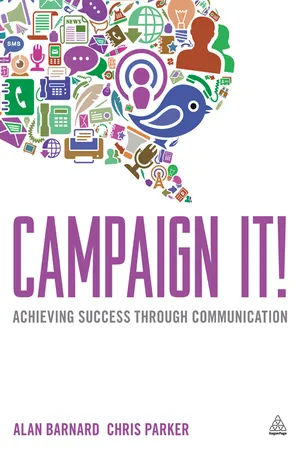
- 232 pages
- English
- ePUB (mobile friendly)
- Available on iOS & Android
eBook - ePub
About this book
Information
01
Our approach to campaigns and campaigning
I have always been a campaigner and over the years I have learnt to become better at it.
ALAN BARNARD
Communication works for those who work at it.
JOHN POWELL
The purpose of this chapter is to:
1 Share and explain our new definition of a campaign.
2 Explain and justify our approach to campaigning, including the purpose and philosophy of campaigning.
3 Outline the attitudes of a campaigner.
4 Introduce and provide an overview of our Campaign It! model.
5 Lay the foundation for everything that is to follow.
In this chapter we:
- Redefine campaigning.
- Explain the purpose of campaigning.
- Discuss the philosophy of campaigning and the attitudes of a campaigner.
- Justify the need for a campaigning approach in all aspects of our personal and professional lives.
- Share the results of our research that asked: ‘How important is communication?’ and ‘How good at communicating are you?’
- Consider why we tend to rate ourselves highly as communicators and ask ‘Are we really that good?’
- Discuss the inevitability of influence.
- Introduce the seven principles of campaigning.
- Introduce the Campaign It! model.
Learning to become better
The Campaign It! model is the result of many years of work that led us both through two very distinct learning curves. The first was based on the fact that Alan (AB) was totally focused on how to influence communities and societies and so to create social and/or global change and that Chris (CP) was totally focused on how to influence individuals and/or groups. Neither of us was fully aware of the skill sets of the other and neither of us had considered the value of these different skill sets to our own work.
Learning from each other required us both to embrace that most basic and challenging of all principles:
‘We can only get better if we learn the things we need to know that we currently don’t.’
Fortunately, we have had much fun learning from each other and we continue to do so.1
The second learning curve was in the creation of the Campaign It! model itself. Being able to do something well is one thing. Being able to structure and provide it for the benefit of others is something else altogether. There is a world of difference in being able to do something that helps others and being able to provide something that enables others to help themselves. We created the Campaign It! model to enable people to help themselves, their families, their businesses or their communities. It is the result of a process that began…
Well, to be honest, that depends to a certain extent on which one of us you ask. Here are our two answers to that same question:
CP: ‘It began in 1976 when I met a man, a Malaysian martial artist, who could use words to change people in ways I had never imagined. I both observed and experienced personally how powerfully he could influence others. At that time I was studying to be a schoolteacher and it seemed to me that knowing how to use words to create powerful and positive change was a most appropriate capability (even though, for some reason, it wasn’t part of the curriculum I was studying!). So I committed myself to learning from him. It was the start of a fascination with how to use words to empower ourselves and others that has continued for over three decades.
‘In 2003, having worked as a schoolteacher and manager, an educational and corporate consultant and trainer, and a university lecturer, I asked Alan Barnard if I could model his approach to campaigning for a book I was writing about management skills and leadership. It was an insightful experience, interviewing and observing the work of a man who was used to operating at the highest levels to create social and national change.
‘Interestingly, like so many hugely talented individuals, Alan was not consciously aware of everything he did to achieve his outcomes. He demonstrated such a level of what Maslow termed “unconscious competence” that often he was only able to discuss the complexity of his work in the most simple of terms. Much of what he did, he said, was the “bleedin’ obvious”. But only to him, it certainly wasn’t to me.
‘The result of our time together was the creation of a basic model, a chapter based on his work and the start of a dialogue that led to us sharing and combining our different interests and skills in communication.
‘I still believe that interpersonal communication, the words we use and the ways we interact with others, is crucial to enabling personal development and change. I understand now, though, that the approach that Alan uses to influence societies can also be applied and has enormous value when seeking to influence individuals, teams and groups. I also appreciate just how many of the principles and strategies that I apply in my work are also used by Alan in his.
‘For example, having a desired, clearly defined end outcome is as important to me when I am working with an individual client or a lecture theatre filled with students, as it is for Alan when planning a corporate, social or political campaign. We both place great importance on the way we sequence our communications, on how we combine emotional language with persuasive facts and figures, and on how we share messages not just information. We both know that influential communication is based on an understanding of those we are communicating with and that you always have to begin from their starting point, not your own. As a result of the work we have done together, I realize now that even a single communication in a corridor can incorporate all of the elements of the Campaign It! model: as long as that conversation is driven by a cause.’
AB: ‘I’ve always been a campaigner. It seems that throughout my life I have come across things that needed improving, and I’ve always seemed to have the desire to work to make those improvements happen. From my school days, through my degree and into work, I’ve always been trying to make changes happen and to influence others to give support and permission for those changes. I’d never wanted to write a book about it, though, until Chris got me thinking one day.
‘Chris was writing a book about leadership aimed at the undergraduate market. He wanted to include some references to campaigning in it and needed an expert to interview. So he asked me.
‘I remember being very uncomfortable. I rarely talked about my work as a campaigner, preferring to operate behind the scenes, and after all, why on earth would I give my secrets away? I was also acutely aware that the media were always looking for process stories about my work for Labour and I wasn’t going to give them any opportunities. But we were talking generically, and Chris was modelling the approach for a book on theory, and wasn’t going to include anything about the specifics of what I do – this was for a different audience – and I wanted to help him out.
‘It took a few weeks, with many more conversations between us, but eventually Chris got back to me with the fruits of his labour. ‘How’s this for the “Barnard Campaign” model?’ he asked.
‘When I looked at it I realized that the model he had produced from what I thought was our sometimes rambling chats was really very clever. It was a little simplistic, in that each stage could have been explored in so much more detail: Chris had just produced the top line explanation for the section in his book, but that top line was spot on in its description of how I think about campaigning.
‘Bloody hell,’ I thought to myself. ‘I wonder if we can write a book in which we simplify and explain the complexity of campaigning, and how it can be used in all walks of life?’
‘Excitingly, at the same time, Chris introduced me to some of the ways in which he had ...
Table of contents
- Cover
- Title page
- Imprint
- Table of contents
- About the authors
- Introduction
- 1. Our approach to campaigns and campaigning
- 2. Cause
- 3. Recognizing and understanding your audiences
- 4. The narrative
- 5. Influencing conversations
- 6. Mapping the campaign
- 7. Integrating activities
- 8. !
- 9. Being a campaigner
- Index
- Full imprint
Trusted by 375,005 students
Access to over 1.5 million titles for a fair monthly price.
Study more efficiently using our study tools.
Frequently asked questions
Yes, you can cancel anytime from the Subscription tab in your account settings on the Perlego website. Your subscription will stay active until the end of your current billing period. Learn how to cancel your subscription
No, books cannot be downloaded as external files, such as PDFs, for use outside of Perlego. However, you can download books within the Perlego app for offline reading on mobile or tablet. Learn how to download books offline
Perlego offers two plans: Essential and Complete
- Essential is ideal for learners and professionals who enjoy exploring a wide range of subjects. Access the Essential Library with 800,000+ trusted titles and best-sellers across business, personal growth, and the humanities. Includes unlimited reading time and Standard Read Aloud voice.
- Complete: Perfect for advanced learners and researchers needing full, unrestricted access. Unlock 1.5M+ books across hundreds of subjects, including academic and specialized titles. The Complete Plan also includes advanced features like Premium Read Aloud and Research Assistant.
We are an online textbook subscription service, where you can get access to an entire online library for less than the price of a single book per month. With over 1.5 million books across 990+ topics, we’ve got you covered! Learn about our mission
Look out for the read-aloud symbol on your next book to see if you can listen to it. The read-aloud tool reads text aloud for you, highlighting the text as it is being read. You can pause it, speed it up and slow it down. Learn more about Read Aloud
Yes! You can use the Perlego app on both iOS and Android devices to read anytime, anywhere — even offline. Perfect for commutes or when you’re on the go.
Please note we cannot support devices running on iOS 13 and Android 7 or earlier. Learn more about using the app
Please note we cannot support devices running on iOS 13 and Android 7 or earlier. Learn more about using the app
Yes, you can access Campaign It! by Alan Barnard,Chris Parker in PDF and/or ePUB format, as well as other popular books in Business & Business Communication. We have over 1.5 million books available in our catalogue for you to explore.