Much of the fear and uncertainty surrounding the global recession is concerned with the adverse impact it will have on organisations and society. However, recessions are nothing new. We know from past experience that when a recession is over, there always emerge organisations and individuals who have not only survived but have thrived. They often emerge stronger, fitter and better performing.
Developing Resilient Organizations argues that one of the fundamental keys to survival in these circumstances is resilience or mental toughness. It can make challenge and change an opportunity rather than a threat. The book addresses a wide variety of organizational issues including motivation, performance, staff retention, behaviour, trust, attention span and teamwork. With case studies from leading organizations across the public and private sector internationally, it will show you how to develop organizational performance, well being and a positive approach to adversity and change in your organization.
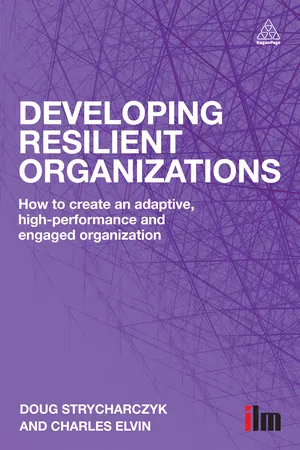
eBook - ePub
Developing Resilient Organizations
How to Create an Adaptive, High-Performance and Engaged Organization
- English
- ePUB (mobile friendly)
- Available on iOS & Android
eBook - ePub
Developing Resilient Organizations
How to Create an Adaptive, High-Performance and Engaged Organization
About this book
Information
PART ONE
Change in the 21st century
01
A general overview
Developing resilient organizations – why should it concern us?
DOUG STRYCHARCZYK
In the beginning…
At the beginning of the 21st century there was generally a feeling of contentment around the world. True, there were still wars and conflicts going on and some perennial problems such as poverty were still around – much remained to be done to create a fairer world. But it could be argued that most economies and societies seemed to be developing nicely or had reason to be moderately optimistic.
In fact, now long forgotten, the issue that most concerned almost everyone was something that came to be called the ‘Millennium Bug’. For some reason only known to the geeky, it was believed that every piece of electronic equipment would stop working at midnight on 31 December 1999. It created a temporary industry that occupied hundreds of thousands of IT experts around the world.
To the disappointment of the IT community and to everyone else’s relief, nothing untoward happened on that date. Computers, cooker timers, watches continued to work pretty much as they had the day before. Many concluded that it was a false alarm – everything continued to work perfectly well. No one even had to reboot anything. Some in the IT industry will claim that it was their diligence and preparation that eliminated the problem and that’s why nothing untoward happened.
There was even a feeling that, at last, leaders in all walks of life had learned how to manage economies, societies and businesses in such a way that we were unlikely to know crisis or recession again. Politicians, economists and business leaders were being credited with an increasing mastery of the world in which we lived, worked and played.
Within a few years this view had changed quite dramatically. By 2008 much of the so-called ‘developed world’ had plunged rapidly into recession. Not just any recession but one that was to become one of the worst for a century. For the next few years, dealing with the fallout from this became the main preoccupation of global leaders. The blame for this recession was, probably quite rightly, placed at the feet of the global financial community, which had adopted inappropriate, sometimes unethical and mostly unsustainable practices.
It has become normal to describe this period from 2008 onwards as a recession. When economists talk about a recession, they often describe it in terms of contractions of the gross GDP of an economy over a period of time. That might describe what is happening. It doesn’t explain why contractions are happening. That is the more interesting question. History tells us that economists are often also talking about the economy going through a period of transition or change. A recession can be an indication that something no longer works well, that something has stopped working or that circumstances are now different and it is time to adapt. The change is usually significant and generally represents something that might be fundamental, important and which has to happen quickly.
In fact, change happens all the time and usually most types of change happen steadily and incrementally. It is often imperceptible and most people, societies and organizations take it in their stride. Even when it is sudden and dramatic, eg when a piece of new technology like the iPad is developed, it can be welcomed with open arms and adopted with astonishing speed without any significant detrimental impact.
The 2008 financial crisis signalled a need for change and it is true that a response to the challenge was an urgent requirement. However, with it came a host of consequences that meant it had a significant and negative impact on the lives of many. Most of the populations in developed countries found their standards of living dropping when for most of the previous 20–30 years these had risen steadily year on year. The ability to create enterprises and re-build economies was hampered by a shortage of capital and a reluctance to invest on the part of many of those who did have capital. One of the curious facts about the 2008 financial crisis is that many big businesses actually built strong cash reserves during this period as they ‘battened down the hatches’.
The impact of these changes on most people was severe – most simply didn’t know how to deal with them. There were whole generations who only knew about recession and its impact from reading about it in books. So, for the immediate period post-2008, politicians, economists, bankers and business leaders were preoccupied with repairing global financial systems so they would eventually work again.
Important as this was, it wasn’t the only aspect of change that had been underway. Some of these other aspects are equally significant and will have a long-term and dramatic impact on the lives of every person on the planet. The global financial crisis appears to have hidden from sight, at least temporarily, a series of other fundamental changes which will impact on the way society works.
These changes are taking place in our workplaces as well as around the world. They impact on the way organizations work and the way people will work in the future. Both are interrelated. People are changing, business is changing, the way we see responsibility and accountability is changing and the way the different peoples of the world interact is changing.
The challenge with this is that change usually has to be managed or handled in some way so that most people can benefit. To do that there are two requirements.
• First, it is essential to notice change, to be aware of its direction and to understand it.
• Second is to understand the consequences of change, which will also often mean looking over the horizon and trying to anticipate further change.
There is probably also a third requirement. Change for most people is, by its nature, often uncomfortable, requiring people, organizations and societies to change the way they see things and the way they behave. There is a need to embrace and to welcome change. It is going to happen anyway. The net effect is almost always positive. It is this notion that underpins what this book is about.
There are two types of organization that emerge: the survivors who have managed to cope in some way with what has happened and those who thrive. The latter have learned to deal with what is happening and see opportunity in the chaos and mayhem where the former mainly see threat.
We, the authors and editors, spend a good deal of our time working with leaders in just about every sector of global society and in the course of our work we travel widely. Our observations are global observations.
In a recession, not everyone suffers. Even in the midst of recession we see that some players are holding their heads above water and some are thriving. Not everyone is desolate and on the brink of disaster. Those in secure, reasonably well-paid jobs can enjoy a recession as their comparative position improves over those who either become unemployed or who have jobs which are not so good and often have had pay frozen for many years. Moreover, this is true even for organizations that operate within the same sector. Many firms and organizations fail in the very same sectors where others have survived.
In the United Kingdom, several household names in the retail world have disappeared from the high street (or the internet if that was where they did their business). At the same time some of their competitors selling the same types of goods and services have gone from strength to strength. In retail, UK business John Lewis has prospered throughout the period of recession while many retailers have gone to the wall. John Lewis is by no means a ‘bargain retailer’: it is not succeeding by cutting prices, it appears to be succeeding with a better offer than its competitors and with much better levels of customer service. Interestingly, John Lewis is a partnership. All staff are partners in the business. Charles will present a view that the level of trust which underpins this employment relationship is a significant factor in their success.
On another part of the UK high street, grocery retail, we do see a ‘budget’ factor. The growth of inexpensive food retailers such as Lidl, Netto and Aldi has been at the expense of the traditional giants on the high street. Their promise has been one of good quality at the lowest prices.
So the global financial crisis has provided a challenge and a threat to all organizations. But why do some continue to do well and others don’t? It can’t just be that the recession has affected some more dramatically than others (although that may be a factor in some situations). It might also be the case that not every economy and society is responding in the same way to what is happening in the wider world.
It is not the recession that determines whether we sink or swim, it is our response to it that matters. As we’ll see, this is precisely why mental toughness is a key factor in organizational success. Those that respond positively and adapt to the world as it changes will survive. This is ‘organizational Darwinism’.
It continues to surprise (and disappoint) that so many leaders of organizations in the private and public sectors can be very parochial. An astonishing number of these seem unaware of what is happening across the world and hold views that are dangerously out of date. Before we hear howls of indignation, we have to add that there are many leaders who do notice change and how it affects their organizations. Some are extremely alert, seem to be constantly evaluating what is happening around them and are ready to change and develop as circumstances dictate. These are the business leaders whose organizations will emerge thriving when the recession ends.
But they appear to be in the minority.
We will dwell for a moment longer on the subject of recessions. They are not unusual. In fact any backward glance at the last 250 years will reveal that recessions happen fairly frequently. Many economists argue that they are cyclical. Sometimes they are comparatively mild. Sometimes they are severe, plunging whole countries into depression.
Recessions nearly always represent a period of what Joseph Schumpeter called ‘creative destruction’. To summarize his work in a few sentences, Schumpeter (1947) theorized that economies develop and grow through business cycles that at some point result in a period of creative destruction. The provocation for this is innovation (ie change) and the agent for innovation, he suggested, is entrepreneurialism. He wrote about two types of entrepreneur: the wild thinker who comes up with new ideas and the large corporation that has the resources to invest in research and development.
Schumpeter suggested that capitalism has within it the seeds of a process where old ways are ousted and replaced with new ways of doing things. He further hypothesized that one of the benefits of capitalism is that education would no longer be only available to a privileged group but would instead become available to everyone who wants it. In turn, this would lead to a much larger group of people having the intellectual capability to challenge the status quo. He argued that this, together with a shortage of fulfilling work for this bigger intellectual group, would lead to a form of discontent, and that one potential outcome would be the ‘demise’ of full-on capitalism and its replacement by a ‘democratic’ or ‘liberal’ capitalism where a new set of values emerges.
This is not new thinking. His most famous work was published in 1942! We’ll look at his ideas at several points in this book. What Schumpeter did was show us one way of looking at what is happening around us and forecasting the future. He wrote in the context of his time.
Ultimately Schumpeter presents us with the Darwinian picture offered earlier. The world evolves and changes and, like the species that interested Darw...
Table of contents
- Developing Resilient Organizations
- Developing Resilient Organizations
- Contents
- List of Figures
- List of Tables
- About the authors
- Acknowledgements
- Also published by Kogan Page
- Introduction
- Part One Change in the 21st century
- 01 A general overview
- 02 The new factors
- 03 Mental toughness
- 04 Trust-based leadership and resilient organizations in the 21st century
- 05 Leadership, resilience and the 21st-century organization
- Part Two Practitioner perspectives
- 06 Leadership and the BP grit in the oyster – developing mental toughness
- 07 Changing times for the public sector
- 08 New realities: Personal growth for an uncertain future
- 09 Ethics, ethical practice and their growing importance in developing sustainably performing organizations in the 21st century
- 10 Big data, big business
- Conclusions
- Index
- Copyright Page
Trusted by 375,005 students
Access to over 1.5 million titles for a fair monthly price.
Study more efficiently using our study tools.
Frequently asked questions
Yes, you can cancel anytime from the Subscription tab in your account settings on the Perlego website. Your subscription will stay active until the end of your current billing period. Learn how to cancel your subscription
No, books cannot be downloaded as external files, such as PDFs, for use outside of Perlego. However, you can download books within the Perlego app for offline reading on mobile or tablet. Learn how to download books offline
Perlego offers two plans: Essential and Complete
- Essential is ideal for learners and professionals who enjoy exploring a wide range of subjects. Access the Essential Library with 800,000+ trusted titles and best-sellers across business, personal growth, and the humanities. Includes unlimited reading time and Standard Read Aloud voice.
- Complete: Perfect for advanced learners and researchers needing full, unrestricted access. Unlock 1.5M+ books across hundreds of subjects, including academic and specialized titles. The Complete Plan also includes advanced features like Premium Read Aloud and Research Assistant.
We are an online textbook subscription service, where you can get access to an entire online library for less than the price of a single book per month. With over 1.5 million books across 990+ topics, we’ve got you covered! Learn about our mission
Look out for the read-aloud symbol on your next book to see if you can listen to it. The read-aloud tool reads text aloud for you, highlighting the text as it is being read. You can pause it, speed it up and slow it down. Learn more about Read Aloud
Yes! You can use the Perlego app on both iOS and Android devices to read anytime, anywhere — even offline. Perfect for commutes or when you’re on the go.
Please note we cannot support devices running on iOS 13 and Android 7 or earlier. Learn more about using the app
Please note we cannot support devices running on iOS 13 and Android 7 or earlier. Learn more about using the app
Yes, you can access Developing Resilient Organizations by Doug Strycharczyk,Charles Elvin in PDF and/or ePUB format, as well as other popular books in Psychology & Human Resource Management. We have over 1.5 million books available in our catalogue for you to explore.