eBook - ePub
Facilitating Reflective Learning
Coaching, Mentoring and Supervision
- 336 pages
- English
- ePUB (mobile friendly)
- Available on iOS & Android
eBook - ePub
About this book
Facilitating Reflective Learning: Coaching, Mentoring and Supervision is written by two leading experts in the field. The text explains how coaching and mentoring works in different situations. The authors guide the reader through key learning theories; describe the different models available for coaching and mentoring; and demonstrate how they can be applied in practice. In this completely revised new edition, robust theory is backed up by practical advice and numerous case studies. The coaching and mentoring skills used in different situations are clearly described. Ready to use resources include templates for contracting, reviewing and evaluating, as well as guidance on group dynamics for team coaching and group supervision. Advice is also included on sensitive areas such as the boundary between mentoring or coaching and therapy, and the desirability of supervision.
Information
PART ONE
How coaching and mentoring support reflective learning
01
The revised situational framework
The situational framework arose from our frustration with the confusion about what coaching is, what mentoring is, and which is best. The argument still rages. Mentoring has been described by Helen Colley as ‘a practice that remains ill-defined, poorly conceptualized, and weakly theorized, leading to confusion in policy and practice’ (Colley, 2003: 13). Mentors are rarely trained, often coming from respected senior ranks in communities and organizations. Coaching describes a wide range of activity, from sports tuition to life coaching which echoes therapy. Coach training can sometimes be achieved ‘in three days’ (Pointon, 2003).
Mentoring or coaching has one clear purpose, the learning and development of an individual, a process which involves change for the individual client and potentially for the organization in which they work. When coaching and mentoring are seen as reflective learning opportunities for change, it is possible to be clear about the terms we use to describe that change. Briefly, the name of the activity is less important than its purpose and what is actually happening, as this will influence the kind of learning outcome.
The situational framework is a map of change, which identifies the purpose, process and learning outcome of particular approaches in the mentoring and coaching field. Ownership of purpose and learning outcome are the two important dimensions in which a coach or mentor is working. These two dimensions give four areas, and the four quadrants of the map are described in detail below. The map is based on the work of sociologists Gibson Burrell and Gareth Morgan (1979), the philosopher Rolland Paulston (1996) and educationalist Ann Darwin (2000).
What is coaching? What is mentoring? There are as many answers to these questions as there are practitioners, and it depends on the situation. The situational model clarifies the confusion about the two terms, and ensures that when practitioners offer coaching or mentoring they and their clients are clear about what is meant. Are corporate clients seeking improved performance or do they want transformation, either individually or for the organization? The situation can be identified by these three questions:
• Who owns the coaching or mentoring purpose? Is it the organization or the individual, or both?
• What process is to be used? Is it directive, non-directive, purely cognitive, behavioural and does it include empathy?
• Which learning outcome is sought as a result of the coaching or mentoring? Improvement (with no change in the status quo) or transformation?
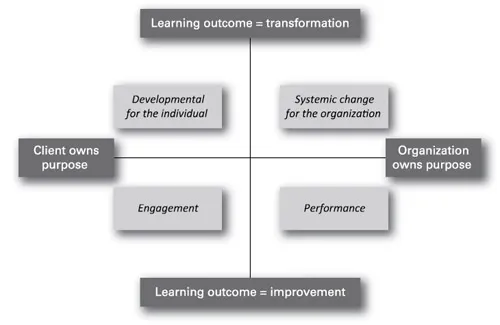
These situational factors, shown in Figure 1.1, will dictate the nature or type of activity on offer, regardless of whether it is called coaching or mentoring.
FIGURE 1.1 Situational coaching or mentoring
SOURCE: © 2010 Dr Anne Brockbank
The situational framework in Figure 1.1 shows two dimensions: ownership of purpose and learning outcome:
From left to right: This is the ownership of purpose dimension, from individual ownership on the left to organizational ownership on the right.
From bottom to top: Learning outcomes range from improvement with no radical change to complete transformation at the top.
Ownership (from right to left)
When the organization dictates the objectives of a coaching or mentoring programme, the employee is less likely to own objectives for themselves. Such a programme will emphasize imposed objectives with less consideration of the personal and social world of the learner.
Where employees resist meeting imposed objectives, a social control mechanism comes into play and this is described as engagement mentoring or coaching. Here employees receive coaching or mentoring which seeks to persuade them to align their own objectives with organizational aims.
These objectives, based on a perceived objective reality, may use personality profiles and learning styles inventories because they assume a set of fixed qualities. Typical inventories categorize individuals as ‘activist’, ‘reflector’, extrovert, introvert etc.
When the individual owns their purpose, the social and emotional world of a learner is acknowledged as part of the developmental process, as well as strategies for achieving that purpose. Such mentoring or coaching uses truly reflective dialogue to stimulate the desired transformation for the client and the process is developmental. Ownership of purpose implies with it the ability to take responsibility for progressing personal objectives, so is needed in flatter, more democratic organizations.
Learning outcome (from bottom to top)
Improvement as a learning outcome suggests that essential factors in the organization remain unchanged; indeed, for induction the process informs about ‘how things are done around here’. The power structure in the workplace remains unaltered by new ideas and the taken-for-granteds (tfgs) remain unchallenged behind what is described by Vivienne Burr as the prevailing discourse (Burr, 1995). Such mentoring or coaching has been described by Ann Darwin as the recycling of power (Darwin, 2000) because of its tendency to replicate existing power relations.
Transformation as a learning outcome suggests that either employee or organization (or both) is radically changed as a consequence of learning and development. To achieve transformation it is necessary to challenge the tfgs within a system or the working environment, and this is known as the prevailing discourse, explained on page 16. For individual transformation, mentoring or coaching invites learners to identify the prevailing discourse in which they work and consider its impact on them, as well as their contribution to it. This allows employees to look beyond their power horizon (Smail, 2001), their perceived limit of action, which is explained on page 18.
We look now at what happens in each quadrant.
The four quadrants
The quadrants are defined by ownership of purpose and learning outcome, as well as the process used in coaching or mentoring, ie the situation defines the coaching or mentoring type used.
The performance situation: The organization seeks improved performance from staff and may use directive coaching/mentoring programmes to achieve this. The purpose here is owned by the organization and the method may be ‘tell’, which is appropriate for an induction situation or apprenticeship programme. In addition, the organization needs to manage the performance of its employees through effective line management. Performance coaching seeks to align the activities and objectives of all employees to business objectives and goals. When resistance is likely, coaching or mentoring initiatives may be presented to staff with the performance intent masked. When Helen Colley researched mentoring programmes she named this kind of masking as engagement, so this is known as engagement mentoring or coaching (Colley, 2003).
The engagement situation: Engagement mentoring or coaching seeks to persuade the employee to adopt the objectives of the organization, or align their own objectives with the organization’s mission. The use of non-directive coaching techniques, such as active listening and empathy, to address resistance and ‘engage’ staff has been described, rather negatively, as ‘sugar-coating’ (Howe, 2008). Line managers are most likely to deliver engagement coaching, although increasingly external practitioners are involved in engagement work. Research shows that engaged employees are more productive and this affects organizational performance (Gallup, 2010).
The developmental situation: The individual seeks change or transformation for themselves through internal or external coaching or mentoring, and their purpose may or may not be aligned with the organization’s objectives. Developmental coaching or mentoring assumes that clients define their own goals, while offering the potential for challenge and transformation, through a dialogue in all three domains of learning, namely thinking, doing and feeling. Such a dialogue, known as reflective dialogue, which includes their emotions as well as the other two domains of learning – knowing and acting – has the potential to lead to transformational learning.
The systemic change situation: The organization seeks to transform itself as a system, through individual developmental coaching or mentoring by internal personnel or external practitioners. This may be supported by strategic mentoring where board members work with senior managers off-line, or team coaching. For the organization to transform itself systemically, the dimensions of individual ownership and organization ownership must move towards each other, and ideally converge. Attempts to transform an organization through performance coaching or mentoring are doomed to failure as the criteria for deep, significant transformative learning include access to the emotional domain, connectedness and agency. Connectedness refers to a relationship which supports learning, and agency means that individuals or teams take ownership of their goals.
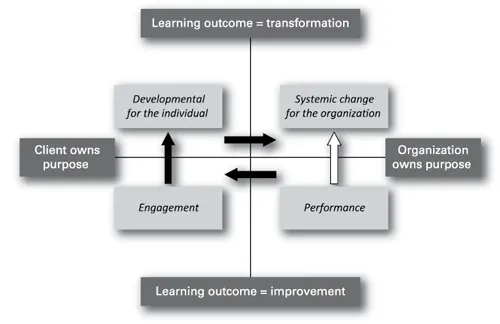
The situational framework for coaching and mentoring addresses some of the confusion about the terms and how they are used, by identifying what factors influence the learning outcomes of the activities. Ownership of purpose and the process used affect learning outcomes as well as the tfgs in the environment. Four types of coaching or mentoring are described: performance, engagement, developmental and systemic, the last referring to organizational transformation, which is likely through the engagement and developmental route and less likely through simple improvement by performance management, and this is shown in Figure 1.2.
How can an organization transform itself through coaching or mentoring?
FIGURE 1.2 Situational coaching or mentoring: the route to organizational transformation
SOURCE: © 2010 Dr Anne Brockbank
As Figure 1.2 shows, coaching and mentoring activity in the performance quadrant, within a performance management structure, while important for addressing corporate goals, is likely to lead to improvement, a laudable aim, but without changing the organiza...
Table of contents
- Cover
- Dedication
- Title Page
- Imprint
- Contents
- Acknowledgements
- How to use this book
- PART ONE How coaching and mentoring support reflective learning
- PART TWO What is the difference between coaching and mentoring?
- PART THREE Coaching or mentoring in each quadrant
- PART FOUR The reflective practitioner: accreditation, ethics, diversity and supervision
- Appendix 1 The coaching contract, records and review
- Appendix 2 Mentoring contract and review
- Appendix 3 Examples of ground rules
- Appendix 4 Company mentoring
- Appendix 5 Group dynamics for supervision and team coaching
- Appendix 6 Evaluation documents for coaches and mentors
- References
- Index
- Full imprint
Trusted by 375,005 students
Access to over 1.5 million titles for a fair monthly price.
Study more efficiently using our study tools.
Frequently asked questions
Yes, you can cancel anytime from the Subscription tab in your account settings on the Perlego website. Your subscription will stay active until the end of your current billing period. Learn how to cancel your subscription
No, books cannot be downloaded as external files, such as PDFs, for use outside of Perlego. However, you can download books within the Perlego app for offline reading on mobile or tablet. Learn how to download books offline
Perlego offers two plans: Essential and Complete
- Essential is ideal for learners and professionals who enjoy exploring a wide range of subjects. Access the Essential Library with 800,000+ trusted titles and best-sellers across business, personal growth, and the humanities. Includes unlimited reading time and Standard Read Aloud voice.
- Complete: Perfect for advanced learners and researchers needing full, unrestricted access. Unlock 1.5M+ books across hundreds of subjects, including academic and specialized titles. The Complete Plan also includes advanced features like Premium Read Aloud and Research Assistant.
We are an online textbook subscription service, where you can get access to an entire online library for less than the price of a single book per month. With over 1.5 million books across 990+ topics, we’ve got you covered! Learn about our mission
Look out for the read-aloud symbol on your next book to see if you can listen to it. The read-aloud tool reads text aloud for you, highlighting the text as it is being read. You can pause it, speed it up and slow it down. Learn more about Read Aloud
Yes! You can use the Perlego app on both iOS and Android devices to read anytime, anywhere — even offline. Perfect for commutes or when you’re on the go.
Please note we cannot support devices running on iOS 13 and Android 7 or earlier. Learn more about using the app
Please note we cannot support devices running on iOS 13 and Android 7 or earlier. Learn more about using the app
Yes, you can access Facilitating Reflective Learning by Anne Brockbank,Ian McGill in PDF and/or ePUB format, as well as other popular books in Business & Human Resource Management. We have over 1.5 million books available in our catalogue for you to explore.