Learning transfer is the missing link in training. Using conventional approaches to training, an average of just 10-20% of learning makes it back into the workplace and contributes to better business outcomes. With the current increased emphasis on efficiency and cost-effectiveness, such a dismal record is no longer acceptable. To improve these statistics and to make training truly valuable we must recognise that successful learning is not just about good content and well executed programmes but also about finding ways to facilitate genuine behavioural change and accountability back in the workplace.
Turning Learning into Action provides the necessary tools to enable trainers, buyers of training and L&D professionals to do just this. It presents the new, proven TLA methodology, which acknowledges the important role of ADDIE in the instructional design process but takes learning a step further. TLA focuses on the fact that to generate significant behavioural change, consistent, systematic follow-up after the training event is critical.
eBook - ePub
Turning Learning into Action
A Proven Methodology for Effective Transfer of Learning
- English
- ePUB (mobile friendly)
- Available on iOS & Android
eBook - ePub
About this book
Information
Part One
The learning transfer challenge
01
The evolution of training
Faced with a business need, problem or opportunity that can be solved by training most businesses go through a process described by the ADDIE model (Figure 1.1). The source of the ADDIE model is fairly obscure although it is thought that it was developed for the United States armed forces in the mid-1970s. Today there are an estimated 100 variations and it is referred to in a variety of different ways such as Instructional Systems Design (ISD), Instructional Systems Design & Development (ISDD), Systems Approach to Training (SAT) or Instructional Design (ID). But almost all the current instructional design models used in business today are variations of the original ADDIE model and I believe that this fact lies at the very heart of the learning transfer shortfall. Let me explain why…
Figure 1.1 The instructional design process as indicated by ADDIE
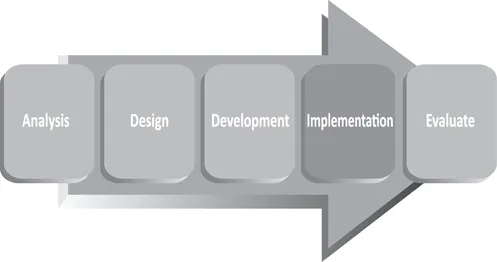
According to Wikipedia (2013) the definition of each element is as follows:
- Analysis – ‘The analysis phase clarifies the instructional problems and objectives, and identifies the learning environment and learner’s existing knowledge and skills.’
- Design – ‘The design phase deals with learning objectives, assessment instruments, exercises, content, subject matter analysis, lesson planning and media selection. The design phase should be systematic and specific. Systematic means a logical, orderly method of identifying, developing and evaluating a set of planned strategies targeted for attaining the project’s goals. Specific means each element of the instructional design plan needs to be executed with attention to details.’
- Development – ‘In the development phase, instructional designers and developers create and assemble content assets blueprinted in the design phase. In this phase, the designers create storyboards and graphics. If e-learning is involved, programmers develop or integrate technologies. Testers debug materials and procedures. The project is reviewed and revised according to feedback.’
- Implementation – ‘The implementation phase develops procedures for training facilitators and learners. Training facilitators cover the course curriculum, learning outcomes, method of delivery, and testing procedures. Preparation for learners includes training them on new tools (software or hardware) and student registration. Implementation includes evaluation of the design. ‘This is also the phase where the project manager ensures that books, hands-on equipment, tools, CD-ROMs, and software are in place, and that the learning application or website functions.’
- Evaluation – ‘The evaluation phase consists of two parts: formative and summative. Formative evaluation is present in each stage of the ADDIE process.’
On the face of it the ADDIE model is a logical, dynamic and flexible framework for instructional designers and training developers to build effective training and performance solutions. Whilst it is incredibly useful and has advanced training effectiveness considerably since its inception, I believe that the model has created an unintended consequence that has led to the inefficiencies in corporate training.
As it is traditionally presented there is rarely, if ever, any specific reference to behavioural change or the idea of transfer of learning. That’s the problem. Consider for a moment that ADDIE refers to a training timeline – before, during and after the training. We will now look at each of these processes in turn.
Before the training
If we look at the ADDIE model from the perspective of timing it is easy to appreciate that the first three stages – analysis, design and development – are all concerned with how that training is created. It is therefore focused on what happens before the training.
During the analysis phase the instructional problem is clarified to ensure that training is actually the best solution. If it is, then the training designer will establish the specific learning problem that needs to be resolved, and sets business goals and performance objectives for the learning solution. Analysis needs to take into account the audience’s need, existing knowledge, timelines and the learning environment. It must also address any learning constraints. Most companies and L&D professionals are already familiar with tools such as training needs analysis (TNA) and are therefore already proficient in training analysis and get it right 80 per cent of the time.
The design phase is focused on the learning objectives, lesson planning, delivery selection, exercises, subject matter, content and means of assessment. Design involves creating a clear vision for accomplishing the roles and objectives of the training.
The development phase is taking the agreed design elements and fleshing them out with the actual content and learning material. The programme is essentially put together and tested ready for implementation.
In our drive to improve and perfect design and development we have come a long way in our understanding of how people learn best. American educational theorist David A Kolb published his adult learning model in 1984 (Figure 1.2). Kolb’s learning theory sets out four distinct stages in the learning cycle and builds on the work of Kurt Lewin, Carl Jung, Carl Rogers, John Dewey and Jean Piaget.
Figure 1.2 Kolb adult learning principles
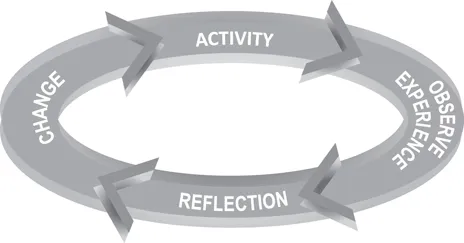
This model is universally acknowledged as one of the most important in explaining how adults learn effectively. It is therefore the blueprint for instructional design and has ensured that learning is designed with role play exercises and skills practice sessions to improve effectiveness.
As a result of Kolb’s influence training also began to incorporate adequate time for reflection so that participants had time to think about what they were learning and relate it back to their own experiences and into the workplace. Trainers have become very skilled at incorporating reflection into the learning process and are keen to help participants to apply the learning to their own working situation – at least theoretically.
Reflection is recognized as a vital component to adult learning as it encourages the learner to assimilate the information and make it personal and relevant to their own life and work situation. It is this reflection stage that helps to facilitate change. If an individual is taught leadership skills but the information remains abstract and one dimensional, and the individual doesn’t have an opportunity to practise those skills or role-play them so they can get an experience of the difference between the new approach and their old approach, then the information remains just that – information. If, on the other hand, they are encouraged to apply that information to a real situation in their working lives, or imagine how they would apply the information to a real situation, then they are better able to see how it can actually help them personally. And if they can do that then change is at least possible.
Before ADDIE, and the insights into adult learning provided by Kolb, corporate training used to be ‘chalk and talk’. A trainer or teacher would stand up at the front of the room with a blackboard, flip chart or whiteboard and talk at his or her students, who would scribble down the occasional note. Improved understanding into the way that adults learn together with a powerful instructional design framework took training from ‘chalk and talk’ to a whole new level of effectiveness. The industry pushed away from lecturing towards facilitation, it ensured that experiential learning and time for reflection was included so that the participants could gain more realistic understanding of the material and have time to consider how the information affected them personally. Today reflection is a recognized part of training design and development and this insight alone has massively improved training.
Generally speaking, instructional designers, companies and training organizations are already really good at design and development. They know how to effectively teach adults and how to incorporate the various elements to improve results. Consequently I’ve seen some outstanding training programmes with rich, original content, interesting and interactive exercises and innovative delivery – and it is clear that most organizations are already getting design and development right 85 per cent of the time.
During the training
Implementation is concerned with everything that happens during the training.
If we were to look at ADDIE in its purest form or best intention, implementation was probably intended to cover more than just the delivery of the material. Certainly I’ve read articles and books over the years that clearly articulate that the fourth stage of the ADDIE model is more than implementing a two-day training programme or other learning event – it is about implementing the whole learning experience. This would certainly imply a process to ensure that learning is transferred into the workplace. But the reality is that over the years implementation has come to focus largely on the delivery of the information in the training event.
The Wikipedia definition for implementation clearly shows that implementation is considered to be almost entirely about the delivery of the training material to participants, making sure that the person delivering the material is properly trained and making sure that the material that has been developed is distributed to the students. By this definition, which is the standard industry definition, most companies are also very good at implementation.
We’ve known for a long time that different people learn in different ways and that the development of technology now allows trainers the ability to combine a variety of learning media in any one programme so as to cater to each style. Traditional old school ‘chalk and talk’ training catered mainly to the audio and visual learner who would absorb information by hearing it and seeing a presentation. Both mediums have been improved by technology, which can bring the information to life through audio or video footage and graphics – all delivered in stunning high definition. For kinaesthetic learners who learn best by experiencing the information, training is now vastly improved by the incorporation of role play, practical experiences, video examples and interactive online quizzes.
In truth everyone learns using all three learning styles, and improved technology and the easy access to computers, smartphones and the internet has certainly revolutionized the delivery and implementation of training. Big bulky folders have been replaced by smaller workbooks; technological flexibility has allowed instructional designers unlimited opportunities to implement learning solutions that truly allow participants to plug into their preferred delivery channel to reinforce learning and get the most out of the learning event.
As a result we are already very proficient at implementation and have become very adept at honing the transfer of information from the trainer to the individual. I’ve seen some brilliant training programmes with superb content and a vibrant delivery style, and where the participants love the training. The vast majority of courses and learning solutions are more than adequate for delivering the results they were designed for. As a result we are already getting it right about 85 per cent of the time.
After the training
In the ADDIE model, evaluation deals with what happens after the training and certainly it is the hot topic in learning and development. HR and learning professionals are being increasingly challenged to demonstrate that the money invested in training is paying dividends. Again we are already very proficient at some evaluation and we’ll explore the various parts in the next chapter.
The challenge with evaluation as it is often described in the context of ADDIE is that it is retrospective – focusing on assessing how successful the knowledge transfer has been to the participant rather than how successful that participant has then transferred that knowledge to the workplace through behaviour change.
Clearly both are important as it is impossible for the learner to apply what he or she has learned unless that knowledge transfer process has been effective. Looking back at the training and evaluating how effectively the knowledge has been transferred to the participant is therefore an essential first step – and we are already very good at this type of evaluation. What we are not so good at is looking back several months after the training event in order to evaluate how effectively the participant is using that new knowledge in the workplace. It is this transfer of learning evaluation that is so often missing.
It is worth noting that there is a huge difference between compliance-based information training and soft-skills training before, during and after the training. Today businesses are required, often by law, to train employees in relation to health and safety issues. This type of training is often focused on compliance and protection – both for the employee and the employer. In this case there is no choice about change – people must comply. Evaluation in this context is therefore often straightforward.
This is not the case with soft-skills training. The term ‘soft skills’ refers to training such as leadership, sales, communication and negotiation skills. More often than not these programmes ar...
Table of contents
- Cover page
- Praise for Turning Learning into Action
- Title page
- Imprint
- Table of contents
- About the author
- Acknowledgements
- Introduction
- Part One: The learning transfer challenge
- Part Two: The learning transfer solution
- Part Three: Making learning transfer happen and the benefits by stakeholder
- Conclusion
- Appendix 1: Turning Learning into Action® learning agreement
- Appendix 2: Sample TLA plan
- Appendix 3: Sample conversation to illustrate the flexible TION part of the ACTION model
- References
- Index
- Full imprint
Trusted by 375,005 students
Access to over 1.5 million titles for a fair monthly price.
Study more efficiently using our study tools.
Frequently asked questions
Yes, you can cancel anytime from the Subscription tab in your account settings on the Perlego website. Your subscription will stay active until the end of your current billing period. Learn how to cancel your subscription
No, books cannot be downloaded as external files, such as PDFs, for use outside of Perlego. However, you can download books within the Perlego app for offline reading on mobile or tablet. Learn how to download books offline
Perlego offers two plans: Essential and Complete
- Essential is ideal for learners and professionals who enjoy exploring a wide range of subjects. Access the Essential Library with 800,000+ trusted titles and best-sellers across business, personal growth, and the humanities. Includes unlimited reading time and Standard Read Aloud voice.
- Complete: Perfect for advanced learners and researchers needing full, unrestricted access. Unlock 1.5M+ books across hundreds of subjects, including academic and specialized titles. The Complete Plan also includes advanced features like Premium Read Aloud and Research Assistant.
We are an online textbook subscription service, where you can get access to an entire online library for less than the price of a single book per month. With over 1.5 million books across 990+ topics, we’ve got you covered! Learn about our mission
Look out for the read-aloud symbol on your next book to see if you can listen to it. The read-aloud tool reads text aloud for you, highlighting the text as it is being read. You can pause it, speed it up and slow it down. Learn more about Read Aloud
Yes! You can use the Perlego app on both iOS and Android devices to read anytime, anywhere — even offline. Perfect for commutes or when you’re on the go.
Please note we cannot support devices running on iOS 13 and Android 7 or earlier. Learn more about using the app
Please note we cannot support devices running on iOS 13 and Android 7 or earlier. Learn more about using the app
Yes, you can access Turning Learning into Action by Emma Weber in PDF and/or ePUB format, as well as other popular books in Business & Human Resource Management. We have over 1.5 million books available in our catalogue for you to explore.