Engaged employees are more productive, motivated and resilient, yet gaining financial support to develop engagement is harder than ever as budgets are being squeezed and everyone is being asked to do more with less. 50 Top Tools for Employee Engagement shows that you don't need expensive interventions or additional resource to achieve employee engagement. It contains practical tools which can be used to make an immediate difference to engagement, whether you're working with individuals, teams or the organization as a whole.
Each tool in 50 Top Tools for Employee Engagement includes guidance on when to use it, how long it will take and useful hints and tips to help get the most out of it. Most importantly, this book will give guidance on how to measure the impact of each tool to show what's working and where efforts are best focused. Addressing all the key areas of engagement throughout the employee life cycle, from talent attraction and induction to career progression and development, this book is a complete resource to engaging your workforce.
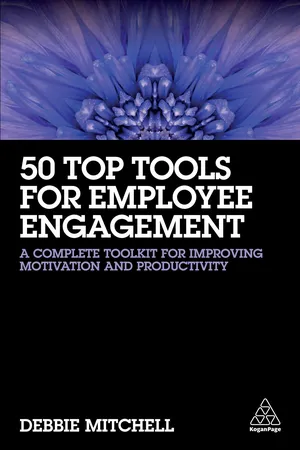
eBook - ePub
50 Top Tools for Employee Engagement
A Complete Toolkit for Improving Motivation and Productivity
- English
- ePUB (mobile friendly)
- Available on iOS & Android
eBook - ePub
50 Top Tools for Employee Engagement
A Complete Toolkit for Improving Motivation and Productivity
About this book
Information
02
Engaging teams
7 Dialogue sheets
The dialogue sheet, a concept that I understand to have first been introduced by Stockholm KTH University, and later developed by other advocates of the process, is an informal and often unfacilitated process that enables small teams to discuss topical issues, with a view to providing feedback, ideas, insights or opinion. They use a large sheet or ‘tablecloth’ to prompt and record their discussions.
The concept as introduced by Stockholm, and developed over time by other practitioners, is in essence a simple one. Small groups discuss a specified issue around a table with a tablecloth upon which they can actively note their comments and ideas. The more informal the better for the dialogue sheet, and often it works well with coffee, doughnuts and without an appointed facilitator or manager to guide the discussion. A self-managed group will take the conversation where they want to, prioritizing what they see as important and enabling a wide range of feedback to the originator of the exercise. Different groups are likely to see things differently, so running the session a few times with different sets of participants can provide diversity in feedback.
The ‘tablecloth’ is often the key for this tool. The tablecloth can be ‘populated’ or designed by the originator to steer the discussion. Whether creative and imaginative, or just posing key questions or words to evoke discussion, the dialogue will initially be driven by these prompts. This can come down to both your artistic/creative abilities and/or the budget you have to help with those things. However, this works as well with a large roll of paper and a marker pen as it would with graphic design and professional printing – so don’t be put off! The critical success factor is in posing the right questions or posting the right prompts, so you will need to think carefully about what you are asking and what you actually want from the exercise.
Best when
The dialogue sheet is a great concept to be used when you want people to engage in proposals, change, or to support implementation of initiatives (eg values, goals, etc). It is most effective in an informal environment, and when not being controlled or managed by someone who is not in the group.
It is possible to run multiple groups at one time, because there is no intervention, so this can be an effective way to manage breakout groups in a larger workshop. Alternatively you can run the dialogue-sheet exercise a number of times in succession, as the outcome is open (no fixed answer or format).
Best for
The dialogue sheet is best for small groups of six to eight people, as the principle requires that there is a lot of self-managed discussion in the process. Larger groups may need more facilitation and you may find that it is more difficult to involve everyone in the debate.
Depending on your subject matter, it works effectively for cross-functional groups, and it does not take account of seniority in the process. However, it is important to make sure that a mixed group is not dominated and/or led by an individual who is more senior.
Resources
You will need a very large sheet of paper – at least A0. If you cannot easily get a sheet that size then just put together four flipchart sheets. An alternative is to buy a paper tablecloth, although you may find the quality is not good for writing on so choose carefully. Ideally this will be printed with your discussion points (see later comments). Provide lots of coloured marker pens for participants to make notes, and some Post-it notes may be useful.
Outcomes
The dialogue sheet should encourage discussion, debate, feedback and commitment or buy-in. Its true output is entirely dependent on the objectives you set, and the questions or statements that you pose on the sheets. However, whatever the topic, in my experience, participants feel engaged by the process, and generally report that they feel they have had an opportunity to share their opinion or shape a debate.
Process
- Identify four to six statements about the issue/project/change, or select key words from a vision statement or mission that could prompt good discussion (controversial can be good!) and write them in the corners of a large sheet of paper.
- Invite small groups (around six people) to get coffee and biscuits (promote informality), put the sheet of paper on the table and invite them to discuss, write comments, questions, etc.
- Minimal intervention from a facilitator allows freedom of discussion and debate within the team.
- Allow around 30 minutes for discussion – and then give the group a chance to give feedback to a facilitator.
- Key points should be noted and fed back to key stakeholders.
Hints and tips
- Make this process have the feel of a social occasion. Encourage participants to bring coffee (or provide it in the room) and offer sweets, biscuits or donuts.
- Poster Pigeon offer extremely good value poster sized prints on their basic quality paper – which is perfect for a dialogue shee...
Table of contents
- Cover
- Title Page
- Copyright
- Contents
- About the author
- Preface
- Acknowledgements
- About this book
- Introduction
- 01 Engaging one on one
- 02 Engaging teams
- 03 Engaging the organization
- 04 In talent attraction
- 05 In induction
- 06 In training
- 07 When life changes happen
- 08 When career changes happen
- 09 On retirement
- 10 On leaving
- 11 For business improvement
- 12 In change
- 13 For customer focus
- 14 In delivering results
- 15 Evaluating your engagement initiatives
- 16 Quick view of tools and templates
- References
- Index
- Backcover
Trusted by 375,005 students
Access to over 1.5 million titles for a fair monthly price.
Study more efficiently using our study tools.
Frequently asked questions
Yes, you can cancel anytime from the Subscription tab in your account settings on the Perlego website. Your subscription will stay active until the end of your current billing period. Learn how to cancel your subscription
No, books cannot be downloaded as external files, such as PDFs, for use outside of Perlego. However, you can download books within the Perlego app for offline reading on mobile or tablet. Learn how to download books offline
Perlego offers two plans: Essential and Complete
- Essential is ideal for learners and professionals who enjoy exploring a wide range of subjects. Access the Essential Library with 800,000+ trusted titles and best-sellers across business, personal growth, and the humanities. Includes unlimited reading time and Standard Read Aloud voice.
- Complete: Perfect for advanced learners and researchers needing full, unrestricted access. Unlock 1.5M+ books across hundreds of subjects, including academic and specialized titles. The Complete Plan also includes advanced features like Premium Read Aloud and Research Assistant.
We are an online textbook subscription service, where you can get access to an entire online library for less than the price of a single book per month. With over 1.5 million books across 990+ topics, we’ve got you covered! Learn about our mission
Look out for the read-aloud symbol on your next book to see if you can listen to it. The read-aloud tool reads text aloud for you, highlighting the text as it is being read. You can pause it, speed it up and slow it down. Learn more about Read Aloud
Yes! You can use the Perlego app on both iOS and Android devices to read anytime, anywhere — even offline. Perfect for commutes or when you’re on the go.
Please note we cannot support devices running on iOS 13 and Android 7 or earlier. Learn more about using the app
Please note we cannot support devices running on iOS 13 and Android 7 or earlier. Learn more about using the app
Yes, you can access 50 Top Tools for Employee Engagement by Debbie Mitchell in PDF and/or ePUB format, as well as other popular books in Business & Human Resource Management. We have over 1.5 million books available in our catalogue for you to explore.