eBook - ePub
The Complete Guide to Recruitment
A Step-by-step Approach to Selecting, Assessing and Hiring the Right People
- 256 pages
- English
- ePUB (mobile friendly)
- Available on iOS & Android
eBook - ePub
The Complete Guide to Recruitment
A Step-by-step Approach to Selecting, Assessing and Hiring the Right People
About this book
Recruiting the right people is one of the most important activities organisations can undertake. Getting it right can mean fast, healthy growth and the fulfilment of business goals; getting it wrong can mean heavy costs, sinking morale and stunted growth. The Complete Guide to Recruitment is a practical self-help guide to best practice in recruitment. With international case studies demonstrating how recruitment contributes to business success, it covers every aspect of the recruitment process including: developing an effective recruitment strategy; relationship building for long-term hiring; assessing and selecting candidates; designing the contract of employment; and creating a great place to work. Also incorporating a broad range of sample adverts, contracts and assessment tests which are available to download and edit, The Complete Guide to Recruitment is ideal for companies of all types and sizes who want to attract and retain top talent.
Information
 | Part One The recruitment environment |
| ‘Joined-up’ recruitment |  |
This chapter is the start of the first section. This section discusses all of the elements that need to be there for great recruitment to take place. It starts with exploring how recruitment relates to other aspects of an organization, goes on to look at the costs of recruiting badly and then gives pointers on retention and engagement to ensure that all your hard recruitment work doesn’t just fly right out of the door.
Recruitment is often seen in organizations as a ‘stand-alone’ activity, handled either by a line manager, HR partners or an internal recruitment team. This means that the opportunity to grow and develop a business through the use of recruitment can often be missed. A ‘joined-up’ approach to recruitment, encompassing the retention, assessment and engagement of an organization’s people as well as one that places recruitment at the heart of a business, will offer significantly increased returns on investment. And in fact, paying significant attention to assessment, retention and engagement will actually reduce the amount of time you need to spend on recruitment.
In this chapter the core activities to create a successful joined-up recruitment environment are explored so you can see how to make recruitment work successfully for your business.
Placing recruitment at the heart of a business
The need for recruitment is driven by the success or failure of other parts of the organization. If your business is highly successful and needs to grow, recruitment will be a prime driver of growth; the capacity to get the right skills in the right place at the right time at the right salaries will determine the capacity to keep up with, or drive, the growth curve. If your business hires the wrong people, loses more people than it hires and is unable to get them to deliver what’s needed, then high volumes of recruitment can be a symptom of a wider problem. Either way, recruitment needs to be both a strong influencer in the business and to have regular board attention. The best recruitment, whether delivered by a busy line manager, a business owner or a recruitment specialist, has influence and is far-sighted. The ability to see how the skills of someone recently sourced or interviewed can impact the business positively is an essential skill for any business.
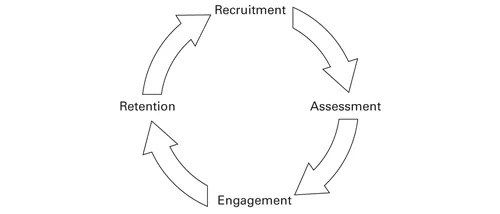
If your business is lucky enough to have a great specialist recruitment team, they can only be as successful as the rest of the business. They can hire great people but if these people are not on-boarded and inducted well, engaged with, developed and retained, then the investment in the great recruitment team will have been a waste of resources. If you have an HR team, you are dependent upon this team being able to hold in mind all aspects of the people process yet focus on each to create the greatest chance of success. If you don’t have an HR or recruitment team, then you’ll need to find a way of creating investment in your people from recruitment through to retention for yourself. But this is not a dark art. Often this means simply paying really good attention to all of the aspects mentioned above and joining them up so they become part of the whole rather than stand-alone elements. Practising joined-up recruitment means taking an interdependent approach as shown in Figure 1.1.
As you can see in Figure 1.1, good recruitment is dependent upon good assessment. Choosing the right people is likely to lead to strong engagement, in turn leading to retention, following back through to recruitment. It is a challenging balancing act to create focus on each area and yet to hold the whole in mind at all times.
For greatest ownership and success, the people responsible for recruitment need to be equally involved in the other areas. Recruitment consultants, whether internal or external, are judged upon whether they provide great people who stay with the business. In reality they rarely have any control over this. Their main focus is getting people hired rather than focusing on making good hiring decisions. Holding recruiters more to account for the quality of their hires can be a good way of changing their focus from getting people into jobs towards a more holistic approach of making the whole employment cycle work better.
Figure 1.1 The employment cycle
The employment cycle explained
Recruitment itself starts when a need for a task or series of tasks is recognized. Whether this is after someone leaving an existing job or identifying a new position, it will include one or both of the following activities:
- conducting a work analysis and defining the tasks to be done;
- determining the best way to get the tasks done.
Once it is identified that a job needs doing, the following activities need to happen:
- agreeing a budget and getting it signed off;
- drawing up a role and person specification along with salary and benefits;
- designing and implementing an internal and external attraction strategy;
- managing and running the assessment process;
- deciding which candidate(s) to offer;
- managing and running the offer process;
- managing and running the on-boarding process.
Assessment
Assessment can shift the chances of appointing someone who will perform in the role from a 30 per cent chance to a 60 per cent chance. Your assessment process will have a major impact on costs and team effectiveness; it must be valid, not open to discrimination claims and designed to assess the competences and behaviours needed in the role.
The candidate experience is also a crucial part of the assessment process. If they have a bad experience, they are likely to tell their friends, so there are two sides to assessment: the overall need to assess the candidate’s capability to do the job and their experience of you as an employer and what that can do for your brand.
In designing your assessment process, you will consider what it takes to be successful in the role you want to hire and then identify how to assess that.
You will design a process either by yourself or with expert help, which will include one or more of the following assessment types:
- CV/application forms;
- psychometric/aptitude testing;
- verbal and numerical reasoning tests;
- business simulations/assessment centres;
- interviews.
Finally, you will need to choose your candidate and appoint them. Appointing may sound like a simple part of the recruitment process but in a candidate-short market (where applicants are in demand elsewhere) it can be a crucial part of the overall strategy.
Engagement
Although the phrase ‘employee engagement’ has a wider context, I am using it here in recruitment terms. So engagement means ensuring that you are able to hire the candidates you want to, they are sufficiently engaged with the process and your business, they accept your offers and that they join feeling really excited about the opportunity. Engagement is the capacity of the business to demonstrate that the organization can meet their objectives, whether these be as simple as providing for their family or furthering their knowledge in astrophysics.
To do this, it’s important to understand the needs, drivers and motivations of your candidates. Turning your unsuccessful candidates down is as much part of the engagement process as offering them a role. Equally important are:
- negotiating the offer;
- writing the offer letter;
- designing the...
Table of contents
- Cover page
- Title page
- Imprint
- Table of contents
- List of figures
- List of tables
- Acknowledgements
- Introduction
- PART ONE: The recruitment environment
- PART TWO: Making great recruitment happen
- Copyright
Trusted by 375,005 students
Access to over 1.5 million titles for a fair monthly price.
Study more efficiently using our study tools.
Frequently asked questions
Yes, you can cancel anytime from the Subscription tab in your account settings on the Perlego website. Your subscription will stay active until the end of your current billing period. Learn how to cancel your subscription
No, books cannot be downloaded as external files, such as PDFs, for use outside of Perlego. However, you can download books within the Perlego app for offline reading on mobile or tablet. Learn how to download books offline
We are an online textbook subscription service, where you can get access to an entire online library for less than the price of a single book per month. With over 1.5 million books across 990+ topics, we’ve got you covered! Learn about our mission
Look out for the read-aloud symbol on your next book to see if you can listen to it. The read-aloud tool reads text aloud for you, highlighting the text as it is being read. You can pause it, speed it up and slow it down. Learn more about Read Aloud
Yes! You can use the Perlego app on both iOS and Android devices to read anytime, anywhere — even offline. Perfect for commutes or when you’re on the go.
Please note we cannot support devices running on iOS 13 and Android 7 or earlier. Learn more about using the app
Please note we cannot support devices running on iOS 13 and Android 7 or earlier. Learn more about using the app
Yes, you can access The Complete Guide to Recruitment by Jane Newell Brown in PDF and/or ePUB format, as well as other popular books in Business & Human Resource Management. We have over 1.5 million books available in our catalogue for you to explore.