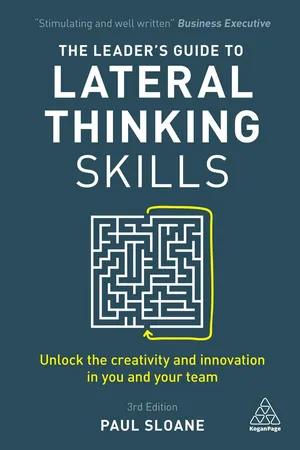
Lateral thinking can help you transform your ability to generate ideas, unlock the creative potential of your team and make your organization more innovative. With a lively, energetic and practical approach, The Leader's Guide to Lateral Thinking Skills will teach you dynamic, up-to-date techniques to unleash the creative energies of your people and show you how to put the techniques to work immediately. Lateral thinking can turn your organization around and make you a better leader.
In The Leader's Guide to Lateral Thinking Skills, highly acclaimed author, trainer and presenter Paul Sloane demonstrates how the lateral leader develops the vision, culture and processes that transform a regular business into an innovation hothouse. This book is packed with real-life examples, practical methods and lateral thinking exercises that you can use today.
eBook - ePub
The Leader's Guide to Lateral Thinking Skills
Unlock the Creativity and Innovation in You and Your Team
- English
- ePUB (mobile friendly)
- Available on iOS & Android
eBook - ePub
The Leader's Guide to Lateral Thinking Skills
Unlock the Creativity and Innovation in You and Your Team
About this book
Information
APPENDIX 1
Tools and techniques
A Brainstorming
The most popular group creativity exercise in business is the brainstorm. It is quick, easy and it works. There are variations and enhancements to make it more powerful. But many organizations become frustrated with brainstorms and have stopped using them. They say they are old-fashioned and not so effective. The real reason for the frustrations is that the brainstorms are not run properly. Here are some simple rules to make sure that your brainstorm works well.
Set clear objectives
The purpose of the brainstorm is to generate many creative ideas to answer a specific goal. It is best to express the goal as a question. A vague or woolly question is not helpful. ‘How can we increase sales?’ is not as good as ‘How can we double sales in the next 12 months?’ However, the parameters of the questions should not be too detailed or it can close out lateral possibilities. ‘How can we double sales, through existing channels and with the current product set?’ is probably too constrained. Once the question has been agreed, it is written clearly for all to see.
It is worth setting objectives for the number of ideas to be generated and the time to be spent. ‘We are looking to generate 60 ideas in the next 20 minutes. Then we will whittle them down to four or five really good ones.’ The brainstorm should not be too long – between 30 and 45 minutes is generally best. The best size of group is somewhere between 6 and 12. Too few people and there are not enough diverse inputs. Too many people and it is hard to control the meeting and to retain everyone’s commitment.
Suspend judgement
In order to encourage a wealth of wacky ideas it is essential that no one is critical, negative or judgemental about an idea. Any idea that is uttered – no matter how stupid – must be written down. The rule about suspending judgement during the idea generation phase is so important that it is worth enforcing rigorously. A good technique is to issue water pistols; anyone who is critical gets squirted.
Quantity is good
The more ideas the better. Brainstorming is one the few activities in life where quantity improves quality. Think of it as a Darwinian process. The more separate ideas that are generated, the greater the chance that some will be fit enough to survive. You need stacks of energy and buzz driving lots of wacky ideas. Crazy thoughts that are completely unworkable are often the springboards for other ideas that can be adapted into great new solutions. So keep the crazy ideas coming – you have to kiss a lot of frogs to find one prince!
Number and display
Number each idea. This makes it easier to cross-reference the ideas and to set goals. ‘We’ve come up with 65 ideas – let’s see if we can get to 80.’ Each idea should be written down as a short action statement in just a few words. The ideas must be clearly visible to all participants. Flip charts work well for this purpose. As each page is filled it is posted on the wall of the room so that the whole catalogue of ideas can be seen. When it comes time to analyse the ideas, all those that are linked can be circled in the same colour.
Analyse and select
The final step in the brainstorm session is to analyse the ideas. One of the best ways is to quickly go through them and perform a triage. Divide the proposals into a) promising, b) interesting possibility and c) reject. For example, you can quickly mark each a) with two ticks, each b) with one tick, and cross through the rejects. This is a group activity led by the moderator, and there is usually good consensus on what to do with most of the ideas. Any that are disputed can be put into category b). If time permits it is a good idea to then categorize and collect the ideas. If time is short do not worry; some people find that it is best to let the ideas stew for a while before returning to them at a later time when the subconscious has had the opportunity to turn them over. Either way, write on a separate flipchart all the ideas in categories a) and b) that are marketing ideas, say, and on another chart all the sales ideas, and so on. This process of rearranging the ideas can help you see new combinations and possibilities. You may well then find that you can synthesize ideas by putting together an a) with a b) to come up with a real winner. For further detailed analysis, a technique like six thinking hats (see S below) can be used.
An alternative method of selecting the best ideas is to give everyone 10 points that they can allocate to their favourite ideas in any way that they want. They can give one point to 10 separate ideas or all 10 to one idea. Then you total the points.
B Random word
As a stimulus to a brainstorm a random word, image or object can work wonders. Just pick up a dictionary and choose a noun at random. Then force connections between that word and the problem to be solved. You will find that all sorts of new associations spring to mind. Say the problem is how to get more people to use buses. The random word from the dictionary is – shark. Some of the ideas it triggers are:
- Free trips to the aquarium as lottery prizes using bus tickets as entries.
- Preferential loans for bus passengers (not at loan shark rates).
- Hot soup on buses in winter (shark’s fin could be one variety).
- Music on buses to make the trip more pleasant (triggered by the Sharks and Jets in West Side Story).
Why does the random word work? I...
Table of contents
- Cover
- Title Page
- Copyright
- Contents
- Acknowledgements
- Introduction
- 01 The need for innovation
- 02 Characteristics of the lateral leader
- 03 The innovation test
- 04 Laying the foundations for change
- 05 Making the vision real
- 06 Challenge your assumptions
- 07 Ask searching questions
- 08 Take a different view
- 09 Combine the unusual
- 10 Adopt, adapt, improve
- 11 Break the rules
- 12 Analyse first
- 13 Increase the yield
- 14 Introduce the random
- 15 Evaluate
- 16 Implement
- 17 Welcome failure
- 18 Use the team
- 19 Organizing for innovation
- 20 Common mistakes: 12 great ways to creativity
- 21 21 Great ways to innovate
- 22 Summary
- 23 The lateral leadership course
- Appendix 1: Tools and techniques
- Appendix 2: Answers to lateral thinking puzzles
- References and recommended reading
- Index
- Backcover
Trusted by 375,005 students
Access to over 1.5 million titles for a fair monthly price.
Study more efficiently using our study tools.
Frequently asked questions
Yes, you can cancel anytime from the Subscription tab in your account settings on the Perlego website. Your subscription will stay active until the end of your current billing period. Learn how to cancel your subscription
No, books cannot be downloaded as external files, such as PDFs, for use outside of Perlego. However, you can download books within the Perlego app for offline reading on mobile or tablet. Learn how to download books offline
Perlego offers two plans: Essential and Complete
- Essential is ideal for learners and professionals who enjoy exploring a wide range of subjects. Access the Essential Library with 800,000+ trusted titles and best-sellers across business, personal growth, and the humanities. Includes unlimited reading time and Standard Read Aloud voice.
- Complete: Perfect for advanced learners and researchers needing full, unrestricted access. Unlock 1.5M+ books across hundreds of subjects, including academic and specialized titles. The Complete Plan also includes advanced features like Premium Read Aloud and Research Assistant.
We are an online textbook subscription service, where you can get access to an entire online library for less than the price of a single book per month. With over 1.5 million books across 990+ topics, we’ve got you covered! Learn about our mission
Look out for the read-aloud symbol on your next book to see if you can listen to it. The read-aloud tool reads text aloud for you, highlighting the text as it is being read. You can pause it, speed it up and slow it down. Learn more about Read Aloud
Yes! You can use the Perlego app on both iOS and Android devices to read anytime, anywhere — even offline. Perfect for commutes or when you’re on the go.
Please note we cannot support devices running on iOS 13 and Android 7 or earlier. Learn more about using the app
Please note we cannot support devices running on iOS 13 and Android 7 or earlier. Learn more about using the app
Yes, you can access The Leader's Guide to Lateral Thinking Skills by Paul Sloane in PDF and/or ePUB format, as well as other popular books in Personal Development & Management. We have over 1.5 million books available in our catalogue for you to explore.